20.1, 20.4 - Magnetic field patterns and currents
Map magnetic fields around magnets and currents, and connect a solenoid's field to its winding direction. Use these patterns to explain why parallel current-carrying wires attract or repel, preparing for quantitative magnetic forces.
Mapping a magnetic field
Can two wires attract even though neither wire is a permanent magnet? Yes: moving charges are another source of a magnetic field. Before explaining the attraction, we need a map that tells us what the field is doing around each wire.
A magnetic field is a field of force associated with moving charges or permanent magnets. It describes magnetic interactions at positions around the source. A moving charge can experience a magnetic force; a current is the organised motion of charge, so a current-carrying wire can also experience a force. A stationary electric charge does not experience a magnetic force merely because it is charged.
The syllabus sometimes describes a magnet or current as “producing” a field. This is shorthand for identifying the source of a force-field model, rather than a statement that it emits some magnetic material. The field is not a stream of particles leaving a north pole.
A small plotting compass provides a useful directional test. Its north-seeking end points along the local magnetic field. Mark that direction at several positions and join the directions smoothly to obtain magnetic field lines. An arrow gives the direction; the tangent to a curved line gives the field direction at any point on it.
[DIAGRAM: asset_name: Magnetic field maps; asset_slug: magnetic-field-maps; caption: Field lines map a bar magnet and a uniform field; description: A horizontal bar magnet has its north pole at the right and south pole at the left. Smooth non-crossing field lines form closed loops, running from north to south outside and south to north inside. A second panel shows straight equally spaced parallel field arrows pointing right and a compass aligned with them.]
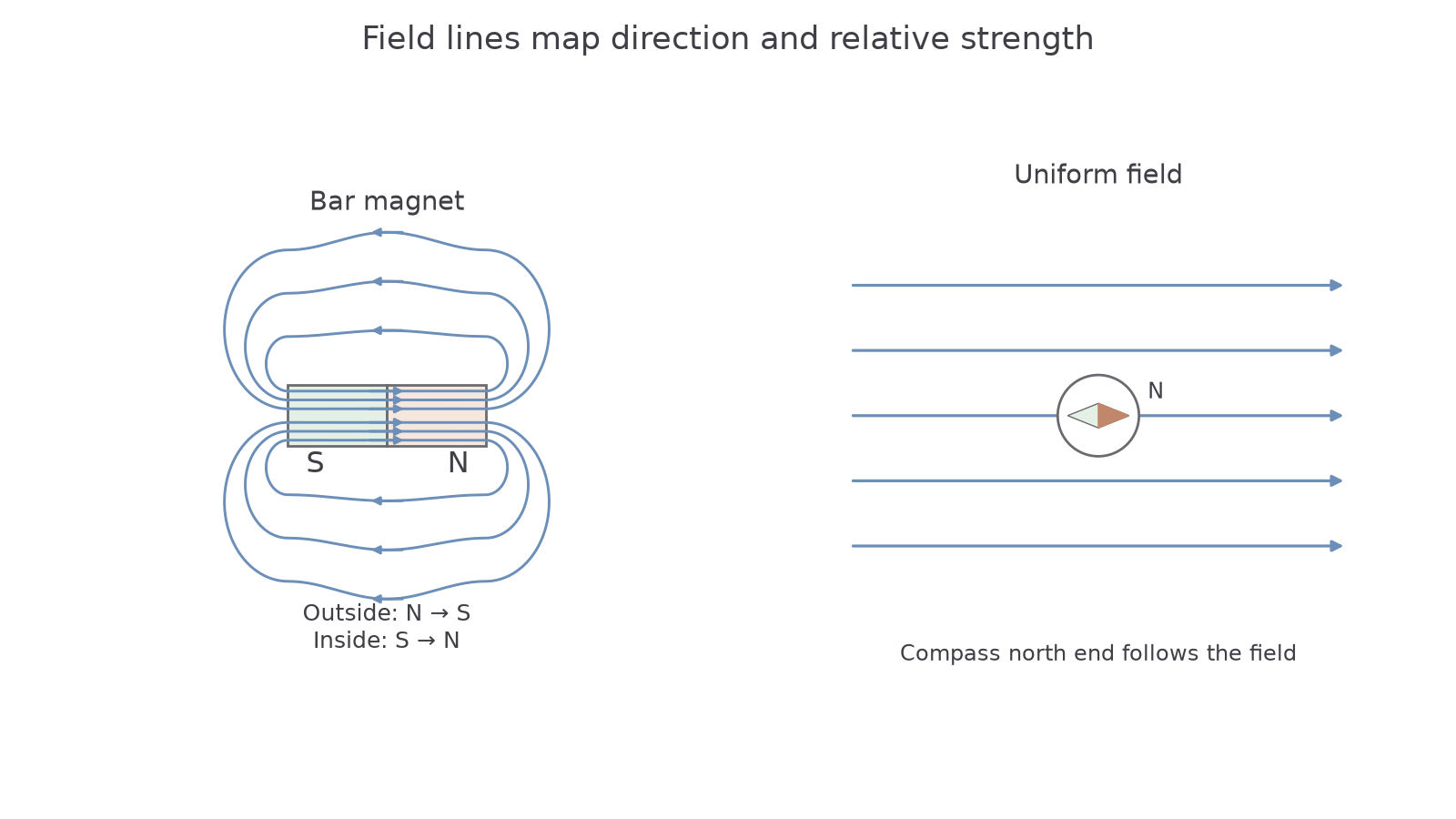
Outside a bar magnet, lines run from north to south; inside the magnet they return from south to north. The complete lines form closed loops. Do not stop them arbitrarily in empty space or draw them crossing. Crossing lines would assign two field directions to one point.
Closer line spacing represents greater field strength. A uniform magnetic field has the same strength and direction throughout a region: represent it by straight, parallel, equally spaced arrows. The number of lines you choose is a drawing convention, not a count of physical threads. Iron filings can help reveal a pattern, but they do not supply its arrows; use a compass or a known source direction for those.
Watch out
A magnetic field arrow does not give the force direction on any moving positive charge. That force also depends on the charge's velocity and is perpendicular to the field. The compass convention maps the field itself.
When a diagram looks out of the page, a dot represents an arrow tip coming towards you. A cross represents the tail feathers of an arrow going away from you, into the page. Keep this convention separate from a positive or negative electric charge.
Fields around wires, coils and solenoids
Changing the shape of a current path changes the magnetic-field pattern. The field at a point is the combined effect of the moving charges along the whole conductor; it is not confined to the conductor's interior.
For a long straight wire, field lines are concentric circles centred on the wire, in planes perpendicular to it. Grip the wire with your right hand: point the thumb along conventional current, and curled fingers give the field direction. A current out of the page therefore has anticlockwise field arrows when viewed on the page. Reversing the current reverses every arrow.
The field becomes weaker farther from the straight wire, so the representative circles should be more widely spaced farther out. You do not need a formula for this field's magnitude in this syllabus. Do not confuse its circular shape with charges circulating around the wire: the charge flow is along the wire.
[DIAGRAM: asset_name: Fields of three current shapes; asset_slug: current-field-patterns; caption: A straight wire, a circular coil and a solenoid have distinct field patterns; description: Three labelled panels show concentric anticlockwise circles around a current dot, a side section through a flat circular coil with top current out of the page and bottom current into the page giving field rightwards through its centre, and a long solenoid with top currents out of the page and bottom currents into the page. The solenoid has continuous nearly parallel interior lines towards its right north end and curved return paths outside.]
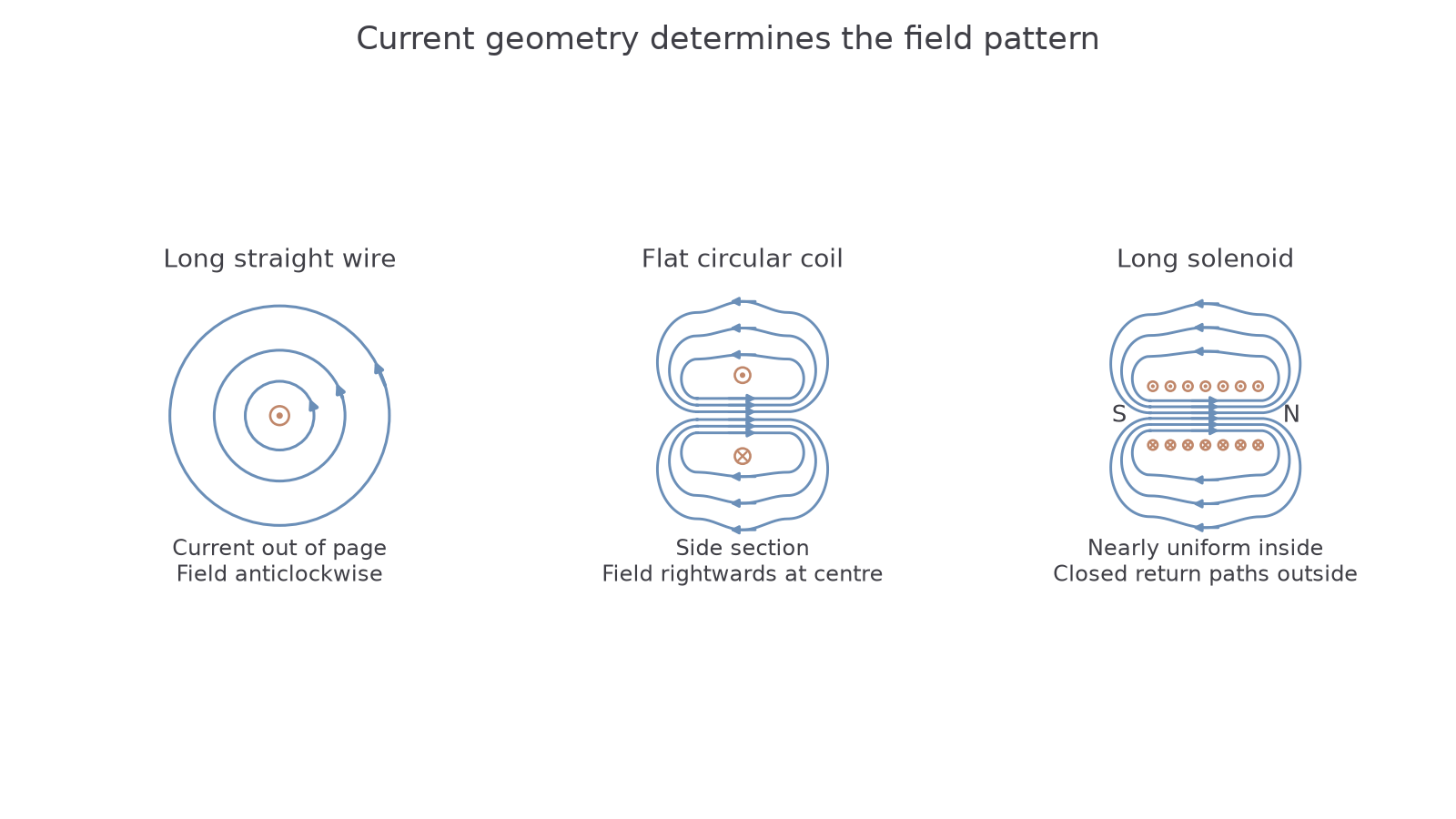
For a flat circular coil, the fields of its different sections reinforce through the centre. Near the centre the lines are approximately straight, parallel and perpendicular to the plane of the coil; farther away they curve around to return through the other face. Viewed from one face, an anticlockwise conventional current makes that face a north pole: field points towards the viewer through that face. A clockwise current makes the viewed face south.
Continue this lesson.
You’re previewing NovaLearn without an account. Create a free account to read the rest.
Create free account