15.3 - Molecular speeds and kinetic energy
Distinguish mean speed, mean-square speed and root-mean-square speed, derive the link between temperature and average translational kinetic energy, and compare molecular speeds without mixing up particle mass and molar mass.
Root-mean-square molecular speed
A gas has no bulk motion and its average molecular velocity is zero: must its molecules have zero kinetic energy? No. Opposite velocity components can cancel in an average, while their squares are positive. The pressure equation depends on that mean of squares.
There are three different averages to keep apart. Mean speed averages the positive speed values. Mean-square speed averages their squares. Root-mean-square speed takes the square root of the mean-square speed, returning a quantity with the unit of speed.
Root-mean-square speed
is root-mean-square speed in , is mean-square speed in , and is the number of sampled molecules. Square first, find the mean, then take the square root. This is not the square root of mean speed.
Not on the data sheet: learn it.
Worked example 1: three sample speeds
Question. Three sample molecular speeds are , and . Find their mean speed, mean-square speed and r.m.s. speed.
Plan. Perform each averaging operation in its stated order.
Check. Squaring the mean speed gives , a different value from the mean of the squares. A real gas has vastly more particles; the three values simply make the averaging operation visible.
[DIAGRAM: asset_name: Average speeds only after choosing the operation; asset_slug: thermal-rms-averaging; caption: Mean-square speed averages squared speeds before the final square root; description: Two bar charts show the three sample speeds 200, 400 and 600 metres per second and their squares 40000, 160000 and 360000 square metres per square second. Separate labels state mean speed 400 metres per second, mean-square speed 186667 square metres per square second, and r.m.s. speed about 432 metres per second.]
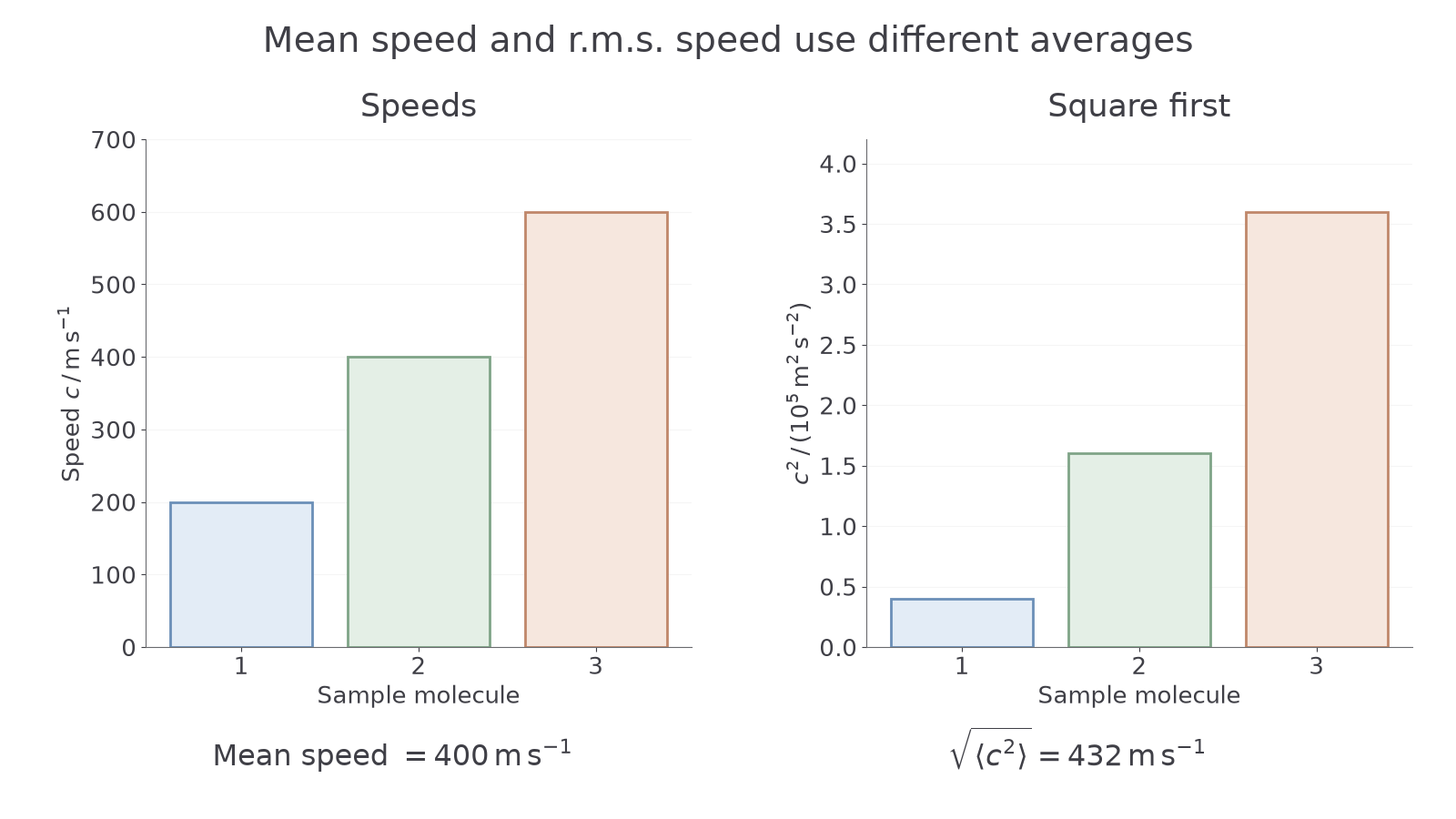
If molecules all had equal speed, mean speed and r.m.s. speed would agree. With a spread of speeds, the faster molecules receive more weight in the squared average, so the r.m.s. speed is larger. Neither is generally equal to the magnitude of the average velocity, which can be zero in a stationary gas.
Watch out
Keep the units with the quantity: a mean-square speed has unit , while its square root has unit . A numerical answer without that distinction can conceal a missing square root.
Try the operation starting from a measured pressure-model quantity.
Temperature and mean translational energy
Pressure provides the bridge from molecular motion to temperature. The kinetic pressure equation and the ideal-gas equation describe the same equilibrium gas, so their right-hand sides must be equal:
The kinetic pressure equation is supplied for Paper 4. The ideal-gas relation is not on the general data sheet; recall it from the ideal-gas lesson.
Equate them and cancel the number of molecules:
The left side is the mean translational kinetic energy of one molecule: kinetic energy associated with the motion of its centre of mass. Molecules do not all have that energy; it is an average over their distribution.
Mean translational kinetic energy
is average translational kinetic energy per molecule in J, is molecular mass in kg, is Boltzmann constant in , and is thermodynamic temperature in K. This is the ideal-gas kinetic model at equilibrium. For polyatomic molecules it is not a formula for all rotational, vibrational or potential-energy contributions.
Not on the data sheet: learn it.
Worked example 2: energy per molecule
Question. Determine the average translational kinetic energy of a molecule in an ideal gas at . Use .
Plan. Use temperature in kelvin and calculate energy for one molecule.
Answer. (3 s.f.).
Check. The kelvin units cancel. Multiplying by the number of molecules would give the gas's total translational kinetic energy; it would not still be energy per molecule.
Continue this lesson.
You’re previewing NovaLearn without an account. Create a free account to read the rest.
Create free account