21.1 - Alternating current and root-mean-square values
Learn to read a sinusoidal alternating current or voltage, calculate its heating effect in a resistor and connect its peak value to an equivalent steady value. You will distinguish an average current of zero from a non-zero mean transfer of energy.
A current that changes direction
A sinusoidal alternating current has zero signed mean over a complete cycle, so how can it keep a heater warm? The sign tells you the current's direction, not whether energy is being transferred. First we need to describe how the current changes with time.
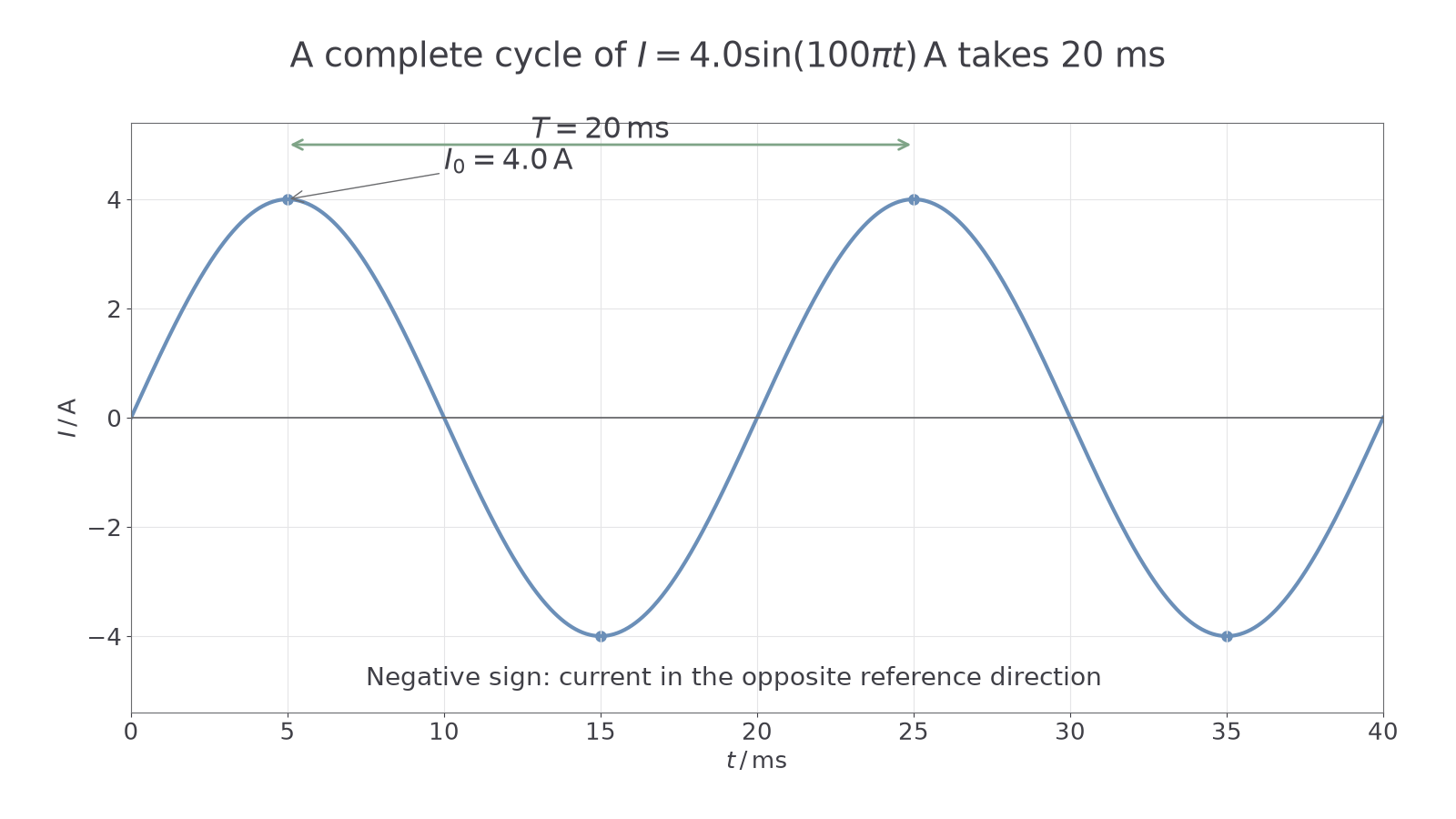
An alternating current reverses direction repeatedly. An alternating voltage reverses polarity. For a sinusoidal variation, the positive and negative halves have the same shape and magnitude but opposite signs. Choose a reference direction for current: negative current means flow opposite to that reference, rather than a negative amount of charge.
The peak value is the largest magnitude reached. The period, , is the time for one complete repeating cycle; frequency is the number of complete cycles per second, in hertz. The peak-to-peak excursion is twice the peak magnitude for a symmetric sine wave. It is not the peak value itself.
Sinusoidally alternating current or voltage
Here and are instantaneous current in amperes and voltage in volts, and their peak magnitudes, time in seconds and angular frequency in . The time origin is chosen at a zero crossing with a positive initial rise. A different phase requires a corresponding shift of the origin or phase.
The data sheet gives the general form . On the data sheet for Paper 4.
The angular-frequency relations and must be recalled; they are not given by the general a.c. formula alone. Use radians for the sine argument. On a time trace, find a complete repeat, such as one positive peak to the next positive peak. A positive peak to the next negative peak spans only half a period.
[DIAGRAM: asset_name: Peak, period and sign of an alternating current; asset_slug: ac-sinusoidal-current; caption: The current reverses sign each half-cycle, but a complete cycle takes 20 milliseconds; description: A current-time graph plots I equals 4.0 sin 100 pi t amperes from zero to 40 milliseconds. It labels positive and negative peaks at plus and minus 4.0 amperes, a 20 millisecond interval between corresponding peaks and the zero-current reference.]
Worked example 1: reading an a.c. equation
Question. A current is , with in seconds. Determine its peak value, period and current at .
Plan. Compare the equation with the sinusoidal form, then evaluate the phase using seconds.
Check. The time is one eighth of a cycle, so the current is positive and below its positive peak. At , three quarters of a cycle, it is .
A symmetrical sine wave's signed mean is zero because equal positive and negative areas cancel over a cycle. That does not cancel the motion's effect in a resistor; the energy calculation comes next.
Heating during both half-cycles
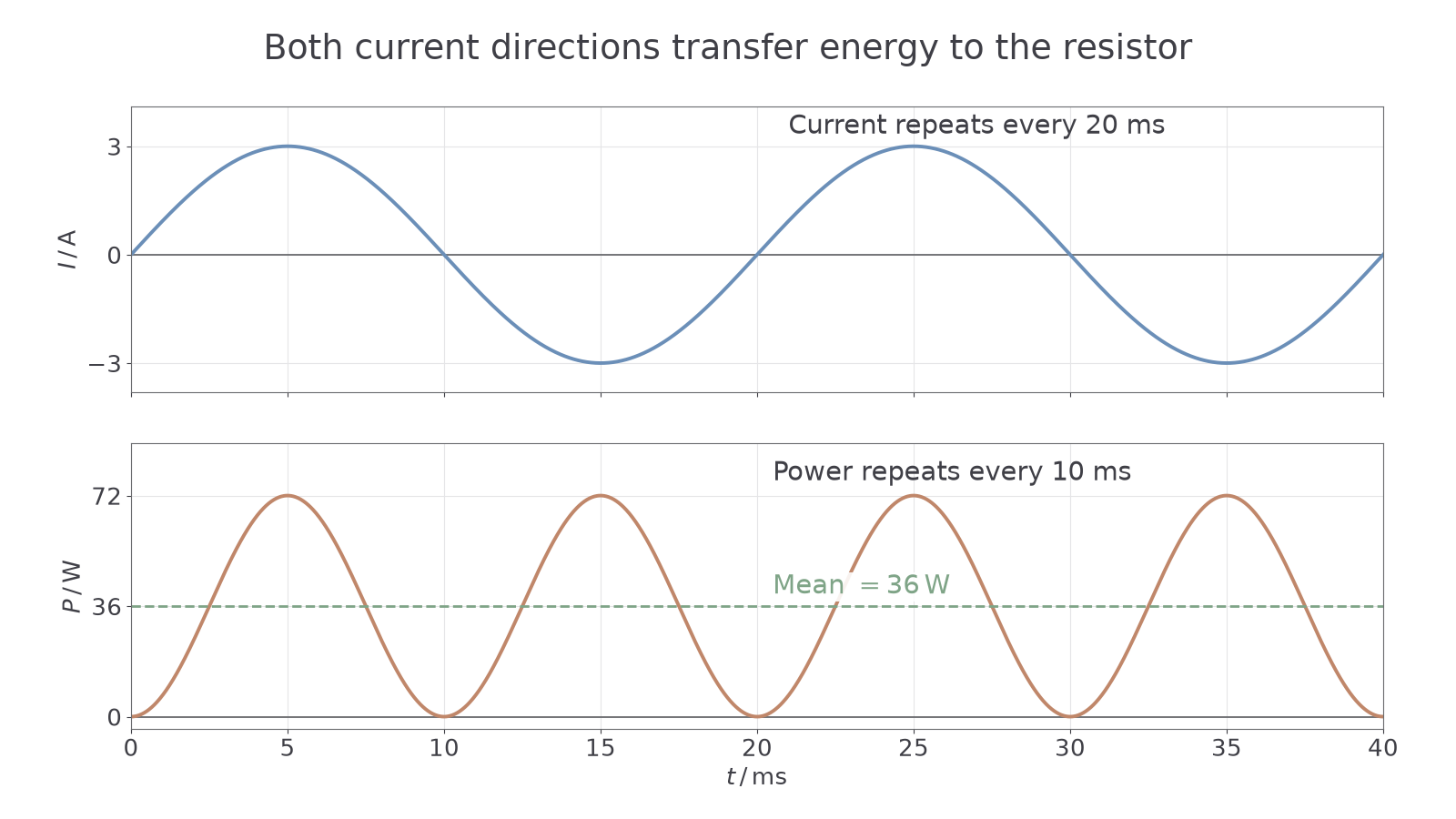
In a fixed resistor, reversing the current also reverses the voltage across it. Their product remains positive: the supply transfers energy to the resistor during both half-cycles. The resistor does not return the first half-cycle's heating energy during the second half-cycle.
For a purely resistive load with constant resistance , current and voltage are in phase and instantaneous power is . These power relations are not on the data sheet: recall them from d.c. circuits. Squaring the sine gives a power trace that is never negative and has two maxima during one current cycle.
Mean power for a sinusoidal resistive load
Here power is in watts, peak current in amperes, peak voltage in volts and resistance in ohms. The factor one half applies to a sinusoidal current/voltage in a constant, purely resistive load. It is not a universal statement about every alternating waveform or circuit.
Not on the data sheet: learn it.
Why one half? Over a full cycle, and have the same mean because one is a quarter-cycle shift of the other. Their sum is always 1, so each mean is one half. Since , its mean is . No cancellation of positive and negative current occurs after squaring.
[DIAGRAM: asset_name: Alternating current and positive heating power; asset_slug: ac-resistive-power; caption: Current has zero signed mean, while its squared heating power has a positive mean; description: Two aligned time graphs show a sinusoidal current of peak 3.0 amperes and frequency 50 hertz and the corresponding power in an 8.0 ohm resistor. Current runs between plus and minus 3.0 amperes. Power runs from zero to 72 watts, repeats every 10 milliseconds and has a dashed mean at 36 watts.]
Continue this lesson.
You’re previewing NovaLearn without an account. Create a free account to read the rest.
Create free account