19.2 - Energy stored by a capacitor
Find stored electric energy from a potential–charge graph and derive useful capacitor-energy expressions. Use them to compare charging conditions and calculate energy transferred during a discharge, keeping source energy distinct from the energy left stored.
The area under a potential–charge graph
If you double a capacitor's voltage, do you merely double its stored energy? For a fixed ideal capacitance, the energy quadruples. The reason becomes visible when you draw potential difference against charge.
Moving a small extra charge between plates requires work. The p.d. opposing that transfer grows as the capacitor charges, so each later coulomb requires more work than an earlier one. You cannot multiply the final p.d. by all the transferred charge as though it had been the p.d. throughout.
For a small transferred charge while p.d. is approximately , the work is . Charge is in , p.d. in , and work in . On a -against- graph this is a thin rectangular area. Adding these areas gives the total work stored as electric potential energy.
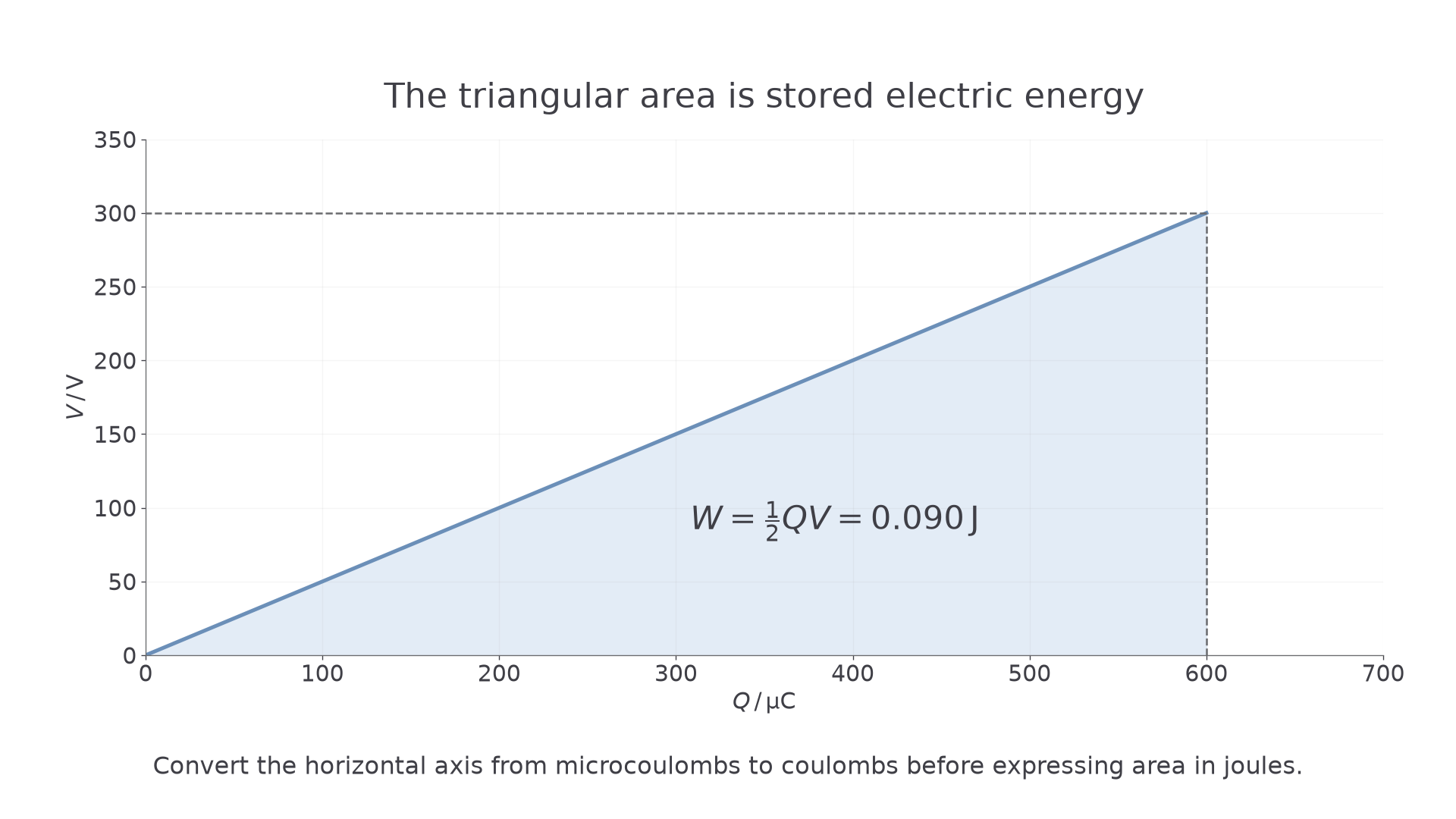
For a fixed linear capacitor, , so the graph is a straight line through the origin. Its gradient is , not . The area from zero charge to is a triangle:
Stored energy from a graph
Here is stored energy in , is charge magnitude on one plate in , and is p.d. magnitude in . The capacitor is initially uncharged and has constant capacitance. The graph area uses changing p.d. during charging, not a constant final p.d. for every charge transfer.
Not on the data sheet: learn it.
[DIAGRAM: asset_name: Stored energy as a triangular area; asset_slug: capacitor-energy-area; caption: The area under the straight V–Q graph is half the final charge times final p.d.; description: A straight graph runs from the origin to charge 600 microcoulombs and p.d. 300 volts. The area below is shaded and labelled 0.090 joules. Horizontal axis is charge in microcoulombs, vertical axis p.d. in volts, and a note requires converting the horizontal scale to coulombs for energy in joules.]
Worked example 1: reading the graph's energy
Question. A linear potential–charge graph ends at and . Calculate the stored energy.
Answer. .
Check. The rectangle would be , twice too large. A horizontal axis in microcoulombs contributes a factor of when expressing the area in joules.
The energy is associated with the separated-charge arrangement and electric field. The charges have not been used up to make that energy; changing their arrangement allows it to be transferred later.
Watch out
On a potential–charge graph, the final point is not the energy. The area gives energy. Make sure the axes are in the stated order and convert their units before evaluating an area.
Choosing an energy expression
The graph result becomes easier to use when you substitute the capacitance definition. Replacing by gives an expression involving capacitance and p.d.; replacing by gives one involving capacitance and charge.
Equivalent stored-energy expressions
Here is in , in , in , and capacitance in . These equivalent forms apply to a fixed linear capacitor. Use the charge on one plate and the p.d. between the plates.
Not on the data sheet: learn it.
At fixed , doubling quadruples . This explains the opening question: the transferred charge also doubles, so both the triangle's base and height double. Halving voltage leaves one quarter of the original energy.
Be precise when comparing different capacitances. At the same p.d., larger stores more energy, from . At the same charge, larger stores less energy, from , because its p.d. is smaller. A claim about “more capacitance” is incomplete until you identify what is held fixed.
Worked example 2: energy from capacitance and p.d.
Question. A capacitor is charged to . Calculate its energy.
Check. Its charge is , so also gives .
When the required energy and operating p.d. are known, choose capacitance by rearranging before substitution.
Exam-style example: a required energy store
Question. A capacitor must store at . Determine its required capacitance.
Answer. About , with unrounded value .
Check. This specifies the energy requirement under an ideal model; a real component must also have a suitable voltage rating and insulation.
Continue this lesson.
You’re previewing NovaLearn without an account. Create a free account to read the rest.
Create free account