7.3 - The Doppler effect for sound
Explain why a moving sound source is heard at a different frequency by a stationary observer. Choose the sign in the moving-source Doppler equation from the wavefront spacing, calculate observed frequencies, and work backwards to a source speed.
Moving sources change wavefront spacing
Why does a steady siren sound higher as its source approaches you and lower as it moves away? The source need not change its own oscillation frequency. Its motion changes the spacing of the sound waves reaching you.
Imagine a source emitting one compression every period . Each compression travels through still air at sound speed . Before the next compression is emitted, the source has moved a distance . Ahead of the source, the next compression starts closer to the previous one; behind it, the next starts farther from the previous one.
[DIAGRAM: asset_name: Wavefronts from a moving source; asset_slug: moving-source-wavefronts; caption: Motion compresses wavefront spacing ahead and increases it behind; description: Circular wavefronts emitted at equal time intervals have centres along the past positions of a source moving to the right. All wavefronts expand at the same speed in the stationary medium. The current source is marked at the rightmost position. Smaller spacing is labelled ahead and larger spacing behind; a rightward arrow shows source motion.]
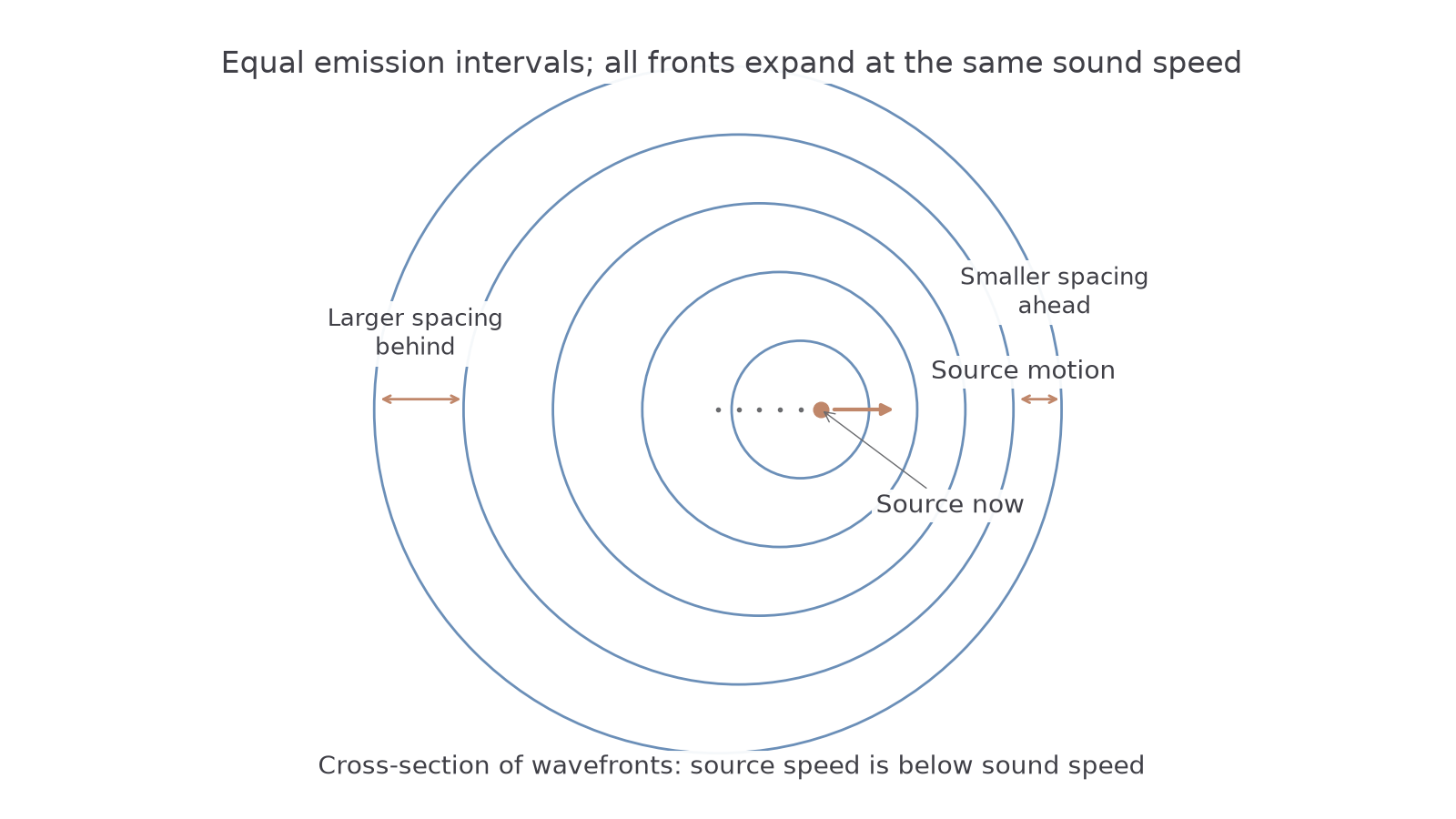
The source frequency counts oscillations per second at the source. The observed frequency counts compressions arriving per second at the observer. With a shorter wavelength ahead but the same sound speed through the medium, is higher. Behind the source the wavelength is longer, so the observed frequency is lower.
Doppler effect for a moving sound source
The observed frequency differs from the emitted frequency when a sound source moves relative to a stationary observer. Approaching source motion increases the observed frequency; receding source motion decreases it.
The air is not carried forward at the source speed. The wavefronts travel at the sound speed appropriate to the medium; source motion changes where successive wavefronts begin. This distinction is the physical reason for the frequency shift.
Model limit
Use this course's equation for a moving source and an observer stationary relative to the medium. The simple calculations treat motion along the source–observer line and a source slower than sound. A moving-observer formula is a different case and is not required here.
Choosing the Doppler sign
A period separates successive emissions. The earlier wavefront travels , while the source moves . Their difference gives the wavelength ahead; their sum gives the wavelength behind.
Substituting each wavelength into gives the supplied equation.
Moving-source Doppler equation
Here is observed frequency and source frequency, both in ; is sound speed and source speed relative to the medium, both in . For an approaching source use ; for a receding source use . The observer is stationary relative to the medium and the source motion is along the observation line.
On the data sheet.
You can choose the sign without memorising a disconnected rule. A higher frequency needs a smaller denominator: subtract for approach. A lower frequency needs a larger denominator: add for recession.
Worked example 1: an approaching source
Question. A source emits sound and moves directly towards a stationary observer at . Sound speed is . Determine the observed frequency.
Plan. Approach means compressed wavefronts and the smaller denominator.
Answer. About .
Check. The result exceeds the emitted , as required for approach.
If this same source moves directly away at the same speed,
Continue this lesson.
You’re previewing NovaLearn without an account. Create a free account to read the rest.
Create free account