6.2 - Energy stored in stretched materials
Find work done from force–extension graphs, derive the elastic-energy expressions for proportional deformation, and distinguish energy supplied during loading from energy recovered during unloading.
Work from a force–extension graph
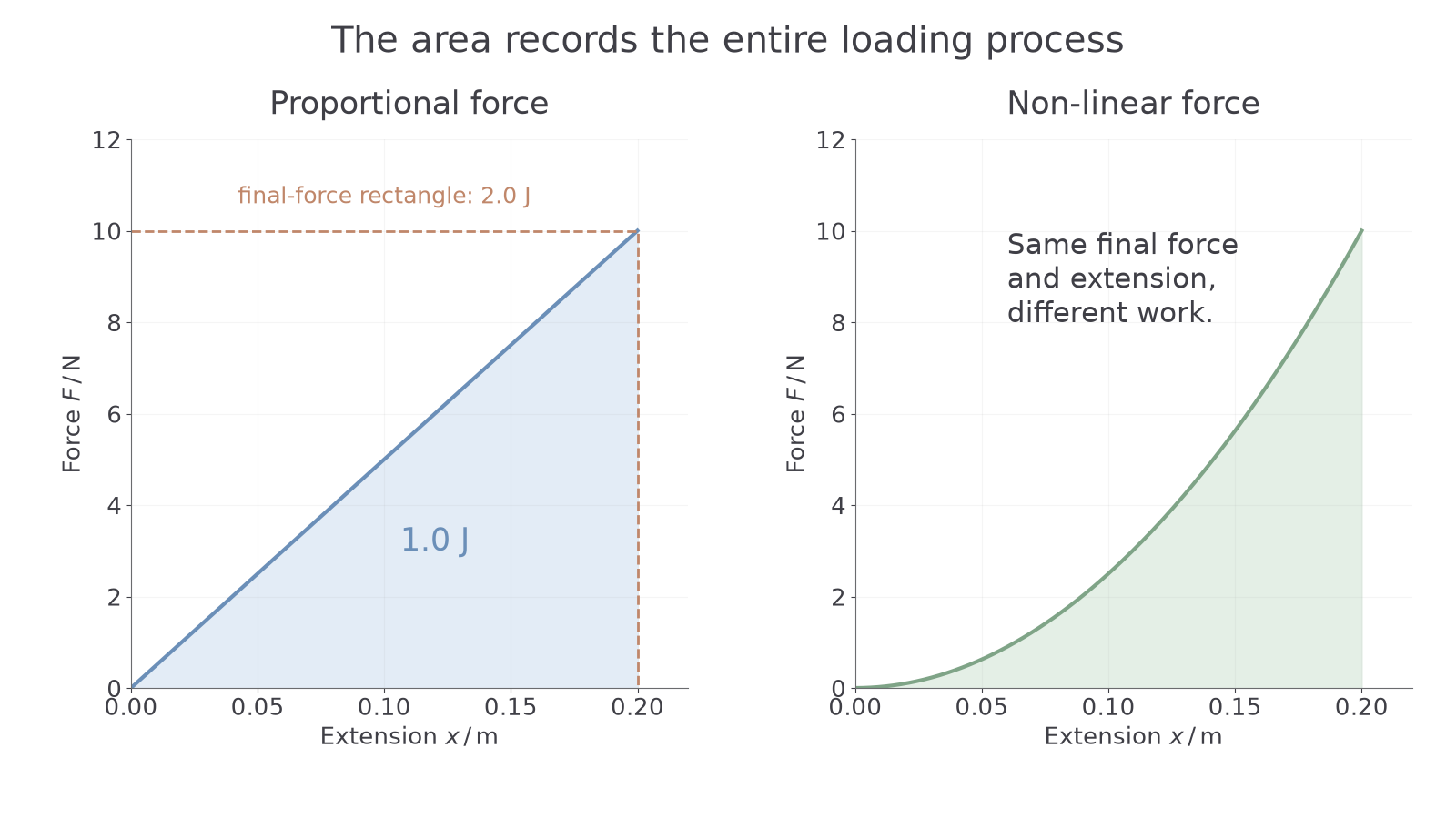
If a spring's final pulling force is and its extension is , is the work done necessarily ? That calculation treats the force as 10 newtons throughout. A spring starting from zero extension normally needs a smaller force early in the stretch.
For a constant force, work is force times displacement in its direction. If the force changes, divide the extension into small intervals. In each narrow interval, the force is approximately constant and the work is approximately the rectangle's area, . Adding the rectangles gives the area under the force–extension graph.
Key idea
The area under a force–extension graph is the work done in stretching the object. The axes must be force and extension: its gradient describes stiffness, while its area describes energy.
The unit check makes sense: multiplied by gives . If extension is plotted in millimetres, the numerical area is in newton millimetres and must be multiplied by to give joules.
A straight graph through the origin gives a triangular area. A curved graph may require counting squares or summing narrow strips; no assumption of proportionality is needed for the area method itself. Read the region between the specified extensions if the object is already stretched at the start.
[DIAGRAM: asset_name: Area is work, not final force times extension; asset_slug: materials-work-area; caption: Work is the whole area below the force–extension curve; description: Two side-by-side force–extension graphs compare a straight proportional rise from zero to 10 newtons at 0.20 metres with a non-linear rise to the same endpoint. Pale shading shows their different areas. On the proportional graph the triangle is labelled 1.0 joule and a dashed rectangle of area 2.0 joules shows the overestimate from using final force throughout. The non-linear graph's area is left unnumbered.]
Worked example 1: stretching an already loaded object
Question. An object's force–extension graph is a straight line between and . Calculate the work done while extension increases between these two values.
Plan. Find the trapezium area, using the average force over this straight segment.
Answer. .
Check. The work must lie between and . Using the total triangle from zero would include work done before this interval.
The same method works for a piecewise straight graph: add the areas of its rectangles, triangles or trapezia. A sudden change in gradient changes stiffness, rather than making the area method fail.
Elastic energy in the proportional region
For an ideal elastic object obeying Hooke's law, the work supplied during stretching can be recovered when it is released. The energy associated with this deformation is elastic potential energy.
Below the limit of proportionality, the force rises uniformly from zero to , so its average during the stretch is . The area under the graph is a triangle:
Substituting gives a second useful form. The factor of one half is a record of the increasing force, rather than an arbitrary part to memorise.
Elastic potential energy
is elastic potential energy in J, is the final load in N, is extension from the unloaded length in m and is spring constant in . Use these forms for elastic deformation within the limit of proportionality, starting from zero extension. For a change between two non-zero extensions, subtract the corresponding energies.
Not on the data sheet: learn it.
Doubling extension quadruples the stored energy, provided the proportional model still holds. Doubling the final force also doubles extension for a fixed spring, so it likewise quadruples the energy. This is why both force and distance matter in stretching.
Worked example 2: energy stored in a spring
Question. A spring of constant is stretched elastically by , within its proportional region. Calculate its stored energy.
Plan. Use , with extension in metres.
Answer. (2 s.f.).
Check. The final force is , and gives the same result. Using would double the answer.
When a spring accelerates a projectile or trolley, use an energy balance rather than assuming all stored energy becomes kinetic energy. Account for any height change and unwanted transfers. Also state whether the spring's own motion and any rotational motion are neglected.
Continue this lesson.
You’re previewing NovaLearn without an account. Create a free account to read the rest.
Create free account