9.3 - Resistance and current-voltage characteristics
Define resistance, state the condition in Ohm's law, and interpret the current–voltage characteristics of a constant-temperature metal, a filament lamp and a semiconductor diode.
Resistance and Ohm's law
Does writing prove that every electrical component obeys Ohm's law? It does not. Resistance can be calculated at a particular operating point even when its value changes as the p.d. changes. Ohm's law is the stronger statement that current is proportional to p.d. under the stated physical conditions.
A component's resistance compares the p.d. across it with the current through it. A large resistance means that a relatively large p.d. is needed for a given current.
Resistance
The resistance of a component is the ratio of the potential difference across it to the current through it.
At an operating point where the current is non-zero, that ratio can be found from a pair of measurements. It does not follow that the same ratio applies at a different temperature or operating condition.
Resistance
is resistance in ohms (), is p.d. in V and is current in A. One ohm means one volt per ampere. For a non-ohmic component, here is the ratio at the specified operating point, not an assertion of constant resistance.
Not on the data sheet: learn it.
Ohm's law describes a component whose current rises in direct proportion to its p.d., provided its temperature and other physical conditions remain constant.
Ohm's law
The current through a conductor is directly proportional to the potential difference across it, provided its temperature remains constant.
A graph of current vertically against p.d. horizontally is called an I–V characteristic. For an ohmic conductor it is a straight line through the origin, and its gradient is . A steeper line means a smaller resistance, not a larger one. If the axes are reversed, with p.d. vertically and current horizontally, the gradient is . For a curved characteristic, use at a chosen point to find the resistance defined here; a tangent gradient is a different quantity.
Worked example 1: a straight-line characteristic
Question. A constant-temperature conductor has current at . Its I–V characteristic is a straight line through the origin. Calculate its resistance and predict its current at .
Plan. The straight line and constant temperature justify using the same resistance at both points.
Answer. and .
Check. Increasing p.d. by a factor of increases current by the same factor. The I–V line has gradient ; plotting the same data as V against I gives gradient . A single measurement pair alone would not establish this proportionality.
Watch out
“Resistance equals voltage divided by current” defines a ratio. “Current is proportional to voltage at constant temperature” states Ohm's law. Giving the equation alone omits the physical condition and the proportional relationship.
Check the distinction directly.
Metal and filament-lamp characteristics
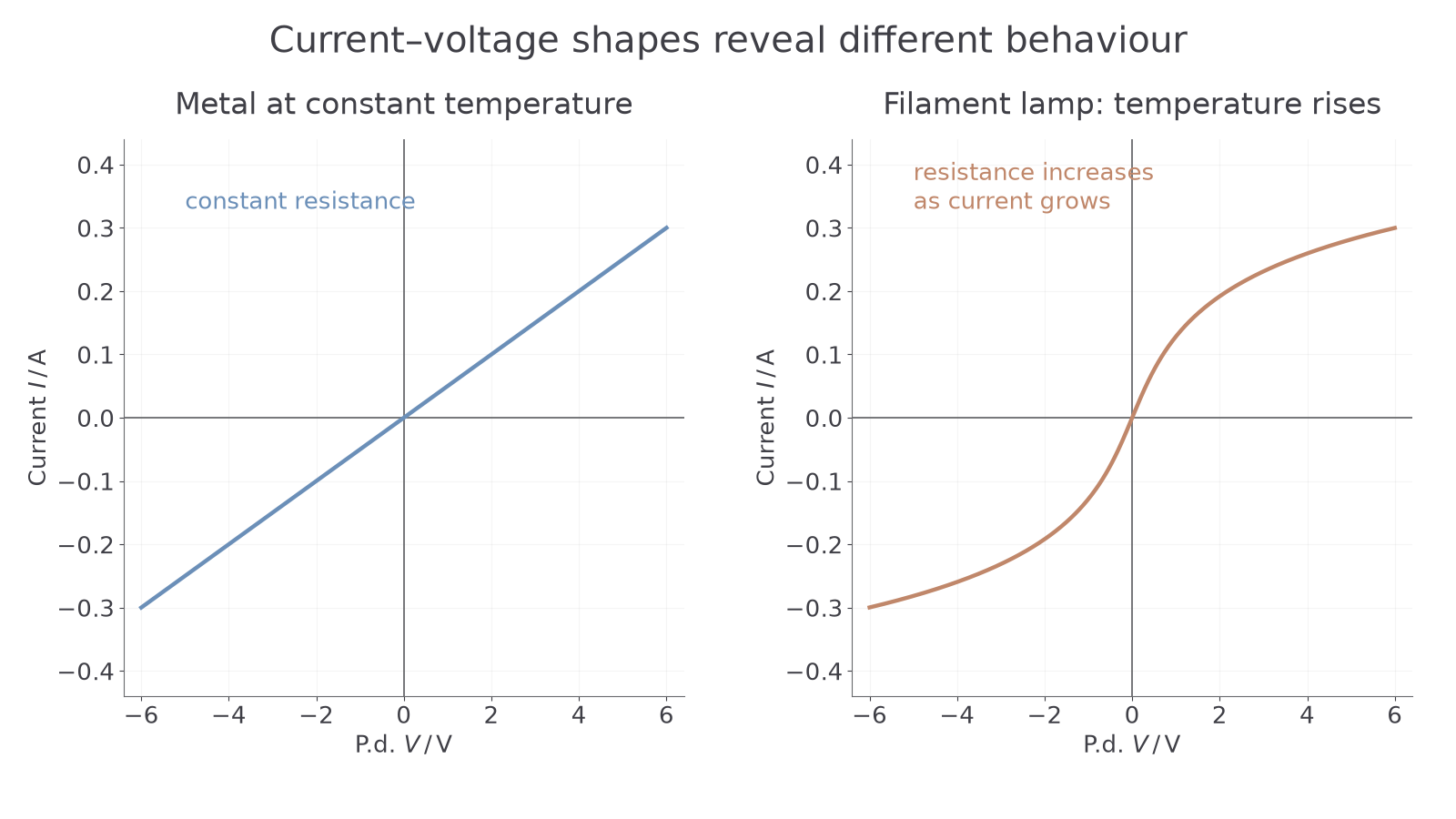
A metal wire held at constant temperature has a straight I–V characteristic through the origin. Reversing the p.d. reverses the current with the same magnitude, giving a matching straight line in the opposite quadrant.
A filament lamp also contains a metal conductor, but its temperature is not constant as the p.d. is increased. Electrical energy transferred in the filament raises its temperature. The metal's lattice vibrations become stronger and scatter charge carriers more, so a larger p.d. is needed to drive the same current: resistance increases.
Its I–V curve therefore bends towards a smaller gradient as the magnitude of p.d. rises. Current still increases, but less than proportionally. The lamp conducts in both directions, with a similar shape when both signs are reversed. If the axes are reversed to show V against I, the curve instead becomes steeper as current grows. Read the axes before recognising a familiar shape.
[DIAGRAM: asset_name: Constant-temperature metal and a filament lamp; asset_slug: electricity-metal-lamp-iv; caption: A constant-temperature metal has constant resistance; a warming filament lamp has increasing resistance; description: Two graphs have current in amperes vertically and p.d. in volts horizontally, with both positive and negative quadrants. The metal graph is a straight line through the origin. The lamp graph is steep near the origin and becomes less steep as the magnitude of p.d. increases, with an odd-symmetric curve in the opposite quadrant. Both carry explicit temperature-condition labels.]
Worked example 2: resistance at two operating points
Question. A lamp takes at and at . Determine its resistance at each point and explain the change.
Plan. Use separately at the two measured points.
Explanation. The filament is hotter at the larger current. Stronger lattice vibrations scatter the carriers more, increasing its resistance. Tripling p.d. did not triple current because the constant-temperature condition was not met.
Check. Both pairs satisfy at their own operating points. That does not make the lamp ohmic across the two points.
Measuring the characteristic
Connect an ammeter in series with the component and a voltmeter in parallel across it. Use a high-resistance voltmeter so its branch current is negligible and the ammeter reading can be taken as the component's current. A variable resistor in series, or a variable low-voltage d.c. supply, varies the operating point. A series current-limiting resistor is important for components that could be damaged by a large current. Read matched current and p.d. values after the readings settle. Reverse the supply to investigate negative p.d. and current.
Continue this lesson.
You’re previewing NovaLearn without an account. Create a free account to read the rest.
Create free account