13.4 - Gravitational potential and energy
Define gravitational potential using a zero at infinity, interpret its negative sign, and calculate potential and potential-energy changes outside a spherical mass. Distinguish force per unit mass from energy per unit mass, and connect signed energy changes to work done by gravity or an external agent.
Potential measured from infinity
How can gravitational potential be negative when raising a mass requires positive work? The sign comes from the chosen zero. Moving outwards can increase a quantity from a negative value towards zero without making that increase negative.
Potential measures energy per unit mass associated with position. For an isolated mass, choose gravitational potential to be zero at infinity, where its gravitational influence tends to zero. A point closer to an attracting mass has a lower potential.
Gravitational potential
Gravitational potential at a point is the work done per unit mass in bringing a small test mass from infinity to that point.
For the signed work in this definition, imagine an external agent bringing the mass in slowly, so its kinetic energy does not change appreciably. Gravity pulls inward and does positive work on the incoming mass. The restraining external agent does negative work. The negative potential records that lower energy relative to infinity.
Conversely, moving the mass outwards slowly requires positive work against attraction. Reaching infinity raises its potential to zero. A finite point therefore has negative potential relative to this reference. Negative potential does not mean repulsive gravity or a negative mass.
Key idea
Potential is a scalar energy-per-mass quantity, measured in . Field strength is a vector force-per-mass quantity, measured in . Their units and physical meanings are different.
If potential changes from to , it has increased by . The final number is less negative and the change is positive. Losing the minus signs before subtraction reverses this conclusion.
Potential at a point does not depend on the small mass used to define it. Two different masses at the same point have the same potential but different potential energies. The gravitational interaction is attractive in each case.
Potential outside an isolated mass
An attractive field grows weaker with distance, so the potential approaches its zero gradually. The potential varies as , rather than the field-strength magnitude's .
Gravitational potential
Here is potential in , is source mass in , and is centre distance in . Use an isolated point mass or a point outside a uniform sphere, with zero potential at infinity. The negative sign expresses attraction relative to that reference.
On the data sheet (Paper 4 only).
Worked example 1: a negative potential
Question. A point is from the centre of an isolated spherical body of mass , outside its surface. Calculate the potential, using .
Plan. Use the centre distance and retain the minus sign.
Answer. Approximately .
Check. The result is negative, and the unit is energy per mass, not force per mass. At twice the radius, potential would be half as negative: .
[DIAGRAM: asset_name: Potential rises towards zero; asset_slug: gravitational-potential-curve; caption: Moving outwards makes the negative potential less negative; description: A graph of potential divided by GM over R against radius divided by R shows the exterior inverse-radius curve, starting at minus one at the surface and approaching zero from below. Points at one and two sphere radii have scaled potentials minus one and minus one half. An upward arrow marks their positive potential difference of one half. The interior region is not plotted.]
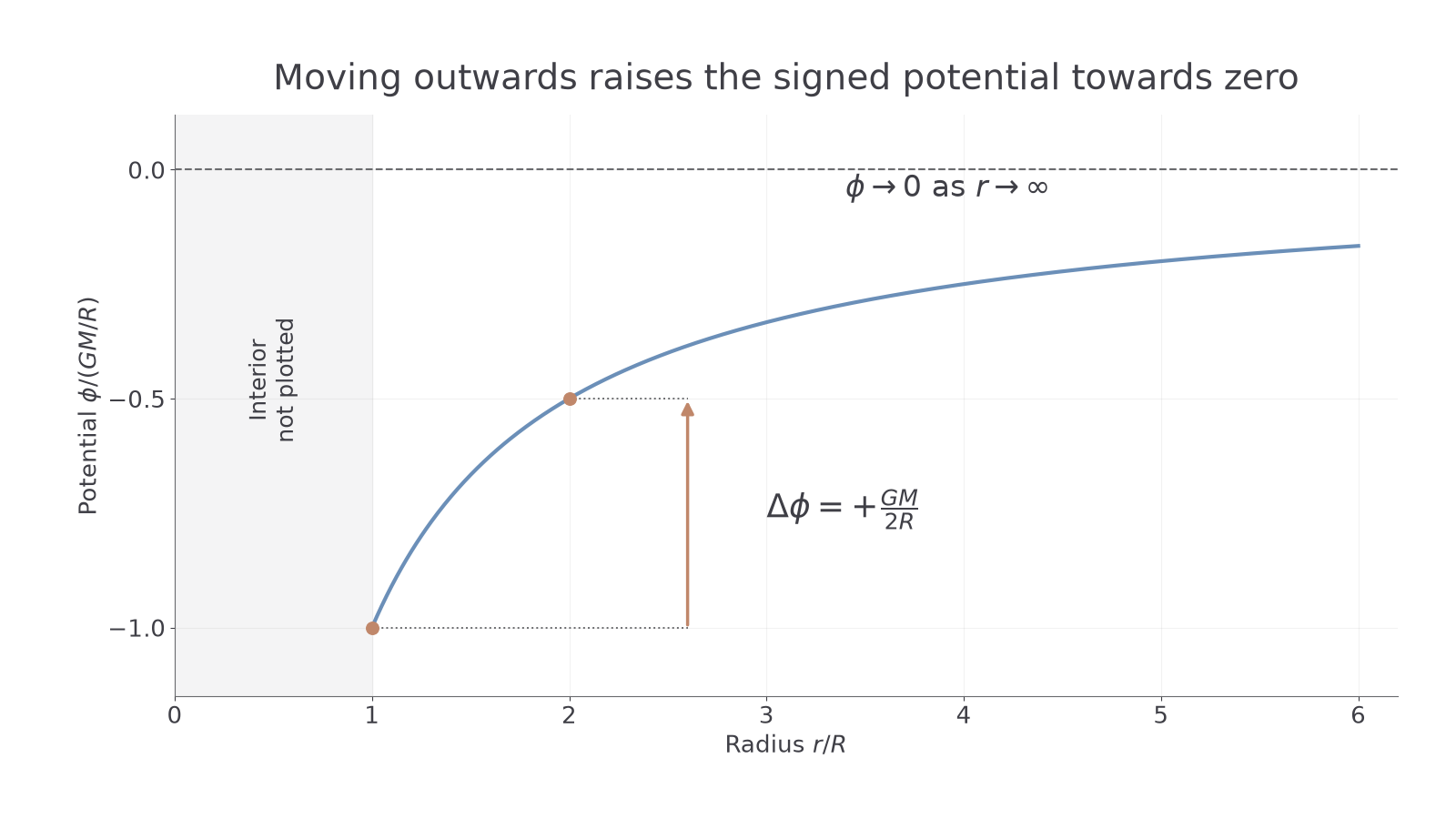
Doubling radius halves the magnitude of potential but quarters the field-strength magnitude. These are different inverse powers. For one isolated source,
The last equality follows by eliminating the common , not by changing potential into a force. It is valid for this isolated exterior point-mass model, rather than a universal relationship for arbitrary fields.
For example, if a sphere's surface potential is written , where is a positive magnitude and its radius is , then and the surface field-strength magnitude is . On opposite sides of the sphere at the same radius, potential is the same scalar value, while field vectors point in opposite directions towards the centre.
Watch out
“Potential decreases with distance” is misleading here. Its magnitude decreases, but the signed potential increases towards zero. State whether you mean the signed value or its magnitude.
Continue this lesson.
You’re previewing NovaLearn without an account. Create a free account to read the rest.
Create free account