8.1 - Stationary waves, nodes and antinodes
Learn how overlapping waves add, how opposite-moving waves form a pattern with fixed nodes, and how experiments with strings, air and microwaves reveal that pattern. You will use node and antinode positions to measure wavelength and identify the modes that fit a system.
Adding displacements where waves overlap
Can two waves meet and leave the medium momentarily undisturbed? They can: an upward displacement from one wave can cancel a downward displacement from another. Each wave still contributes; the resultant displacement happens to be zero at that place and time.
Principle of superposition
When waves meet at a point, the resultant displacement is the sum of the displacements that each wave would cause separately at that point.
Add displacements with their signs. For transverse waves, choose upward as positive, for example. For longitudinal waves, add the particles' displacements along the same reference direction. This addition describes the small-amplitude, linear-wave model used here; strongly nonlinear waves need a different treatment.
If one pulse displaces a string by and another by at the same point, the resultant is . If both displacements are positive, they reinforce. Equal opposite displacements cancel. After pulses pass through each other in the ideal linear model, they continue propagating with their previous shapes; they have not permanently used each other up.
A wave's amplitude is its maximum displacement, not its instantaneous displacement. You cannot add two amplitudes blindly: the resultant depends on the phase difference and on which displacements coincide.
Watch out
Zero resultant displacement at one instant does not prove that there is no wave or no energy. A single moving wave also passes through zero displacement, and overlapping waves can cancel locally.
Try the signed addition before considering a whole pattern.
Fixed nodes and oscillating antinodes
Two progressive waves with the same frequency and wavelength travelling in opposite directions can superpose to form a stationary wave. Equal amplitudes give complete cancellation at its nodes. Reflection commonly supplies the opposite-moving wave, but the boundary conditions also determine which stable modes fit the apparatus.
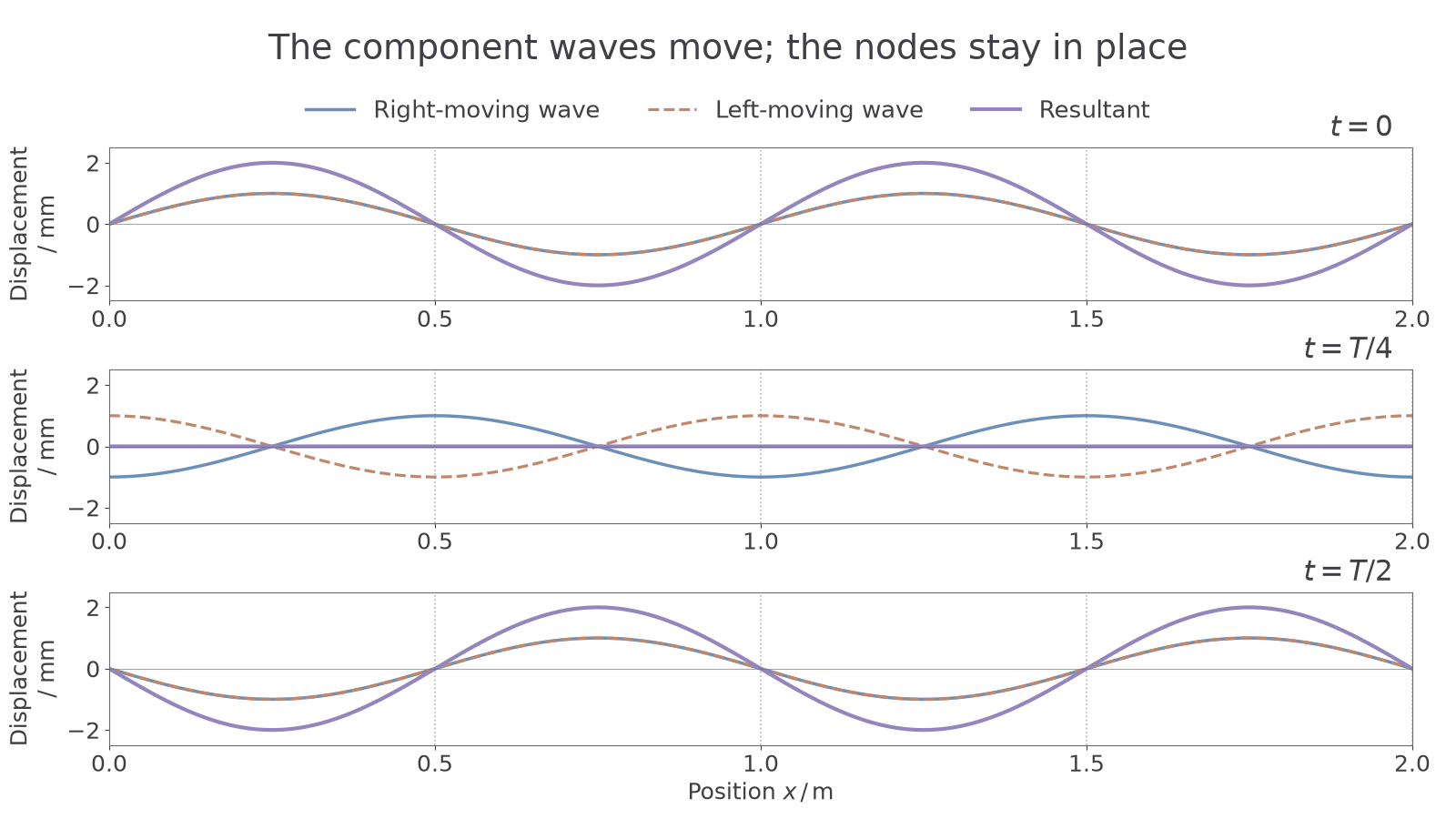
Imagine drawing both progressive waves at the same instant. At each position, add their vertical displacements to plot the resultant. A quarter of a period later, shift one component a quarter-wavelength right and the other a quarter-wavelength left, then add again. Some positions always receive equal opposite displacements. Other positions alternate between large positive and negative resultant displacements.
[DIAGRAM: asset_name: Graphical formation of a stationary wave; asset_slug: superposition-stationary-snapshots; caption: Adding two opposite-moving waves gives fixed nodes even though the component waves continue moving; description: Three aligned displacement-position plots show the two progressive waves and their resultant at zero, one quarter-period and one half-period. The component amplitudes are one millimetre and the wavelength is one metre. Nodes at whole half-wavelength positions stay at zero in every snapshot; at one quarter-period the whole resultant is momentarily zero, while the antinodes later move again.]
Node and antinode
A node is a position of zero amplitude: its displacement remains zero. An antinode is a position of maximum amplitude in the stationary-wave pattern.
At a node the two components always cancel. At an antinode the resultant amplitude is twice either component's amplitude when they are equal. Between a pair of neighbouring nodes, all particles oscillate in phase, although their amplitudes differ. Particles in adjacent loops are in antiphase. A node has no oscillation whose phase can be compared.
The pattern does not travel along the medium. In the ideal equal-wave model there is no net energy transfer along it over a cycle: the two equal average energy flows in opposite directions balance. This does not mean the oscillating medium has no energy. A progressive wave instead carries a travelling pattern and net energy in its direction of travel.
Key idea
At the instant when the whole string passes through equilibrium, an antinode also has zero displacement. It is still an antinode because its amplitude, the largest displacement it reaches, is not zero.
This distinction is a useful test of the stationary-wave model.
Stationary waves in three experiments
The same superposition model appears in very different apparatus. What oscillates must be identified correctly: a string moves transversely, air particles move longitudinally, and a microwave has oscillating electric and magnetic fields.
Stretched string. Use a signal generator and mechanical vibrator to drive a taut string, with a reflecting fixed end and a controlled tension, for example from a mass over a pulley. Vary frequency slowly until clear loops appear. Mark the effective nodal boundaries of the vibrating length. The small driven-end motion is treated as negligible in the fixed-end model. Nodes remain almost still while the antinodes blur over a large displacement. Secure the stand and keep the area beneath the tensioning mass clear.
For a string length bounded by nodes, an integer number of half-wavelengths must fit:
Continue this lesson.
You’re previewing NovaLearn without an account. Create a free account to read the rest.
Create free account