8.4 - Measuring wavelengths with a diffraction grating
Learn how the spacing of a diffraction grating determines the directions of its bright orders. You will convert a line density into a slit separation, find allowed orders and use a screen measurement to determine light's wavelength.
From line density to slit spacing
How can grooves too close to count by eye reveal a wavelength far too small for a ruler? A diffraction grating converts that tiny length into a large angle: waves from many regularly spaced openings reinforce in selected directions.
A diffraction grating has many parallel, equally spaced narrow slits or equivalent repeating lines. Each transmitted slit spreads the incident light, and the resulting waves overlap. A bright principal maximum occurs where the contributions from successive slits arrive in phase. Many slits make these main maxima much sharper than the broad bright regions of a simple two-slit pattern.
The spacing is the distance from one slit centre to the next. A quoted line density tells you how many equally spaced lines occur per unit length. It is a reciprocal length, not a length.
Spacing from line density
Here is the number of lines per metre, in , and is the spacing in metres. Convert a density in lines per millimetre to lines per metre before finding an SI spacing.
Not on the data sheet: learn it.
For example, lines per millimetre means lines per metre, not .
Worked example 1: a grating's spacing
Question. A grating is marked 600 lines per millimetre. Determine its line spacing in metres.
Plan. First express the line density per metre, then take its reciprocal.
Answer. About . Check. Hundreds of lines fit in one millimetre, so the spacing must be much less than a millimetre.
A denser grating has a smaller spacing. It therefore sends a given non-zero order further from the central direction, provided that order is still physically allowed. You will see why in the grating equation next.
Watch out
The number printed on the grating is usually a line density. Substituting 600 as a spacing, or forgetting the per-millimetre conversion, gives impossible wavelengths and orders.
Check the conversion with a different grating.
Bright orders and their angular limits
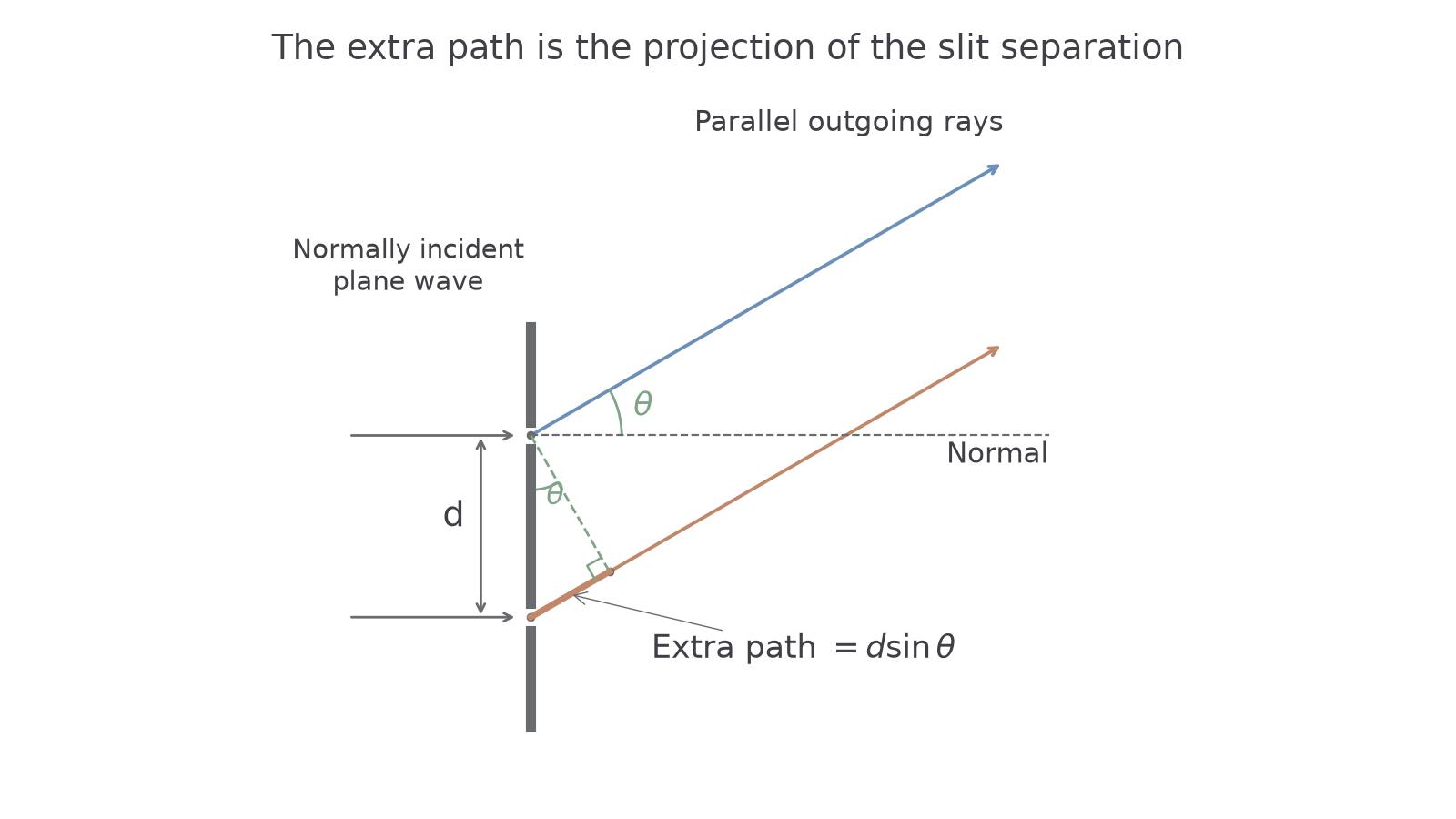
At normal incidence, light reaches successive slits in phase. In a direction making angle with the grating normal, the path difference between neighbouring slits is . Reinforcement of all the contributions requires this difference to be an integer number of wavelengths.
[DIAGRAM: asset_name: Path difference between neighbouring slits; asset_slug: superposition-grating-path; caption: For normal incidence, successive slits reinforce when their path difference is an integer wavelength; description: Two adjacent slit centres separated vertically by d emit parallel rays at angle theta to the horizontal normal. A perpendicular construction line meets the lower ray, identifying the extra distance as d sin theta. A small right-angle marker and angle theta link the path triangle to the ray direction.]
Diffraction-grating equation
Here is slit spacing in metres, is wavelength in metres, is the angle from the grating normal and is the order. This form assumes normal incidence. There are corresponding non-zero orders on both sides of the central direction.
Not on the data sheet: learn it.
The zero order has : its path difference is zero for every wavelength. The first orders lie to either side, followed by the second orders, and so on. For a fixed grating and order, increasing wavelength increases the angle. Thus red light is further from the centre than blue light in the same order; white light's wavelengths overlap in the zero order but separate in non-zero orders.
An order is possible only if , because a sine cannot exceed 1. The greatest allowed integer below the limit gives the highest order. Do not round this upper bound upwards. The equality case is the grazing limit at , rather than an ordinary spot on a screen facing the grating.
Worked example 2: an angle and the last order
Question. Light of wavelength falls normally on a grating with spacing . Determine the first-order angle and the highest non-grazing order.
Plan. Use the grating equation for the first order, then test the sine limit separately.
Answer. First order ; highest order 3. There are seven principal maxima in total: zero and orders 1, 2 and 3 on each side.
Check. Order 4 would need a sine greater than 1. If a calculation of a known bright spot gives order 1.998 because of rounding or measurement uncertainty, identify it as order 2; that is different from finding an upper bound for all possible orders.
Continue this lesson.
You’re previewing NovaLearn without an account. Create a free account to read the rest.
Create free account