9.6C - Identifying ions in unknown salts
This core practical is about using a logical sequence of qualitative tests to identify the ions in unknown salts. The evidence is mostly observations: flame colours, gases, litmus changes and precipitates. A strong practical answer names the reagent, describes the positive observation, and then deduces the ion rather than guessing a whole salt from one test.
Practical Plan
The aim is to identify ions in unknown salts using the specified cation and anion tests. These are the tests from the qualitative analysis section: flame tests, sodium hydroxide tests, the ammonia gas test, carbonate tests, sulfate tests and halide tests.
Qualitative Test
A qualitative test is a test that identifies what substance or ion is present from an observation, rather than measuring how much is present.
For the simple deductions here, assume each unknown is a pure salt containing one type of cation and one type of anion from the taught list. You do not rely on a single observation unless that observation is the whole test for the ion. For example, a flame test can identify a metal ion, but it cannot identify the anion in the salt.
The safest and cleanest plan is:
- Practise the tests on known substances so you know what a positive result looks like.
- Label the unknown and record its appearance.
- Use a fresh small portion for each test.
- Carry out a flame test on the solid.
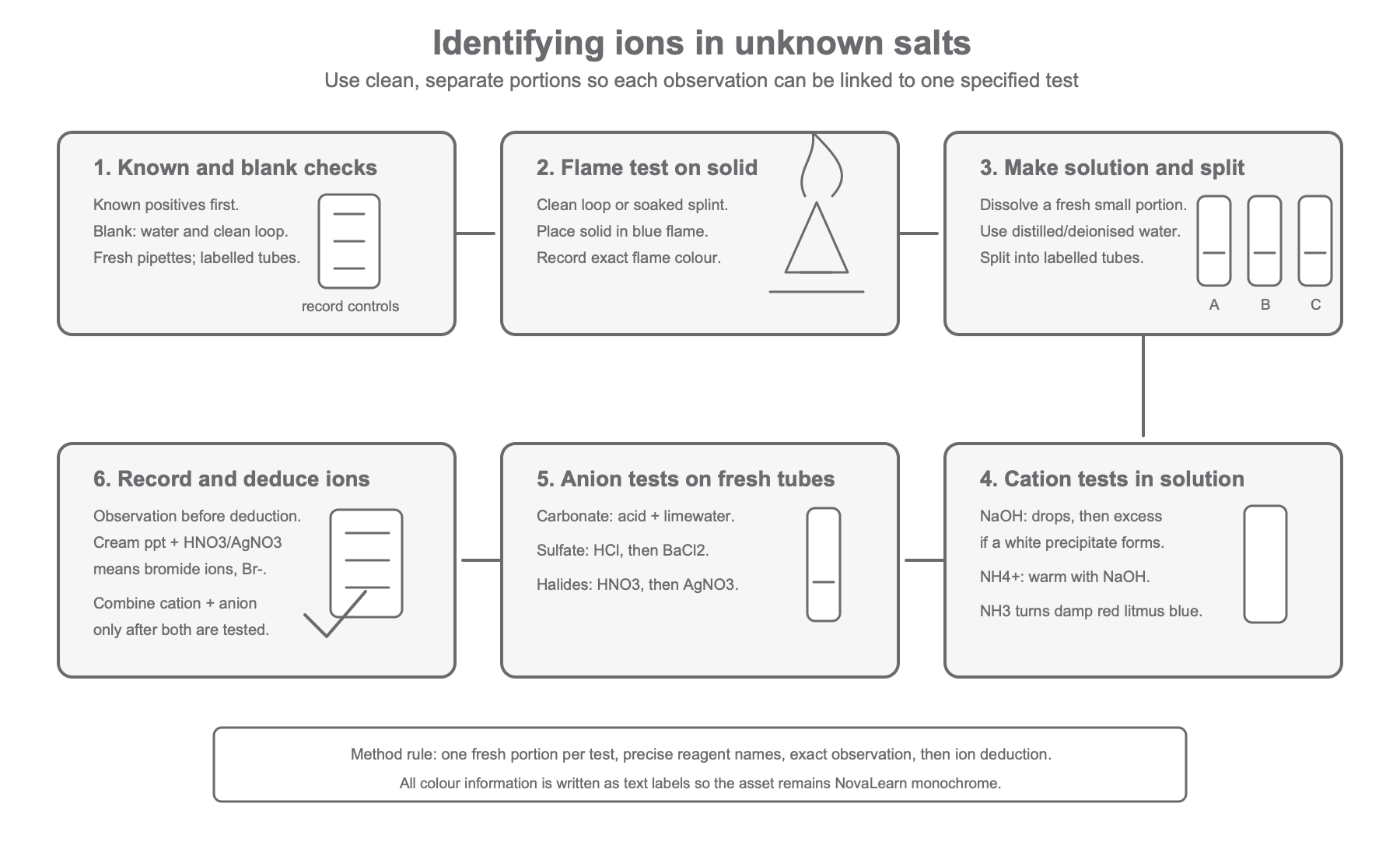
- Dissolve a fresh small portion in distilled or deionised water, where possible, and split the solution into labelled test tubes.
- Test separate portions for cations using sodium hydroxide solution.
- Test separate portions for carbonate, sulfate and halide ions.
- Record the observations immediately and compare them with known positive controls.
- Deduce the ions present from the full pattern of results.
Using separate portions matters because each test adds new ions or reagents. A sample that has already had hydrochloric acid added is no longer suitable for the halide test, because hydrochloric acid contains chloride ions.
[DIAGRAM: asset_name: ion_test_workflow: Identifying ions in unknown salts test order - diagram 1; asset_slug: 210_9_6c_core_practical_identify_the_ions_in_unknown_salts_using_the_tests_for_the_diagram1; file: diagram_assets/210_9_6c_core_practical_identify_the_ions_in_unknown_salts_using_the_tests_for_the_diagram1.png; recommended_method: deterministic_drawn; description: Exact monochrome workflow diagram for Edexcel core practical 9.6C. Shows six linked stages: known and blank checks, flame test on a solid with clean loop or soaked wooden splint, dissolve a fresh portion in distilled/deionised water and split into labelled tubes, sodium hydroxide cation tests including warm ammonium test with damp red litmus, anion tests for carbonate with dilute acid and limewater, sulfate with dilute hydrochloric acid then barium chloride, and halides with dilute nitric acid then silver nitrate, then recording observations and deducing ions. Assessed apparatus-and-method visual, so it is generated deterministically with white background and #6A6B6E linework/text. Nearby prose gives all observations for accessibility.]
Apparatus, Safety And Controls
Use small quantities. Qualitative tests need clear observations, not large amounts of chemicals.
Core apparatus and reagents include:
- eye protection
- unknown salts and known reference salts
- Bunsen burner and heat-resistant mat
- test tubes, test tube rack and test tube holder
- flame test loops or wooden splints soaked in water
- spatula
- dropping pipettes
- distilled or deionised water
- sodium hydroxide solution
- dilute hydrochloric acid
- dilute nitric acid
- barium chloride solution
- silver nitrate solution
- red litmus paper
- limewater for testing carbon dioxide
Controls make the observations more valid.
| Control or check | Why it is used |
|---|---|
| known positive samples | show what the correct flame colour, gas test or precipitate should look like |
| blank distilled water test | checks that water and glassware do not give a precipitate on their own |
| clean-loop flame blank | checks that the flame test loop is not contaminated before the sample is tested |
| fresh pipettes and labelled tubes | prevent one reagent being carried into another test |
| same approximate sample size and reagent volume | makes weak and strong observations easier to compare |
This is a qualitative practical, so it is not usually set up with one independent variable and a numerical dependent variable. The dependent evidence is the observation from each test. Controlled practical features include the amount of unknown used, the volume and concentration of reagent added, whether a sample is warmed, the cleanliness of apparatus, and the use of fresh portions.
Safety must be specific to the practical. Wear eye protection because acids, alkalis, barium chloride and silver nitrate can splash. Keep the Bunsen burner on a heat-resistant mat and use a test tube holder when heating. Treat unknown salts as potentially harmful and use a spatula, not fingers. Do not smell gases directly; test ammonia with damp red litmus paper at the mouth of the tube. Silver nitrate can stain skin and clothing. Barium chloride is toxic if swallowed; use the dilute solution supplied and handle spills and waste as instructed by the teacher.
Cation Tests
Cations are positive ions. In this practical, the cation tests use either a flame test or sodium hydroxide solution.
For a flame test:
- Clean the flame test loop using dilute hydrochloric acid and heat it until it gives no flame colour, or use a fresh soaked wooden splint.
- Put a small amount of the solid unknown on the clean loop or splint.
- Hold the sample in the blue Bunsen flame.
- Record the flame colour immediately.
- Compare the colour with known positive samples where available.
| Ion | Positive flame-test observation |
|---|---|
| red flame | |
| yellow flame | |
| lilac flame | |
| orange-red flame | |
| blue-green flame |
Sodium contamination can give a strong yellow flame and mask other colours. This is why the clean-loop check and known controls matter.
Sodium hydroxide solution is used to test for several cations in solution. Add sodium hydroxide solution dropwise first. If a white precipitate forms, add excess sodium hydroxide solution to help distinguish aluminium ions from calcium ions.
| Ion | Observation with sodium hydroxide solution |
|---|---|
| white precipitate; dissolves in excess sodium hydroxide | |
| white precipitate; does not dissolve in excess sodium hydroxide | |
| blue precipitate | |
| green or grey-green precipitate | |
| brown or red-brown precipitate | |
| ammonia gas is produced when warmed with sodium hydroxide solution |
The test for ammonia gas is to hold damp red litmus paper just above the mouth of the tube, clear of liquid and glass. Ammonia turns damp red litmus paper blue. This confirms the gas produced from warming ammonium ions with sodium hydroxide solution.
The precipitate can also be represented by an ionic equation:
Copper(II) hydroxide precipitate
Continue this lesson.
You’re previewing NovaLearn without an account. Create a free account to read the rest.
Create free account