3.14 - The ionic equation for neutralisation
In acid–alkali neutralisation, hydrogen ions and hydroxide ions react to form water. You will write the ionic equation, check its atoms and charge, and distinguish the reacting ions from ions that remain unchanged in solution.
The reacting ions
An aqueous acid supplies hydrogen ions, . An alkali supplies hydroxide ions, . The symbol means dissolved in water.
These ions react to form water:
Ionic equation for neutralisation
There are two hydrogen atoms and one oxygen atom on each side. The total charge on the left is , matching neutral water on the right. The product is water, , rather than hydrogen gas, .
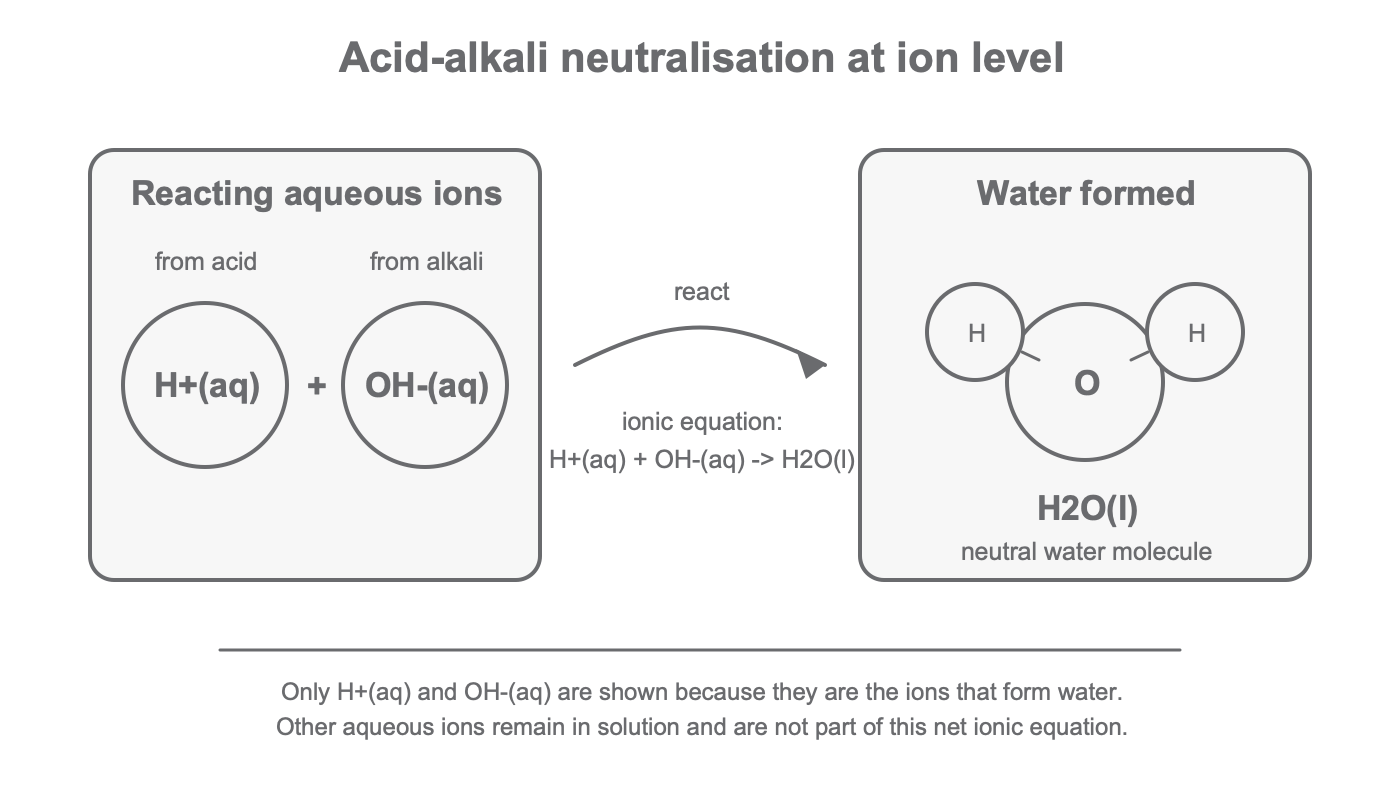
The circles labelled with ion formulae are symbols for the reacting ions. The water model shows one oxygen atom joined to two hydrogen atoms.
Continue this lesson.
You’re previewing NovaLearn without an account. Create a free account to read the rest.
Create free account