4.11 - Life-cycle assessment stages
A product affects the environment before, during and after its use. You will follow the four stages of a life-cycle assessment and connect each stage to specific resource use, waste or emissions.
Following the whole life
Life-cycle assessment
A life-cycle assessment (LCA) considers a product's environmental effects from obtaining raw materials through manufacture and use to disposal.
The four stages are obtaining raw materials → manufacturing → using → disposing of the product. Disposal is also called end of life and includes possible recovery or recycling.
[DIAGRAM: asset_name: life-cycle assessment stages - diagram 1; asset_slug: 113_4_11_life_cycle_assessment_stages_diagram1; file: diagram_assets/113_4_11_life_cycle_assessment_stages_diagram1.png; recommended_method: deterministic_drawn; description: Deterministic monochrome flow diagram for Edexcel 1CH0 4.11 showing the four life-cycle assessment stages in order: obtaining raw materials, manufacturing the product, using the product, and disposing of the product when it is no longer useful. Each stage includes short environmental-effect prompts. This is exact assessed vocabulary support, so it must use deterministic drawing, white background, #6A6B6E linework and text, and no colour coding.]
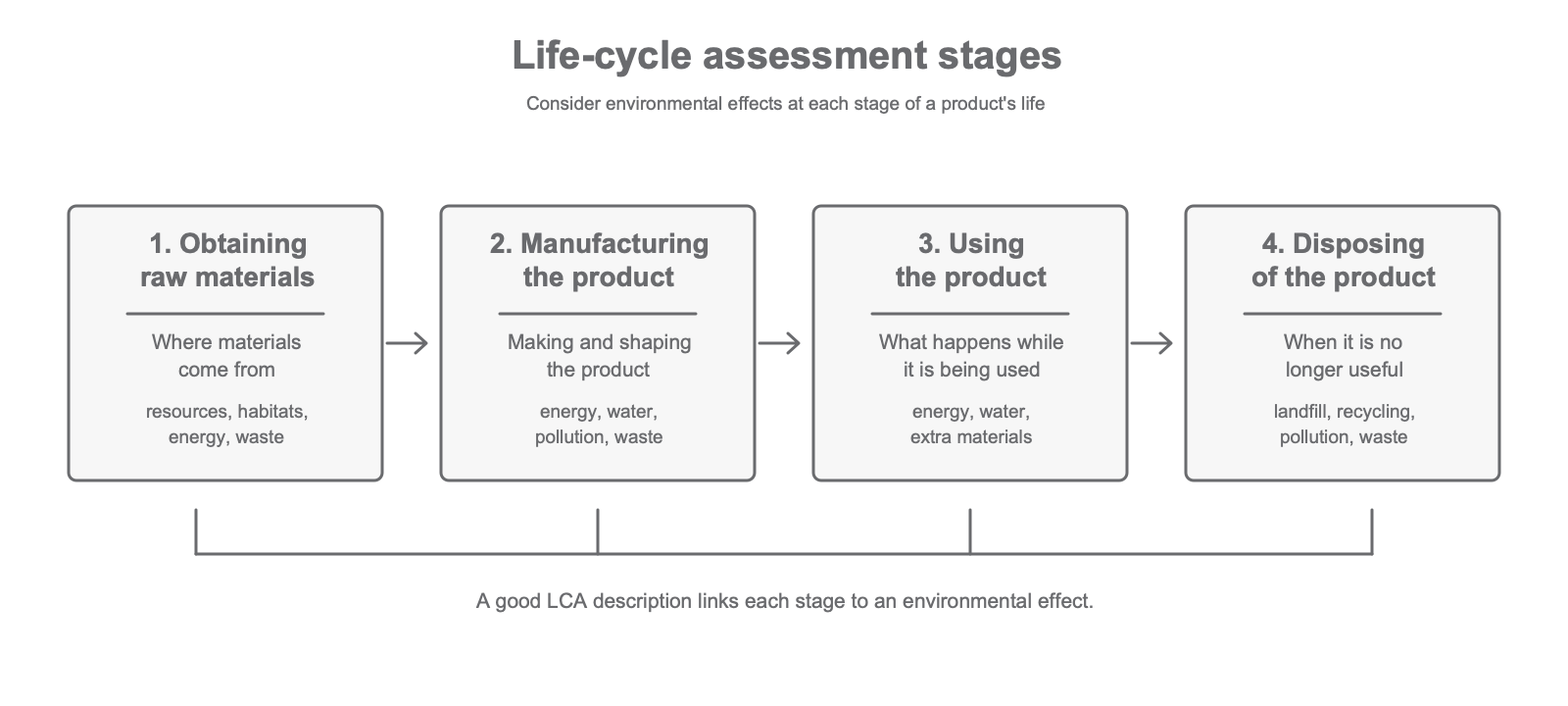
These stages provide a checklist. Transport can occur between or within several stages, so it must also be accounted for; it is not automatically excluded because it is not one of the four headings. A study should state its boundary: which processes it includes. For example, an energy figure for a factory alone is not the energy for the whole life of the product.
Use the same boundary when comparing products and count each process once. If electricity generation is included in a stage's emissions figure, adding it again would double-count those emissions.
Obtaining materials and making the product
Obtaining raw materials can involve mining metal ores, extracting crude oil for some plastics, or collecting scrap. It can use energy and water, deplete finite resources, damage habitats and produce waste rock or dust.
Manufacturing changes these materials into the product. Chemical processing, heating, shaping, joining and packaging may need energy and water and produce waste or emissions. The division between material processing and product manufacture can vary between studies; define it clearly and include every process once.
For an aluminium bottle, mining bauxite obtains a raw material. Producing aluminium and shaping it into the bottle require further processing. A complete assessment includes both, even if the study groups metal production with its raw-material supply.
Continue this lesson.
You’re previewing NovaLearn without an account. Create a free account to read the rest.
Create free account