3.21 - Preparing an insoluble salt by precipitation
Prepare an insoluble salt by mixing two suitable solutions, then collecting the solid precipitate. You will choose the reactants and explain how filtration, washing and drying give a pure, dry sample.
What precipitation makes
A precipitation reaction happens when two aqueous solutions are mixed and an insoluble solid forms. The solid is called a precipitate. For preparing an insoluble salt, the precipitate is the product you want to collect.
Precipitate
A precipitate is an insoluble solid that forms when solutions are mixed.
The reactants are soluble salts, so they are written with the state symbol (aq). The insoluble salt is written with the state symbol (s) because it forms as a solid.
For example, calcium nitrate solution and sodium carbonate solution can be mixed to make calcium carbonate:
Example precipitation equation
Calcium carbonate is the insoluble salt. Sodium nitrate is soluble, so it stays dissolved in the liquid. That is why the method must collect the solid residue, not the filtrate.
Choosing soluble solutions
To prepare a particular insoluble salt, the two mixed solutions must contain the ions needed for that salt. Each starting salt must be soluble so that the ions are free to mix in solution.
Use the solubility rules from 3.19 as a quick check:
- nitrates are soluble
- sodium, potassium and ammonium salts are soluble
- common carbonates are insoluble except sodium, potassium and ammonium carbonates
- common sulfates are soluble except those of lead, barium and calcium
- common chlorides are soluble except those of silver and lead
For calcium carbonate, a sensible pair is calcium nitrate solution and sodium carbonate solution. Calcium nitrate is soluble because all nitrates are soluble. Sodium carbonate is soluble because it is a sodium salt. When the ions mix, calcium carbonate is insoluble, so it forms a precipitate.
If a question gives the named solutions, you may not need to choose the reactants. You still need to recognise that the wanted insoluble salt is the solid formed, and the other soluble product remains in solution.
Filter, wash and dry
The method for a pure, dry insoluble salt is:
- Prepare or use two solutions of soluble salts that will form the required insoluble salt.
- Mix the solutions in a beaker or conical flask and stir. A precipitate forms.
- Filter the mixture using filter paper in a filter funnel.
- Keep the solid residue on the filter paper. This residue is the insoluble salt.
- Wash the residue with a small amount of distilled water while it is still in the filter paper.
- Leave the water to drain through, then dry the solid using clean filter paper, a warm place or another suitable drying method.
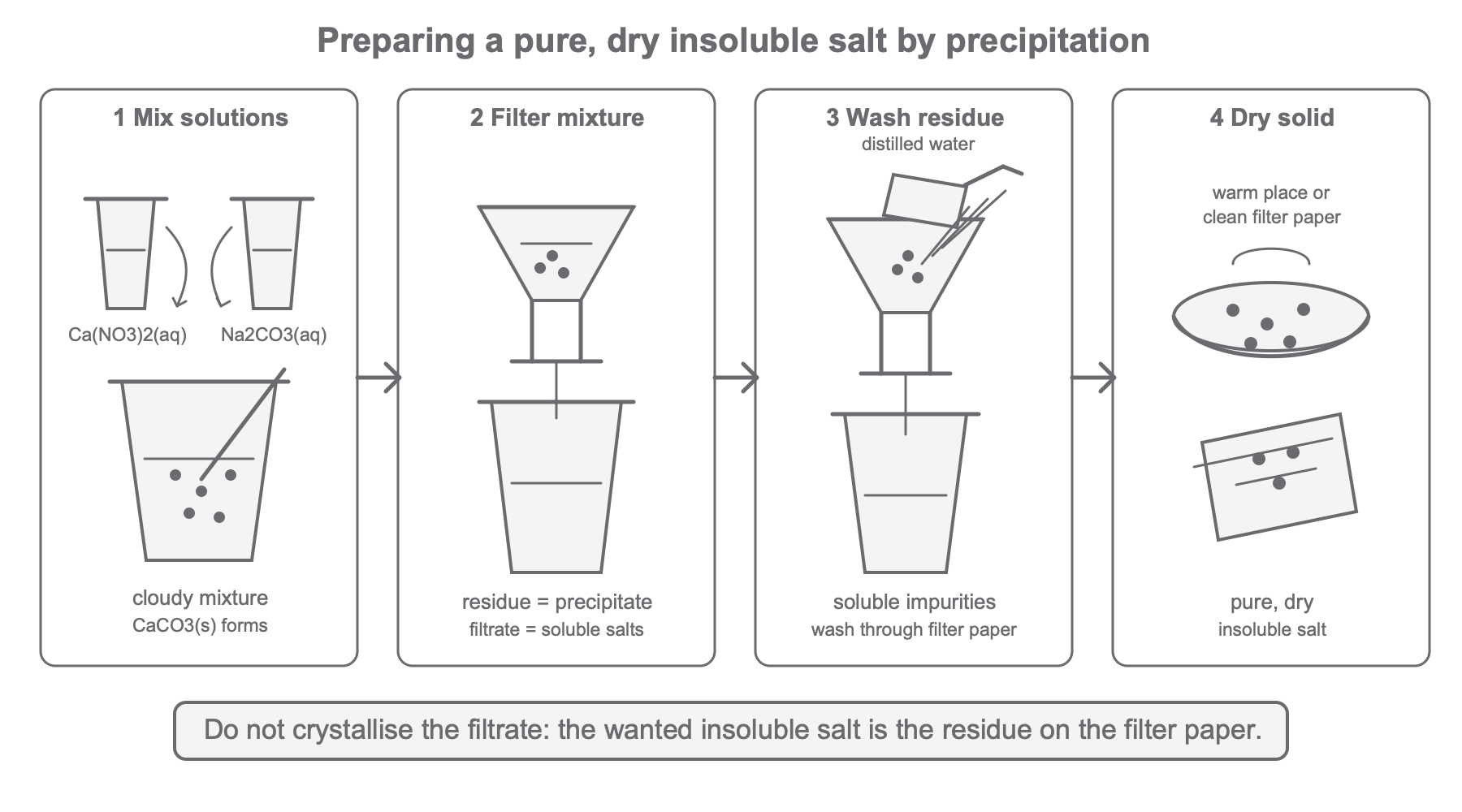
The wash step matters. The wet precipitate is coated with solution, which contains soluble salts and possibly excess soluble reactant. Distilled water rinses those soluble impurities through the filter paper. Drying then removes water from the washed solid.
Continue this lesson.
You’re previewing NovaLearn without an account. Create a free account to read the rest.
Create free account