5.10C - Calculating concentrations and volumes from titrations
A titration gives an accurate reacting volume: the volume of one solution needed to exactly react with a fixed volume of another solution. In this lesson, you use those results to calculate either an unknown concentration or an unknown volume required. This separate Chemistry point is Higher tier only. Follow the balanced-equation ratio as well as the concentration and volume units.
What a titration result tells you
In an acid-alkali titration, a measured volume of one solution is placed in a conical flask using a pipette. The other solution is added from a burette until the indicator shows the end point. The titre is the volume delivered from the burette.
Concordant titres are accurate titres within the stated tolerance. Exclude the rough trial and any result outside that close group, then add the selected titres and divide by their number.
For calculation questions, the experimental method is usually already done. Your job is to use the useful result, usually a mean titre from concordant accurate titres, rather than a rough trial.
Titre
The titre is the volume of solution added from the burette to reach the end point in a titration.
A titration calculation always depends on the balanced equation. If the equation shows a 1:1 ratio, the reacting amounts in moles are equal. If the equation shows a 1:2 ratio, one substance reacts with twice as many moles of the other substance.
For example:
| Balanced equation | Mole ratio used in the calculation |
|---|---|
| 1 mol HCl reacts with 1 mol NaOH | |
| 1 mol H2SO4 reacts with 2 mol NaOH |
Relationships and units
The main relationship is the same concentration relationship used for solutions:
Moles in a solution
where:
| Symbol | Meaning | Unit needed in this relationship |
|---|---|---|
n | amount of substance | mol |
c | concentration | mol dm^-3 |
V | volume | dm^3 |
Titration volumes are usually measured in , but the calculation needs .
Volume conversion
So and .
You may also need rearranged forms:
| Unknown | Relationship to use |
|---|---|
| moles | |
| concentration | |
| volume |
Use the full calculator value through the working. Round only at the final answer, unless the question asks for a particular number of significant figures or decimal places.
Calculation route
Most titration calculations follow the same route. Start with the solution where both the concentration and the reacting volume are known. Use to calculate its moles. Then use the mole ratio from the balanced equation to find the moles of the unknown solution.
[DIAGRAM: titration_calculation_route: Titration calculation route - diagram 1; asset_slug: 129_5_10c_titration_calculations_for_unknown_concentration_or_volume_diagram1; file: diagram_assets/129_5_10c_titration_calculations_for_unknown_concentration_or_volume_diagram1.png; recommended_method: deterministic_drawn; description: Monochrome flow diagram showing how titration results lead from mean titre, cm3 to dm3 conversion, known solution moles using n = c x V, balanced-equation mole ratio, then either c = n / V for unknown concentration or V = n / c for unknown volume. Assessed/exact calculation route; all formulae are also explained in nearby prose for accessibility.]
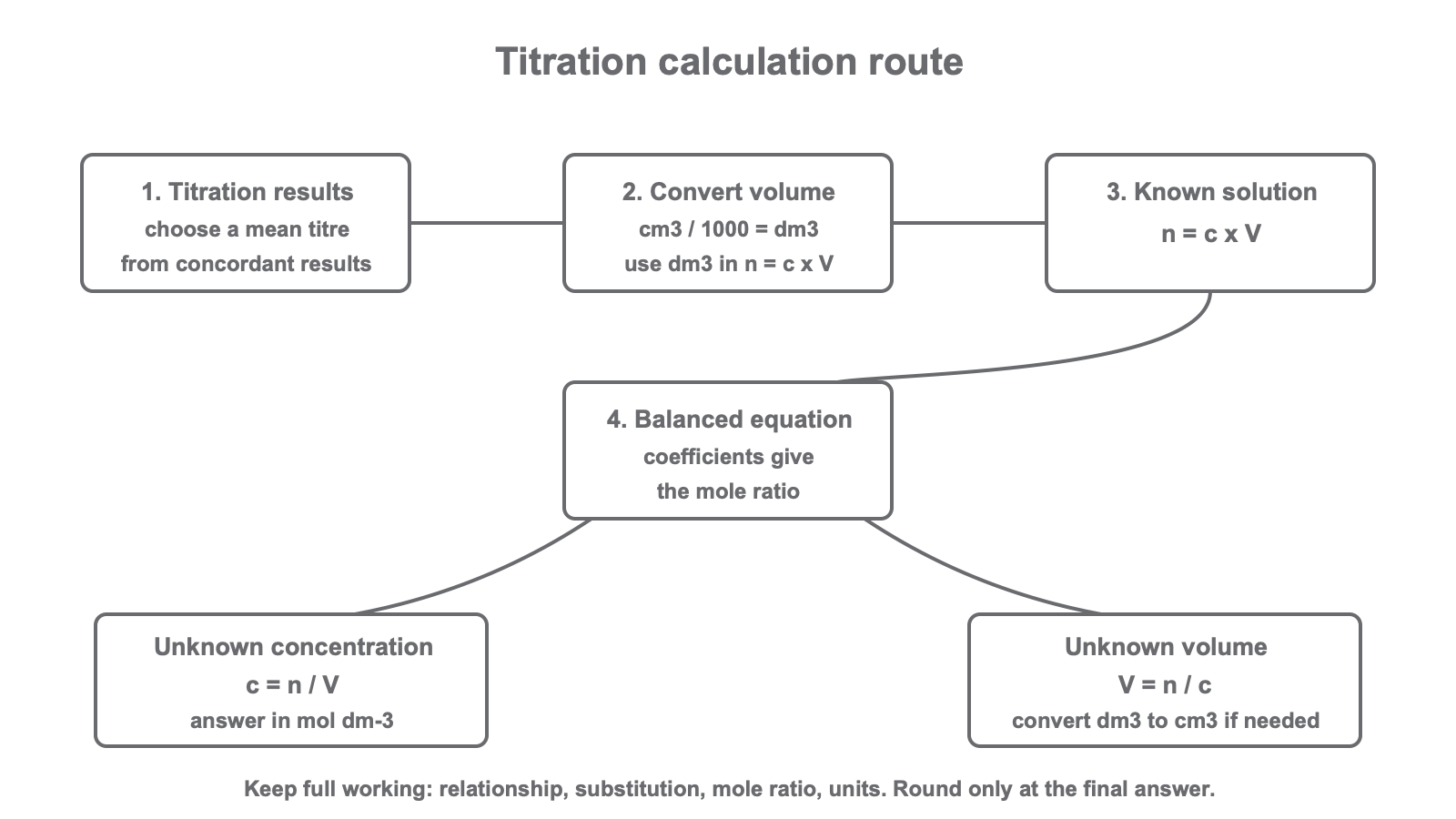
A reliable written method is:
- Write or use the balanced equation.
- Convert any volume in into .
- Calculate moles of the solution with known concentration and known volume.
- Use the mole ratio to find moles of the other solution.
- Calculate the unknown concentration using , or the unknown volume using .
- Give the final answer with the correct unit.
Do not use automatically. It only works directly for a 1:1 reaction; the safer Edexcel method is to go through moles and the balanced-equation ratio.
Edexcel calculation habits
For Calculate questions, show enough working that the method can be followed. A correct final answer may gain credit, but clear working protects you if you make one arithmetic slip because later correct steps can often be credited using error carried forward.
Strong titration calculation answers usually include:
Continue this lesson.
You’re previewing NovaLearn without an account. Create a free account to read the rest.
Create free account