5.20C - How quickly equilibrium is reached
Higher tier. Learn how temperature, reacting-particle concentration, gas compression and catalysts affect how quickly equilibrium is approached, while keeping rate separate from equilibrium yield.
Time to reach equilibrium
In a closed system at dynamic equilibrium, the forward and reverse reactions are still happening, but their rates are equal. The rate of attainment of equilibrium is about the time taken to get to that balanced state.
Rate of attainment of equilibrium
The rate of attainment of equilibrium is how quickly a reversible reaction reaches dynamic equilibrium.
A faster rate of attainment means the mixture reaches equilibrium in a shorter time. A slower rate of attainment means it takes longer.
[DIAGRAM: asset_name: rate_attainment_graph; asset_slug: 139_5_20c_rate_of_attainment_of_equilibrium_is_affected_by_a_changes_in_temperature_diagram1; file: 139_equilibrium_attainment_checked.png; recommended_method: plotted_data; description: Exact plot of the illustrative lesson table. Experiment 2 reaches a recorded product amount of 0.80 at 80 s; experiment 1 reaches 0.80 at 140 s. Both remain at the same recorded amount. Axes show seconds and arbitrary amount units; points are connected without curve overshoot.]
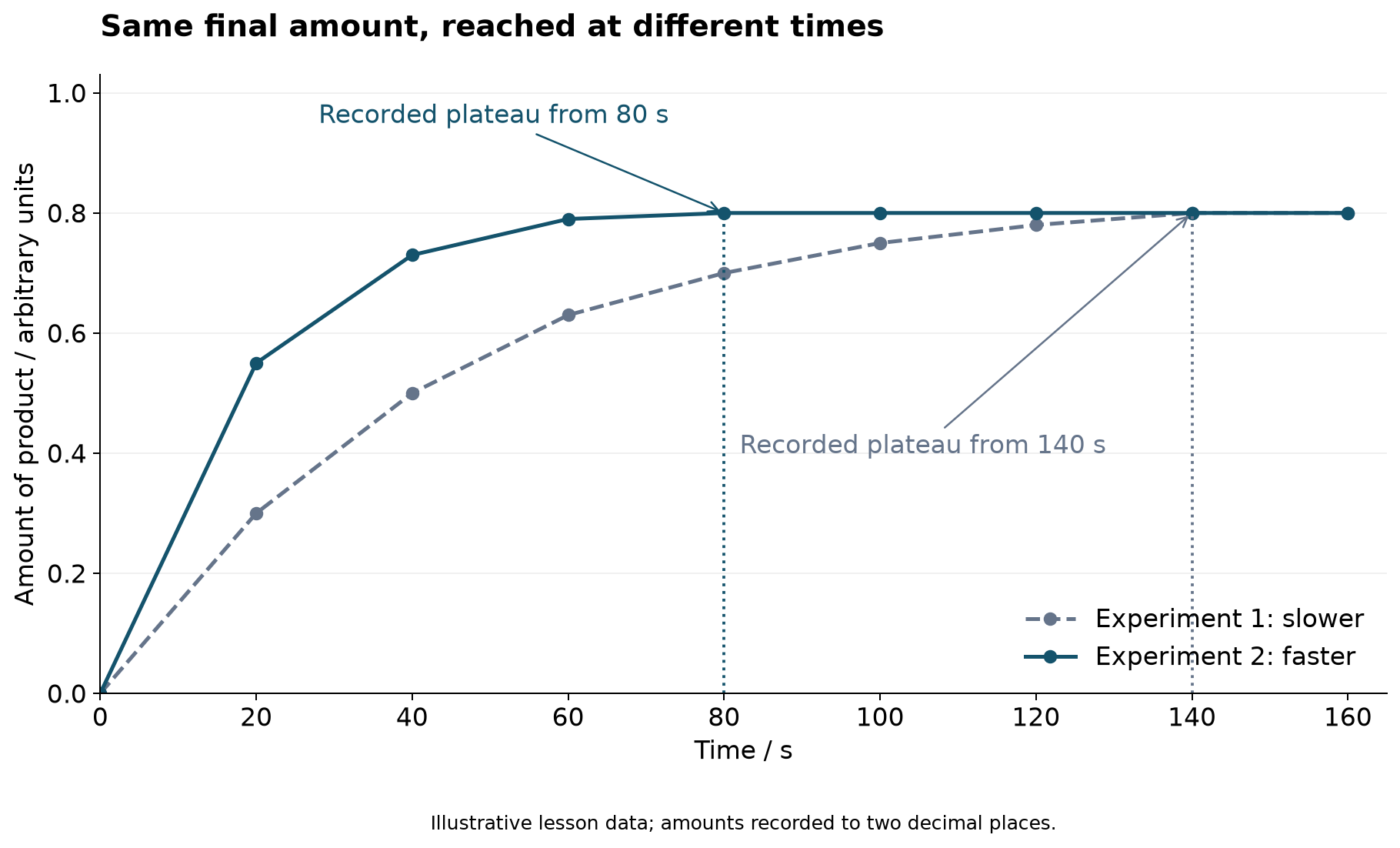
The graph uses the illustrative measurements discussed later in the lesson. It does not say that every condition change gives the same final amount of product. It only shows the rate idea: one mixture reaches its equilibrium plateau sooner. For catalysts, the final equilibrium position is unchanged; for temperature, pressure and concentration, the final position may also change, but that is a different prediction from the rate prediction.
Changing temperature
Increasing temperature usually makes equilibrium be reached faster. Particles have more kinetic energy, so they move faster. They collide more often, and a greater proportion of collisions have enough energy to react.
In a reversible reaction, both the forward and reverse reactions can happen. Increasing temperature increases the rates of both directions, so the mixture reaches equilibrium in a shorter time.
Decreasing temperature has the opposite effect. Particles move more slowly, there are fewer successful collisions each second, and equilibrium is reached more slowly.
Temperature can also change the equilibrium position, and therefore the equilibrium yield. Faster attainment and a larger final amount of product are separate predictions.
Pressure and concentration
Increasing the concentration of reacting particles means more particles per unit volume. They collide more often, so the relevant reaction is faster. Decreasing concentration has the opposite effect.
For gases, compression at constant temperature puts the same particles into a smaller volume. Their concentrations and pressure increase, collisions become more frequent, and equilibrium is generally approached faster. Increasing total pressure by adding an unreactive gas at constant volume does not increase the concentrations of the reacting gases; this is not the compression described here.
Continue this lesson.
You’re previewing NovaLearn without an account. Create a free account to read the rest.
Create free account