6.10 - Hydrogen halides and acidic solutions
Learn how halogens form hydrogen halides and why dissolving a hydrogen halide in water produces an acidic solution.
Forming hydrogen halides
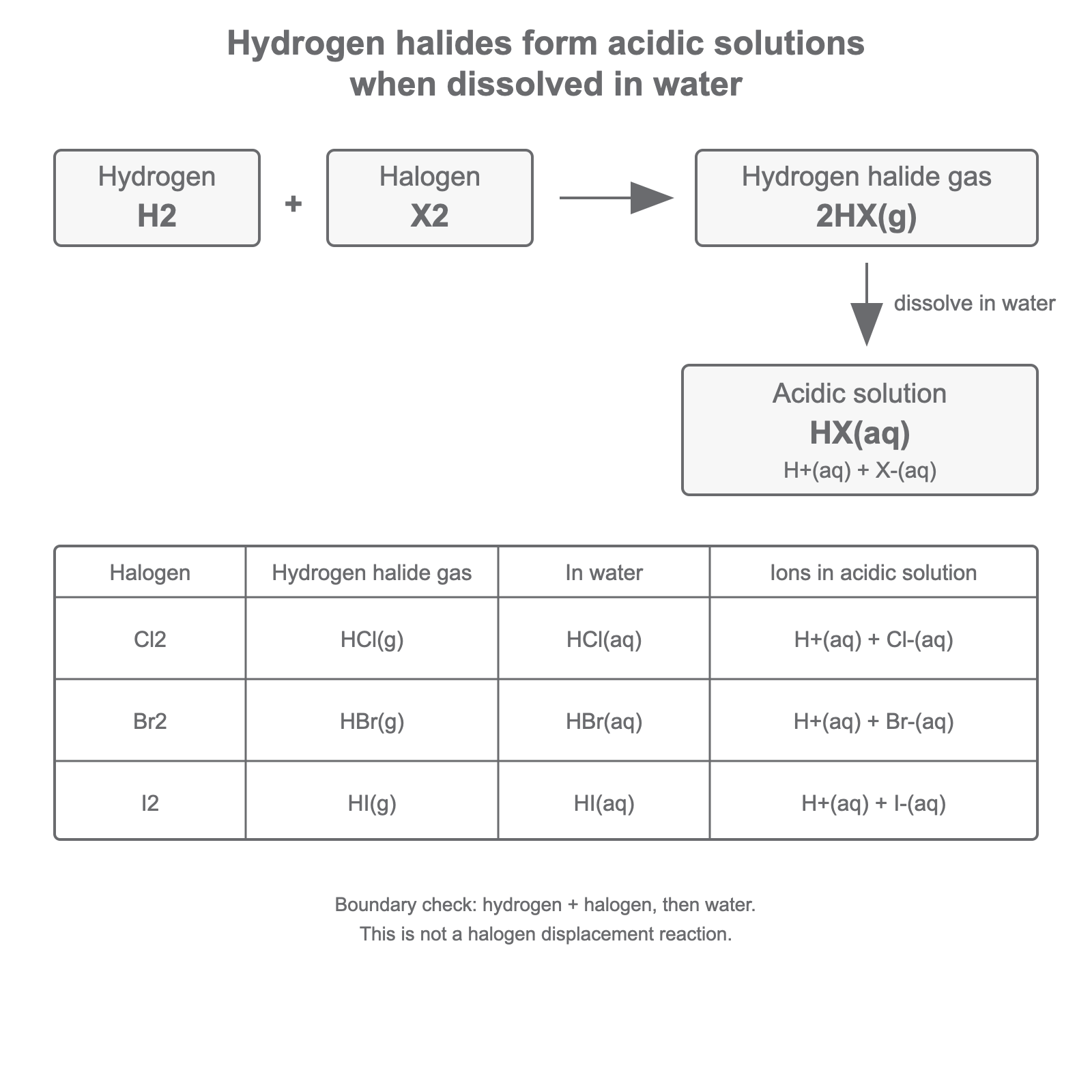
A hydrogen halide contains hydrogen and a halogen. Its formula is HX, where X represents the halogen.
| Halogen | Hydrogen halide |
|---|---|
| Chlorine, Cl2 | Hydrogen chloride, HCl |
| Bromine, Br2 | Hydrogen bromide, HBr |
| Iodine, I2 | Hydrogen iodide, HI |
Hydrogen and the halogens have diatomic molecules. The formation pattern is H2 + X2 → 2HX: two hydrogen atoms and two halogen atoms on each side. For example:
Reaction conditions differ between halogens; this pattern describes the products, not a claim that all react at room temperature. For heated hydrogen and iodine vapour, the reaction is reversible:
The gas symbol for iodine here refers to the heated vapour, not iodine's room-temperature state.
From hydrogen halide to acidic solution
Hydrogen chloride gas, HCl(g), consists of molecules. Dissolving it in water produces hydrochloric acid, HCl(aq). The solution contains hydrogen ions, H+(aq), and chloride ions, Cl−(aq).
[DIAGRAM: asset_name: hydrogen_halide_to_acidic_solution_flow: Hydrogen halide to acidic solution flow - diagram 1; asset_slug: 156_6_10_hydrogen_halides_and_acidic_solutions_diagram1; file: diagram_assets/156_6_10_hydrogen_halides_and_acidic_solutions_diagram1.png; recommended_method: deterministic_drawn; description: Exact monochrome flow diagram showing the Edexcel 6.10 pattern: halogen molecule X2 reacts with hydrogen H2 to form hydrogen halide HX(g), then HX(g) dissolves in water to form HX(aq), an acidic solution containing H+(aq) and X-(aq). Include example rows for Cl2/HCl/Cl-, Br2/HBr/Br-, and I2/HI/I-. Deterministic drawing is required because formulae, charges, state symbols and the gas-to-aqueous distinction are assessed; no displacement arrows or halide-solution displacement reactions.]
Continue this lesson.
You’re previewing NovaLearn without an account. Create a free account to read the rest.
Create free account