4.7 - Choosing a metal extraction method
Use the reactivity series to decide whether a metal oxide can be reduced with carbon or needs electrolysis. Compare iron and aluminium, and explain why energy cost matters when choosing a method.
Carbon as the comparison point
Extraction obtains a metal from its ore. When the metal is present as a compound, reduction is needed to obtain the element. More reactive metals tend to form more stable compounds, making reduction harder.
Compare the metal with carbon in the reactivity series:
- A metal below carbon can often be obtained from its oxide by heating with carbon.
- A metal above carbon cannot be extracted from its oxide by carbon reduction. Electrolysis is used for metals such as aluminium.
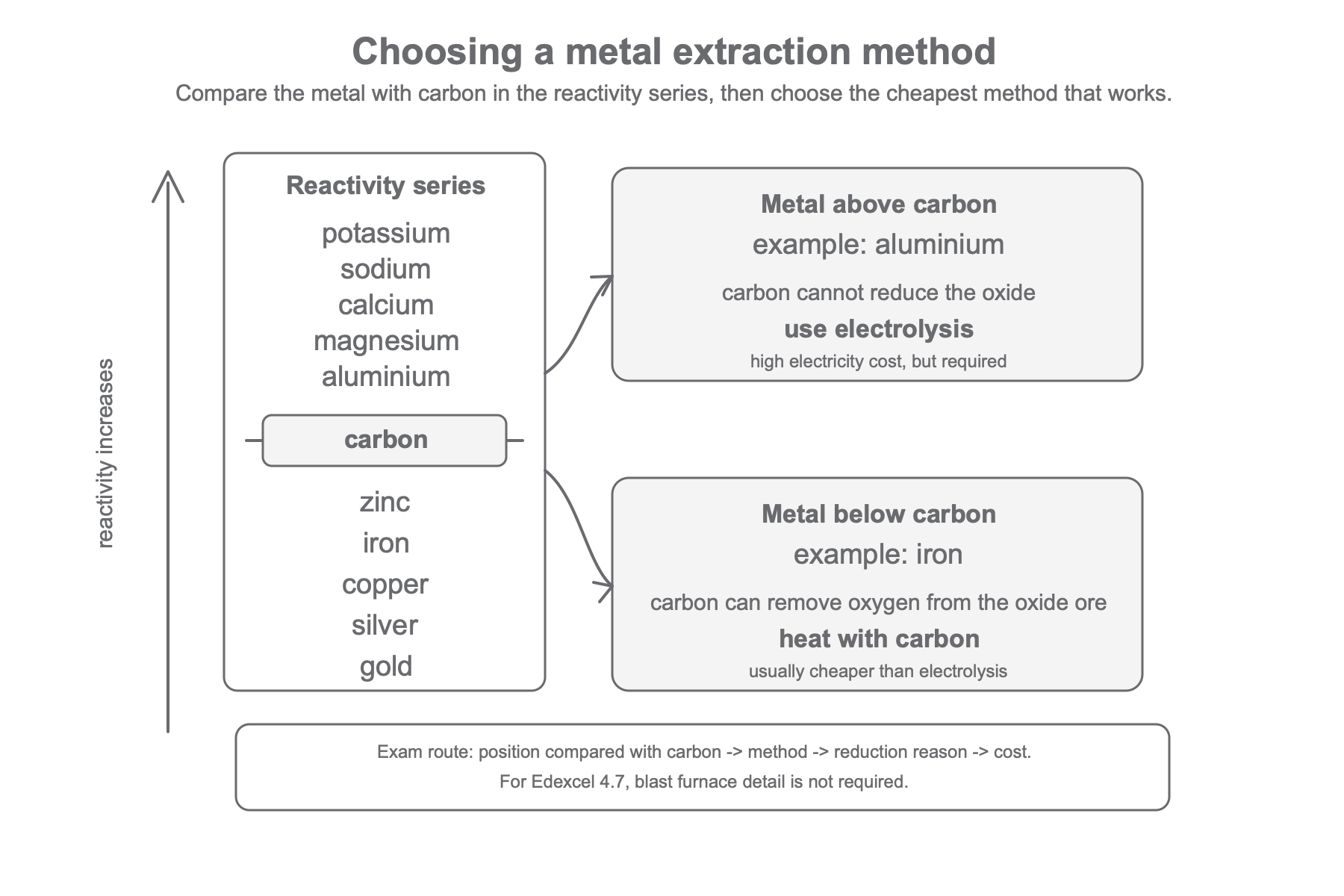
This is a guide to extraction from compounds. Native gold is already the uncombined metal, so it does not need reduction from an oxide. Method choice also considers the actual ore, purity required and cost; the diagram summarises the carbon/electrolysis comparison.
Iron: reduction using carbon
Iron is less reactive than carbon. When iron oxide is heated with carbon, carbon can remove oxygen from the oxide, producing iron. A simplified word equation is:
iron oxide + carbon → iron + carbon dioxide
Carbon reduction can produce carbon monoxide or carbon dioxide depending on conditions; carbon monoxide can also reduce iron oxide. The shared idea is oxygen removal from the oxide, not that every furnace reaction has one fixed equation.
Continue this lesson.
You’re previewing NovaLearn without an account. Create a free account to read the rest.
Create free account