9.14C - Addition reaction of ethene with bromine
Follow what happens when bromine adds to ethene, then use the same bond changes to predict products from other alkenes. You will track both atom conservation and where each bromine atom attaches. This is a separate Chemistry point.
How bromine adds across C=C
In an addition reaction, two reactant molecules join to form one product, with no atoms lost as a smaller molecule. Bromine is : two Br atoms joined by a single bond.
During bromine addition to an alkene, the C=C double bond becomes a C–C single bond. The Br–Br bond breaks and a new C–Br bond forms at each of the two carbons originally in C=C. The carbon atoms stay connected. All the original carbon and hydrogen atoms remain.
For ethene:
ethene + bromine → 1,2-dibromoethane
CH2=CH2 + Br2 → BrCH2–CH2Br
[DIAGRAM: asset_name: ethene_bromine_addition_structure: Ethene bromine addition structures - diagram 1; asset_slug: 218_9_14c_addition_reaction_of_ethene_with_bromine_diagram1; file: 218_9_14c_addition_reaction_of_ethene_with_bromine_diagram1.png; recommended_method: deterministic_drawn; description: Exact monochrome deterministic structural reaction diagram for Pearson Edexcel GCSE Chemistry 1CH0 9.14C. It shows ethene with all covalent bonds and a C=C double bond, bromine as Br-Br, an arrow to 1,2-dibromoethane with a C-C single bond and one Br atom attached to each carbon. Labels required: ethene, bromine, 1,2-dibromoethane, C=C opens, one Br added to each carbon. The diagram is assessed structural support, so it must be deterministic and monochrome. Colour-change information is taught in nearby prose and not by colouring the asset.]
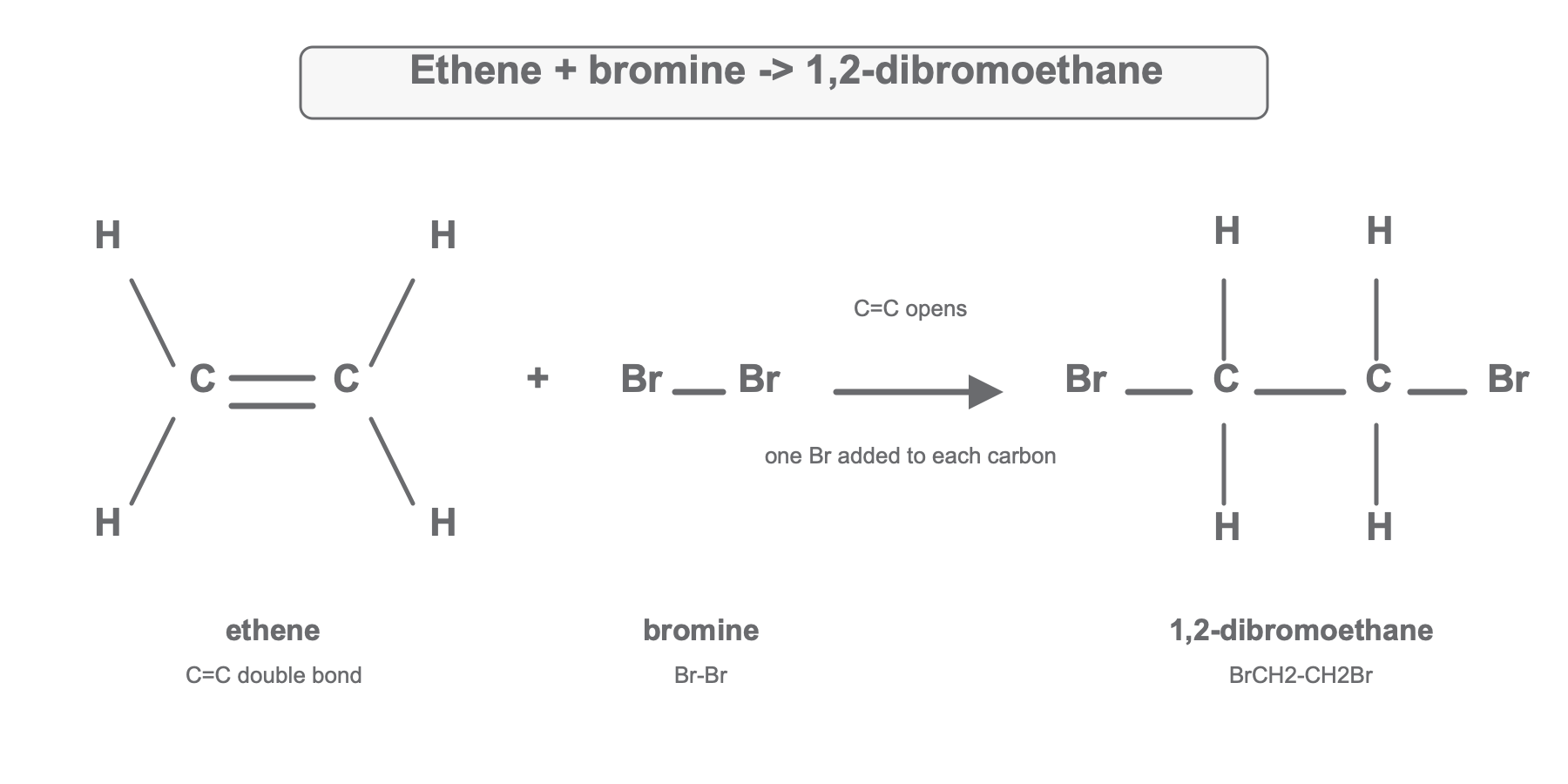
The figure’s phrase “C=C opens” means its bond order changes from double to single; it does not mean the carbon chain splits. Each product carbon has two C–H bonds, one C–C bond and one C–Br bond: four bonds in total.
Continue this lesson.
You’re previewing NovaLearn without an account. Create a free account to read the rest.
Create free account