6.4 - Comparing alkali-metal reactivity
Use observations to compare lithium, sodium and potassium, then extend the Group 1 reactivity trend to another alkali metal. Also consider what makes a comparison of demonstrations convincing.
Reading the reactivity pattern
Under similar conditions, the reactions with water become more vigorous in the order lithium < sodium < potassium. Lithium reacts least vigorously of these three; potassium reacts most vigorously of these three.
[DIAGRAM: asset_name: alkali_metal_water_reactivity_trend: Alkali metal water reactivity trend - diagram 1; asset_slug: 150_6_4_pattern_in_reactivity_of_the_alkali_metals_lithium_sodium_and_potassium_wi_diagram1; file: 150_6_4_pattern_in_reactivity_of_the_alkali_metals_lithium_sodium_and_potassium_wi_diagram1.png; recommended_method: deterministic_drawn; description: Exact monochrome trend diagram for Edexcel 6.4 showing three water-trough panels in vertical Group 1 order: lithium at the top with gentle fizzing, sodium below with faster fizzing and more movement, and potassium below with very vigorous reaction and possible ignition. A downward arrow states increasing reactivity with water. Deterministic drawing is required because the labels and sequence are assessed specification content.]
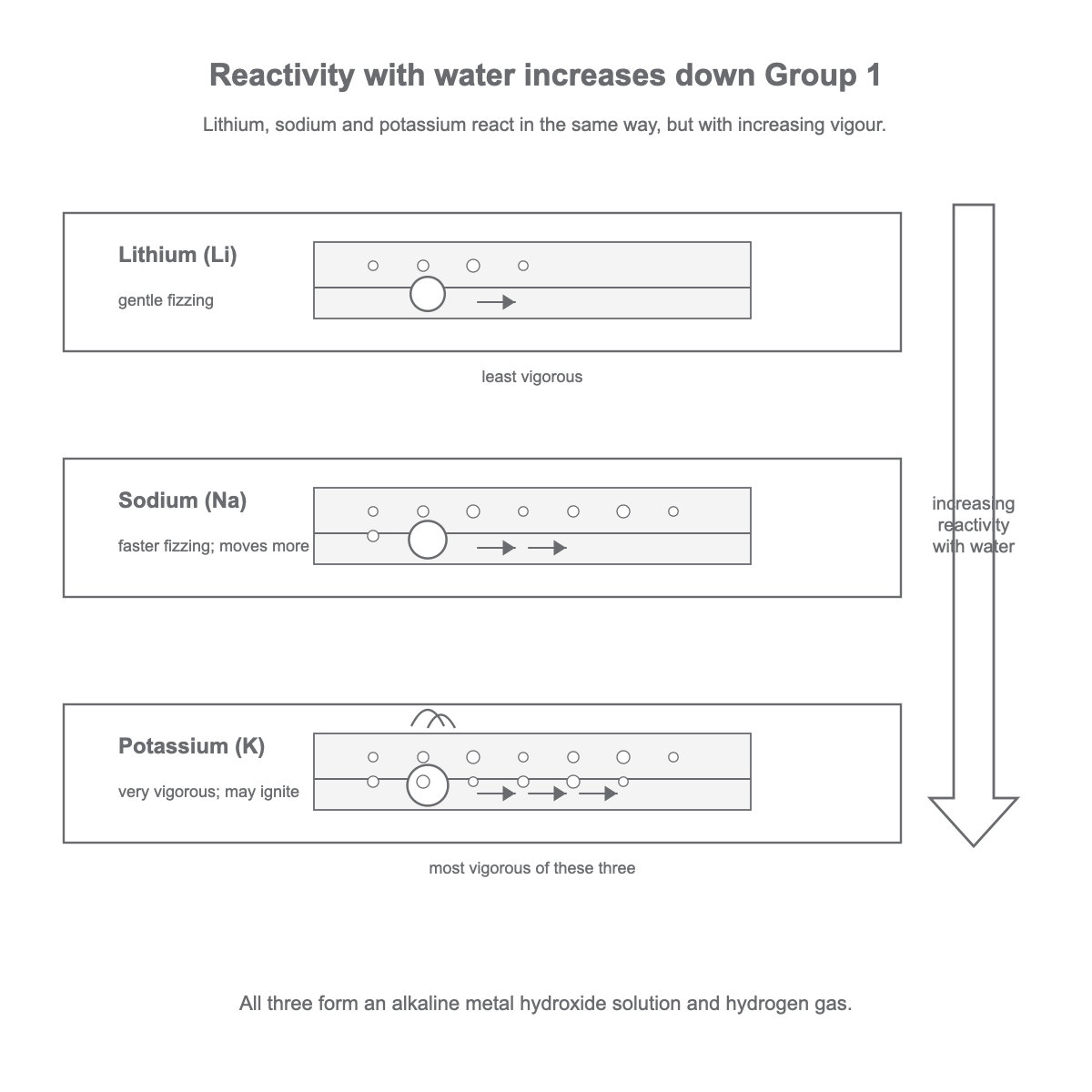
Faster fizzing shows that gas is forming more rapidly. Faster movement and ignition can also indicate a more vigorous reaction. All three metals form hydrogen and an alkaline metal hydroxide solution; the difference is how readily and rapidly they react.
Distinguish the rate of heat release from the total heat released. A vigorous reaction releases energy quickly; a large amount of a slower-reacting metal may release more energy overall. Neither the total amount of bubbles nor total heat alone is a fair measure of reactivity.
Continue this lesson.
You’re previewing NovaLearn without an account. Create a free account to read the rest.
Create free account