8.12 - Sulfur dioxide and acid rain
Follow how sulfur dioxide contributes to acid rain and why lower pH can damage ecosystems and materials.
From gas to acidic rain
Sulfur dioxide, SO₂, can dissolve in water droplets and make them acidic. Reactions involving water and oxygen in the atmosphere can also form acids from SO₂. Rain carrying this additional acidity has a lower pH than normal rain: acid rain.
Normal rain is already slightly acidic, partly because carbon dioxide dissolves in it. Acid rain means extra acidity, not simply any rain with pH below 7. Here we focus on sulfur dioxide as the pollutant source.
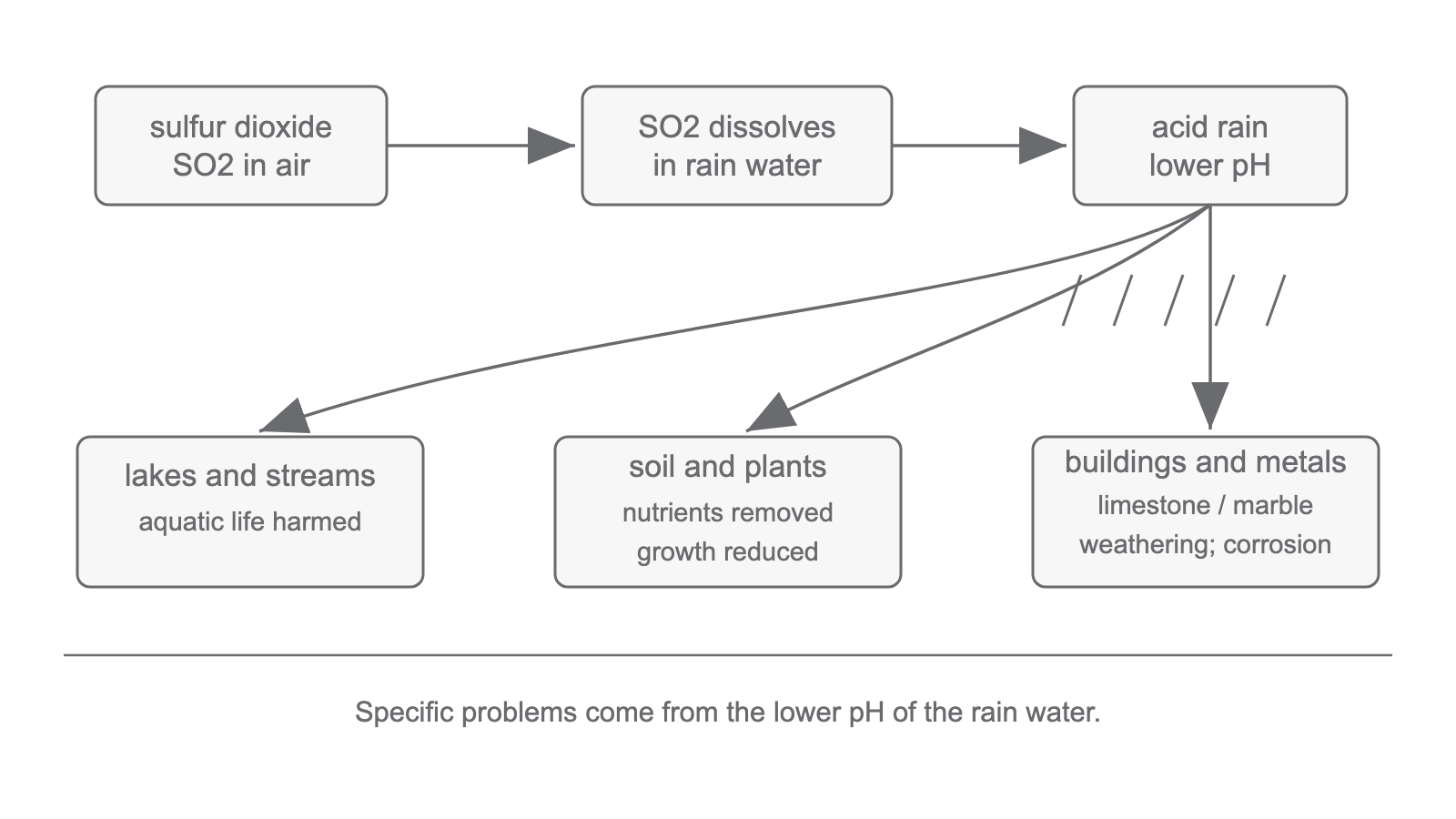
[DIAGRAM: asset_name: Acid rain cause and effects - diagram 1; asset_slug: 190_8_12_some_problems_associated_with_acid_rain_caused_when_sulfur_dioxide_dissolv_diagram1; file: 190_8_12_some_problems_associated_with_acid_rain_caused_when_sulfur_dioxide_dissolv_diagram1.png; recommended_method: deterministic_drawn; description: Monochrome flow diagram showing the exact Edexcel 8.12 chain. Labels: "sulfur dioxide, SO2, in air"; "SO2 dissolves in rain water"; "acid rain: lower pH"; three branches labelled "lakes and streams: aquatic life harmed", "soil and plants: nutrients removed, growth reduced", and "buildings and metals: limestone/marble weathering, metal corrosion". Deterministic drawing is required because the labels and direction of cause-and-effect are assessed. White background with #6A6B6E linework, arrows and text. Accessibility: the nearby prose explains each branch fully.]
Water, soil and living things
When acidic rain or runoff enters a lake, it can lower the water's pH. Fish, eggs and other organisms tolerate only a limited pH range. Conditions outside that range can reduce survival and disrupt food webs.
Continue this lesson.
You’re previewing NovaLearn without an account. Create a free account to read the rest.
Create free account