4.8 - Biological methods of metal extraction
Evaluate bacterial extraction and phytoextraction as ways of obtaining metals from low-grade sources. This Higher-tier lesson explains both routes, why a final chemical step is needed, and how to weigh speed, yield and environmental risks.
Why Biological Methods Are Used
Most metals are extracted from ores, but not every ore is worth treating by a traditional method. A low-grade ore contains a relatively low concentration of the metal or metal compound wanted. If a company has to dig up, heat, crush and transport huge masses of rock to obtain a small mass of metal, the process may be too expensive or environmentally damaging.
Low-grade ore
A low-grade ore is an ore that contains a low percentage of the useful metal or metal compound.
Biological extraction methods use living organisms as part of the extraction route. Two examples are:
- bacterial extraction, often called bioleaching
- phytoextraction, often called phytomining in GCSE resources
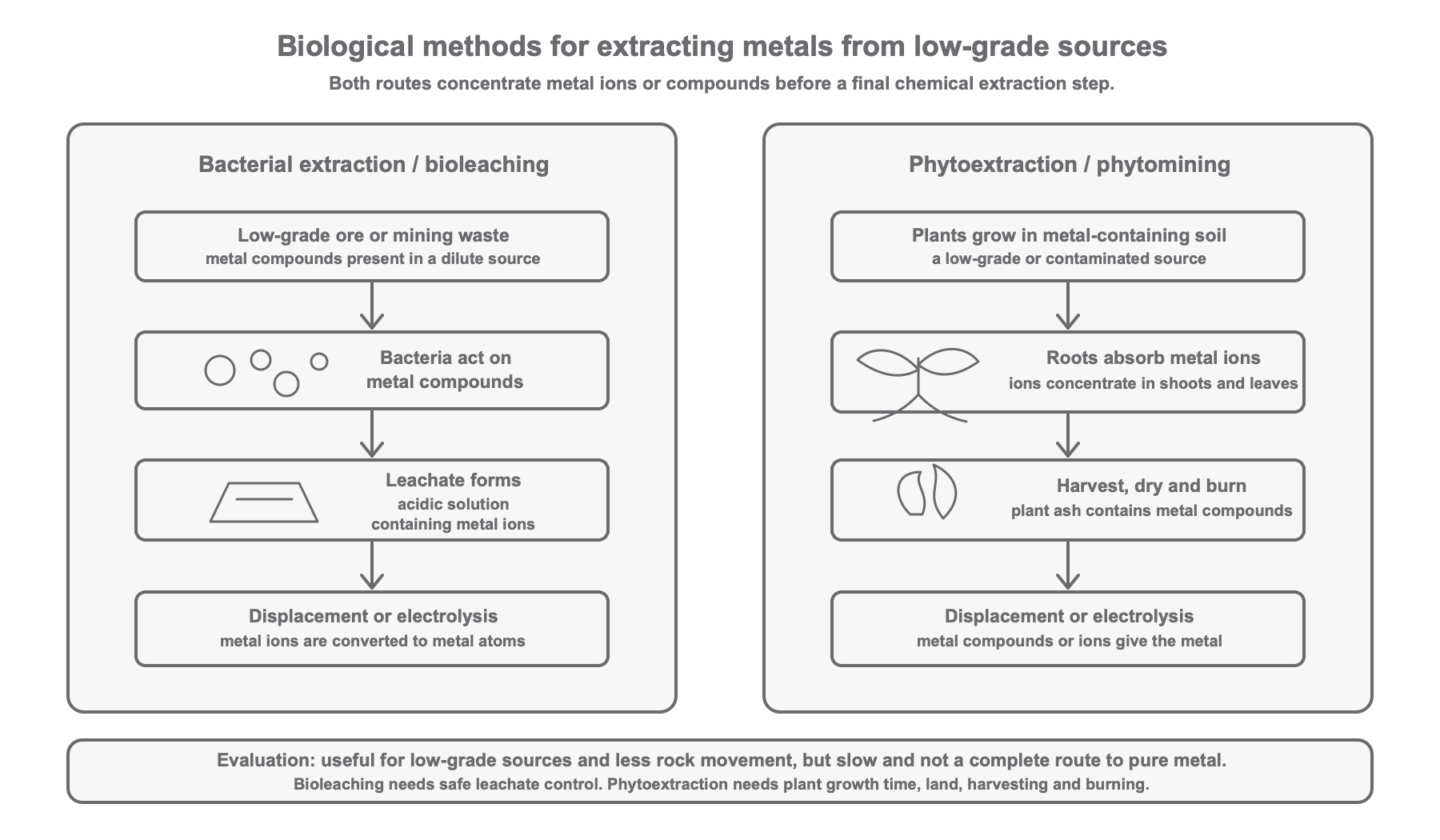
These methods are usually taught using copper because copper can be extracted from low-grade ores and mining waste. Do not treat the biological method as the whole extraction. The biological stage helps recover metal ions or concentrate metal compounds; a final chemical step is still needed to obtain the metal.
Bacterial Extraction
Bacterial extraction uses bacteria to help break down metal compounds in low-grade ore or mining waste. The bacteria carry out reactions that produce an acidic solution containing dissolved metal ions. This solution is called leachate.
Leachate
Leachate is a solution formed when a liquid passes through a material and dissolves substances from it. In bacterial metal extraction, the leachate contains metal ions.
For copper extraction, the useful ion in the leachate may be copper(II), written as Cu²⁺. The leachate is not pure copper metal. The copper ions must still be reduced to copper atoms, for example by displacement using a more reactive metal such as iron or by electrolysis.
The strength of bacterial extraction is that it can treat ores or waste with too little metal for normal mining routes to be attractive. It also does not require the high temperatures associated with some extraction methods. The weaknesses are important: it can be slow, the leachate is acidic, and the liquid must be contained and treated so dissolved substances do not escape into the environment.
Phytoextraction
Phytoextraction uses plants. Some plants absorb metal ions from soil through their roots. The ions are transported through the plant and become concentrated in tissues such as shoots and leaves.
Phytoextraction
Phytoextraction is a biological extraction method in which plants absorb metal ions from soil and concentrate them in their tissues.
The general route is:
- Grow suitable plants on soil containing the metal compound.
- Let the plants absorb metal ions through their roots.
- Harvest, dry and burn the plant material.
- Use the ash, which contains a higher concentration of metal compounds than the original soil.
- Treat the ash to dissolve the metal compounds, then extract the metal from the resulting solution by displacement or electrolysis where suitable.
The plant stage is a concentration step. It moves metal from a very dilute source into a smaller mass of plant ash or treated solution. That is why phytoextraction can be useful where the original ore or soil is too low-grade for a normal extraction route.
The main disadvantage is speed: plants take time to grow, and the process may need large areas of land. Harvesting, drying, transport and burning also require resources. Burning releases carbon dioxide, while growth takes up carbon dioxide; the net climate impact depends on the whole process rather than either fact alone.
Continue this lesson.
You’re previewing NovaLearn without an account. Create a free account to read the rest.
Create free account