3.24 - Ion movement during electrolysis
Use ion charges and the connections to a DC supply to explain which way ions move during electrolysis.
Opposite charges determine movement
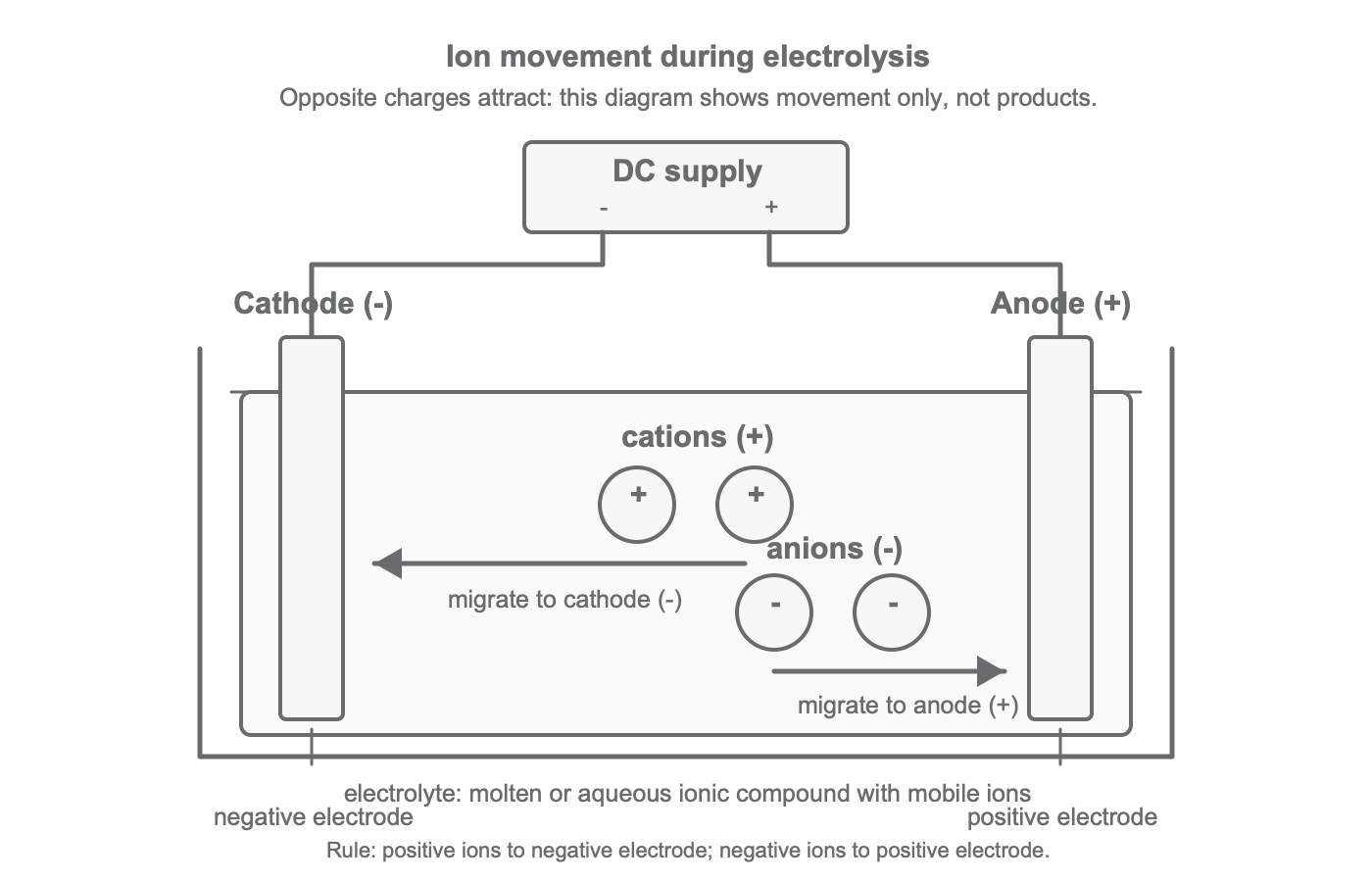
A cation is a positive ion; an anion is a negative ion. In an electrolyte these ions are free to move. The DC supply establishes opposite charges on the two electrodes.
| Connection to supply | Electrode in electrolysis | Ions attracted |
|---|---|---|
| Negative terminal | Cathode (negative) | Cations (positive) |
| Positive terminal | Anode (positive) | Anions (negative) |
Opposite charges attract. A positive ion therefore migrates towards the negative cathode, and a negative ion towards the positive anode. Migrate means move through the electrolyte. The ions do not travel through the metal leads; electrons carry charge there.
[DIAGRAM: asset_name: ion_movement_electrolysis_cell: Ion movement to electrodes during electrolysis - diagram 1; asset_slug: 095_3_24_ion_movement_during_electrolysis_diagram1; file: diagram_assets/095_3_24_ion_movement_during_electrolysis_diagram1.png; recommended_method: deterministic_drawn; description: Exact monochrome electrolysis-cell teaching visual for Edexcel 3.24. Shows a DC supply connected to a negative cathode and positive anode in an electrolyte, with cations (+) moving towards the cathode and anions (-) moving towards the anode. Includes labels that this visual shows ion movement only and does not predict products. Deterministic drawing is required because electrode charges, arrow directions and ion labels are assessed details.]
Continue this lesson.
You’re previewing NovaLearn without an account. Create a free account to read the rest.
Create free account