4.10 - Advantages of recycling metals
Recycling keeps useful metals in circulation and can reduce the need for extraction from ores. You will use evidence about energy, costs, environmental effects and available scrap to judge when recycling is advantageous.
Recovering a useful metal
Recycling processes a used material into a useful product again. Metal recycling can involve collection, separation from other materials, melting and reshaping. Reuse keeps an object in use without this remaking: using a steel beam again as a beam is reuse; melting scrap steel to make new beams is recycling.
Metal atoms are not used up when an object is made. Recovering them reduces the amount of new metal needed from ores. Ores are finite resources: their supply is limited and they are not replaced on human timescales.
Recycling cannot necessarily supply all demand. Products may stay in use for years before becoming scrap; some metal is not collected or is lost during processing; mixed or contaminated scrap needs separation. A tonne of recovered metal only replaces a tonne of newly extracted metal if it can serve the same purpose and quality requirements.
Energy, costs and environmental effects
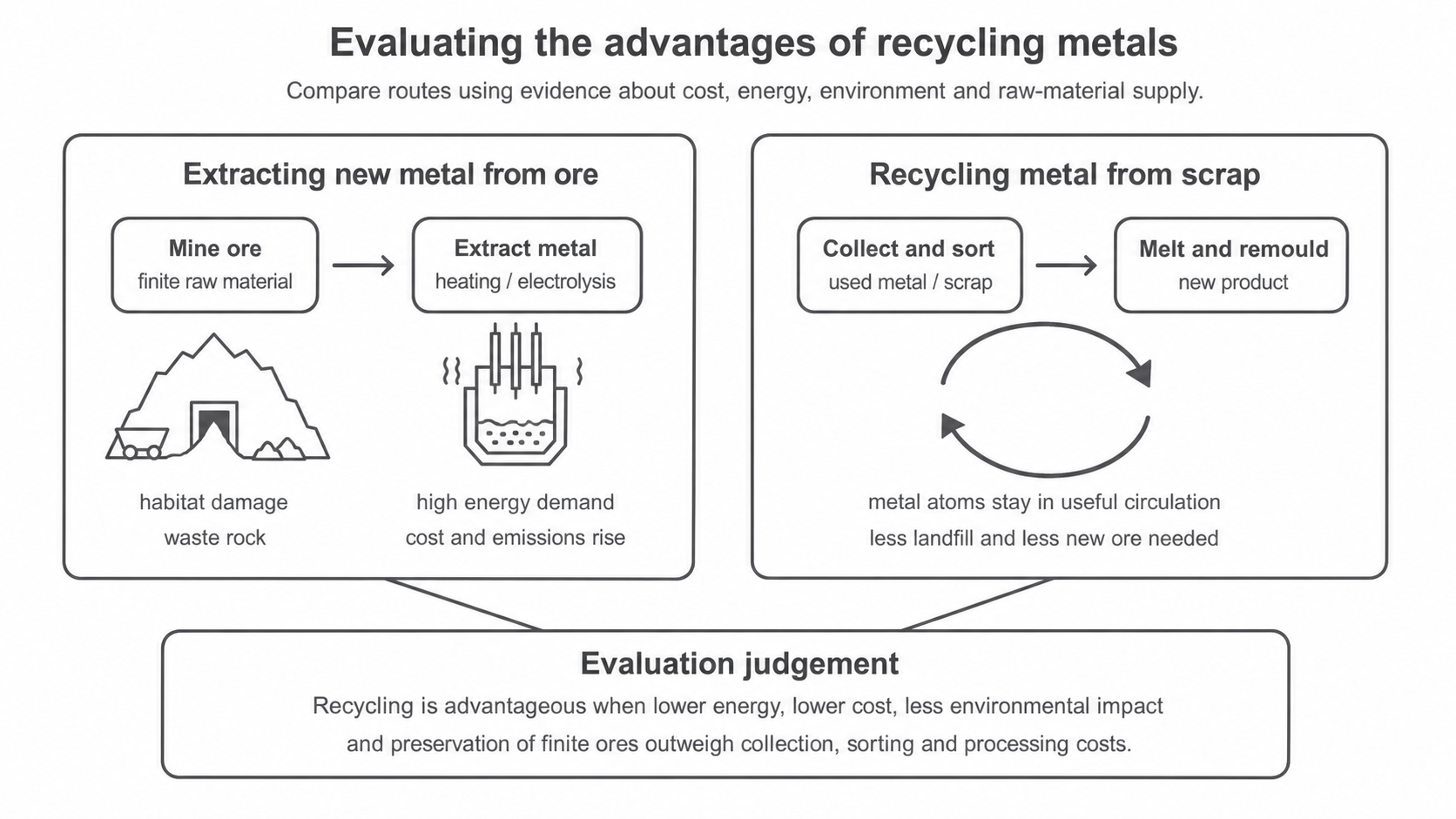
Extracting a metal from ore can involve mining, crushing, transport, heating and chemical reduction or electrolysis. Recycling still needs collection, sorting, transport and processing, but can avoid energy-intensive extraction steps. Aluminium extraction uses electrolysis; suitable aluminium scrap can instead be melted and reshaped.
Lower energy demand can reduce fuel or electricity costs. It does not prove that the whole process is cheaper: compare all relevant costs, including collecting and separating the scrap.
[DIAGRAM: asset_name: recycling_vs_extraction_evaluation: Recycling metals compared with extracting metals from ores - diagram 1; asset_slug: 112_4_10_advantages_of_recycling_metals_diagram1; file: 112_4_10_advantages_of_recycling_metals_diagram1_imagegen_v1.png; recommended_method: deterministic_drawn; description: Exact monochrome comparison flow diagram for Edexcel 4.10. It contrasts an ore extraction route, labelled mine ore, extract metal, higher energy and more environmental disturbance, with a recycling route, labelled collect and sort scrap, melt and remould, lower energy in many cases and less landfill. A final evaluation box says to use evidence about cost, energy, environmental impact and raw-material supply before making a judgement. Deterministic drawing is used because the labels and comparison arrows carry assessed evaluation content.]
Continue this lesson.
You’re previewing NovaLearn without an account. Create a free account to read the rest.
Create free account