4.2 - Displacement reactions as redox reactions
Explain metal displacement by following electrons. In this Higher-tier lesson, you will identify which atoms lose electrons, which ions gain them, and why these changes happen together.
Atoms and ions in displacement
A more reactive metal can displace a less reactive metal from a solution of its salt. Zinc added to copper(II) sulfate forms zinc sulfate and copper:
Zn(s) + CuSO4(aq) → ZnSO4(aq) + Cu(s)
The zinc starts as neutral metal atoms. Copper starts as Cu²⁺ ions in solution. Sulfate ions remain unchanged: they are spectator ions. Removing them gives the ionic equation:
Zn(s) + Cu²⁺(aq) → Zn²⁺(aq) + Cu(s)
The metal atoms and metal ions change; sulfate does not turn into copper.
Following the electrons
Oxidation and reduction
Oxidation is loss of electrons. Reduction is gain of electrons. A redox reaction includes both changes.
Zinc atoms lose two electrons and form positive ions. Copper(II) ions gain those electrons and become neutral copper atoms:
Oxidation: Zn(s) → Zn²⁺(aq) + 2e⁻
Reduction: Cu²⁺(aq) + 2e⁻ → Cu(s)
Each half-equation conserves charge: the oxidation line has total charge zero on both sides, and the reduction line has total charge zero on both sides. The two electrons lost are exactly the two gained. Adding the half-equations cancels the electrons and gives the ionic equation.
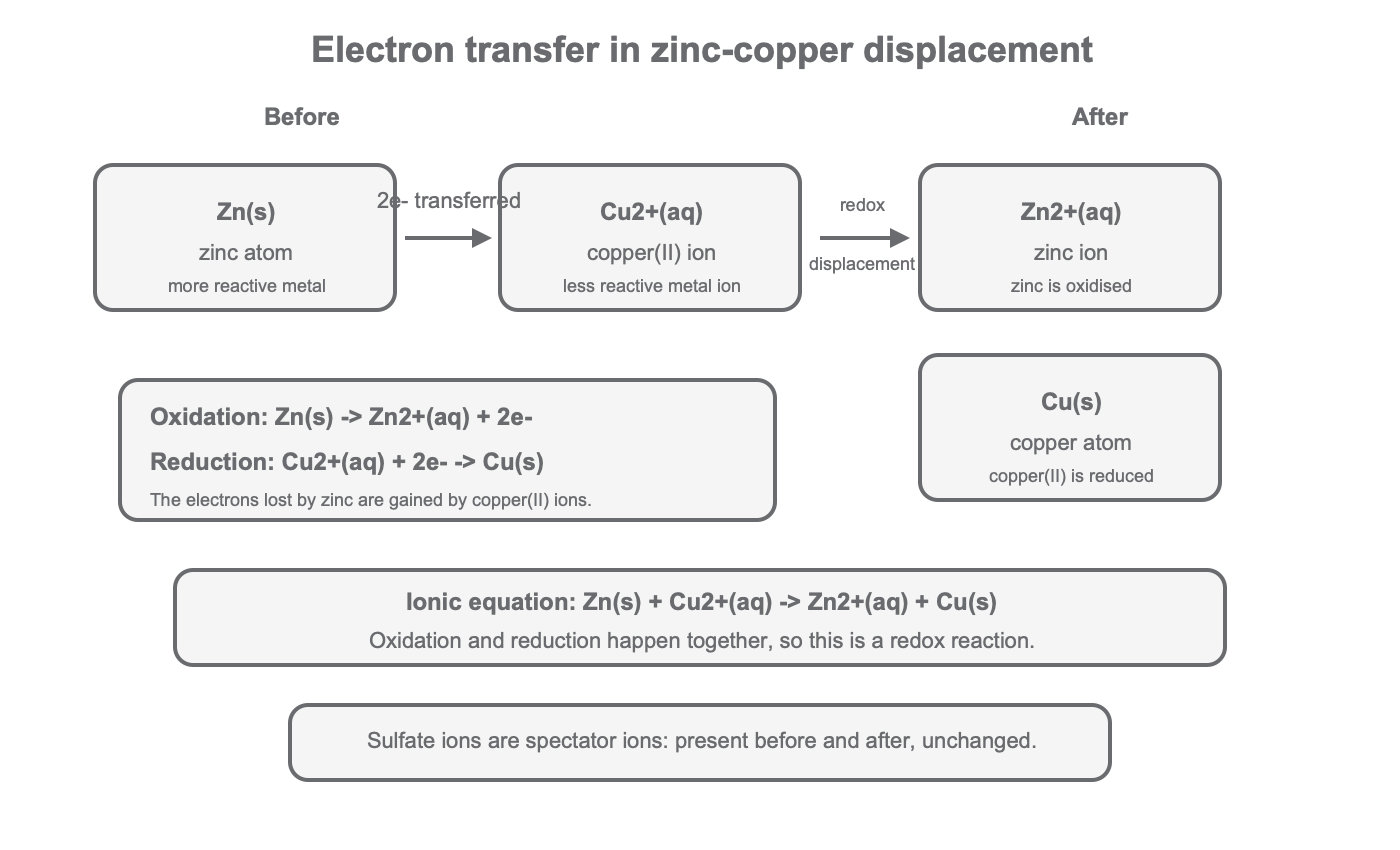
Read the upper diagram as an overall before-and-after summary: zinc becomes zinc ions and copper ions become copper. The electron arrow runs from zinc to copper(II) ions; neither element changes into the other.
Continue this lesson.
You’re previewing NovaLearn without an account. Create a free account to read the rest.
Create free account