2.7 - Separation techniques for mixtures
Mixtures can be separated using differences in physical properties. You will learn how five separation methods work and which kinds of mixtures each method can separate.
Physical differences used in separation
A mixture contains substances that are not chemically joined together. A separation technique does not make a new substance; it uses a physical difference between the substances, such as particle size, solubility, boiling point, or how far a dissolved substance travels with a solvent.
The table connects each method to a physical difference.
[DIAGRAM: asset_name: separation_techniques_matching_map: Separation techniques matching map - diagram 1; asset_slug: 066_2_7_separation_techniques_for_mixtures_diagram1; file: separation_methods_repaired.png; recommended_method: imagegen; description: Five-row property-to-method map: insoluble solid filtration; dissolved solid crystallisation; solvent simple distillation; miscible liquids fractional distillation by repeated evaporation and condensation; soluble dyes chromatography by different travel distances. The adjacent text supplies the same decisions.]
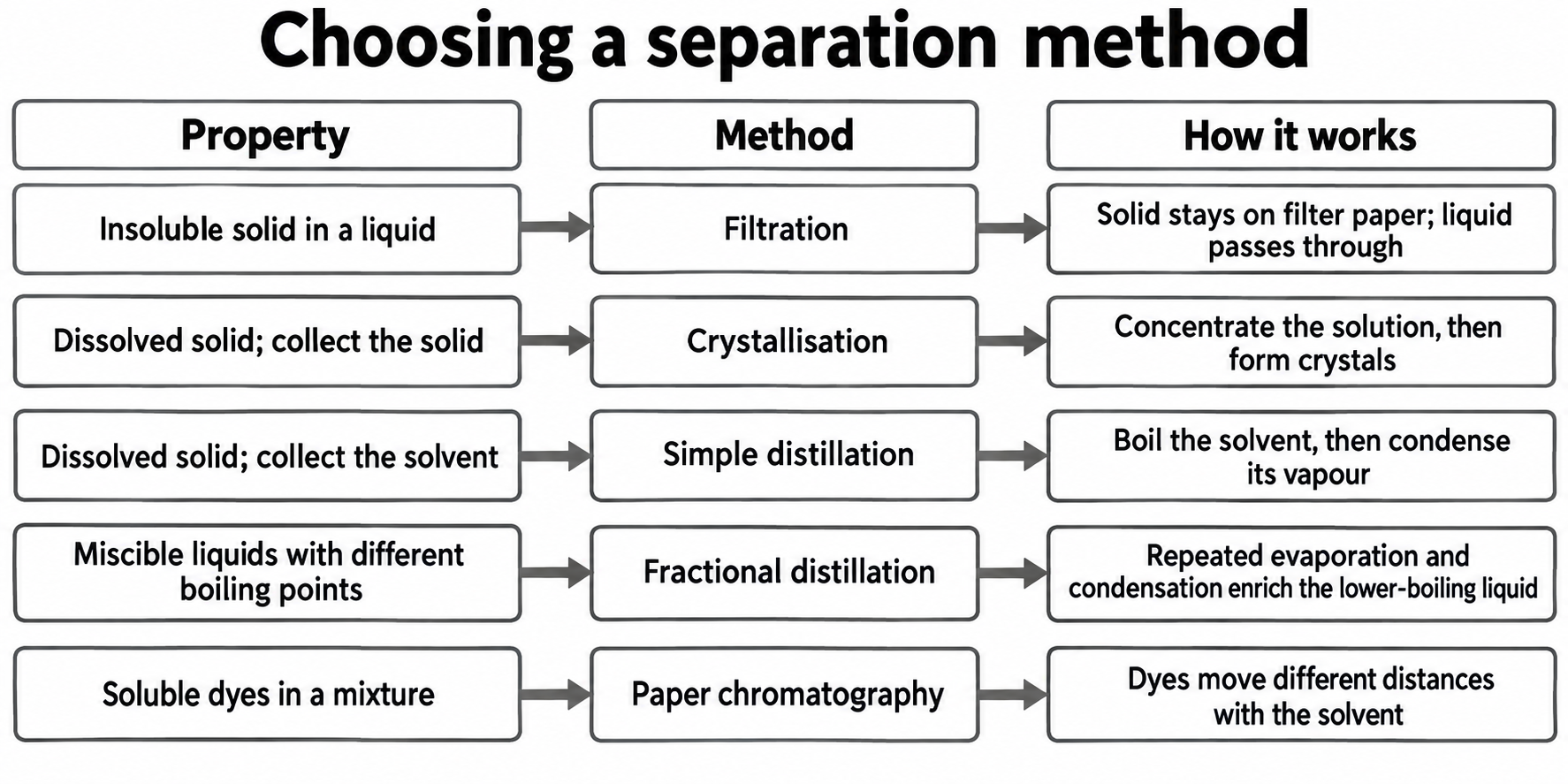
| Technique | Type of mixture it can separate | Physical difference used |
|---|---|---|
| Filtration | insoluble solid mixed with a liquid | particle size / insolubility |
| Crystallisation | soluble solid dissolved in a solution | solubility and evaporation of solvent |
| Simple distillation | solvent from a solution, or a liquid from dissolved solids | boiling point difference |
| Fractional distillation | mixture of liquids that dissolve in each other | different boiling points |
| Paper chromatography | small amounts of soluble substances, often dyes or inks | different movement with a solvent on paper |
Filtration and crystallisation
Filtration separates an insoluble solid from a liquid. The mixture is poured through filter paper in a funnel. The liquid that passes through is the filtrate. The insoluble solid left on the paper is the residue.
Filtrate and residue
The filtrate is the liquid that passes through the filter paper. The residue is the solid left on the filter paper.
This works only when the solid is insoluble in the liquid. If the solid has dissolved, its particles are too small to be trapped by the filter paper, so filtration will not recover the dissolved solid.
Crystallisation separates a soluble solid from its solution. Some solvent is evaporated so the solution becomes more concentrated. For a solid that is less soluble in cold water, cooling a hot saturated solution forms crystals. Filter the crystals and dry them. Continued slow evaporation can also form crystals; this is especially useful for sodium chloride because its solubility changes little with temperature. Avoid heating to dryness when the solid could decompose.
Continue this lesson.
You’re previewing NovaLearn without an account. Create a free account to read the rest.
Create free account