8.5 - How crude-oil fractions differ
Use hydrocarbon molecule size to explain differences in boiling point, flow and ease of ignition between crude-oil fractions.
Size and property trends
Fractions are mixtures of hydrocarbons with similar boiling points; most hydrocarbons in crude oil are alkanes. Fractions near the top of a fractionating column generally contain smaller molecules, while heavy fractions contain larger molecules. Along an alkane series, larger molecules contain more carbon and hydrogen atoms.
[DIAGRAM: asset_name: Crude-oil fraction property trends; asset_slug: 183_8_5_how_crude_oil_fractions_differ_diagram1; file: fraction-property-trends-reviewed.png; recommended_method: imagegen; description: Increasing molecule size raises boiling point and viscosity, while lowering volatility and ease of ignition; accurate comparison chart without molecular sketches.]
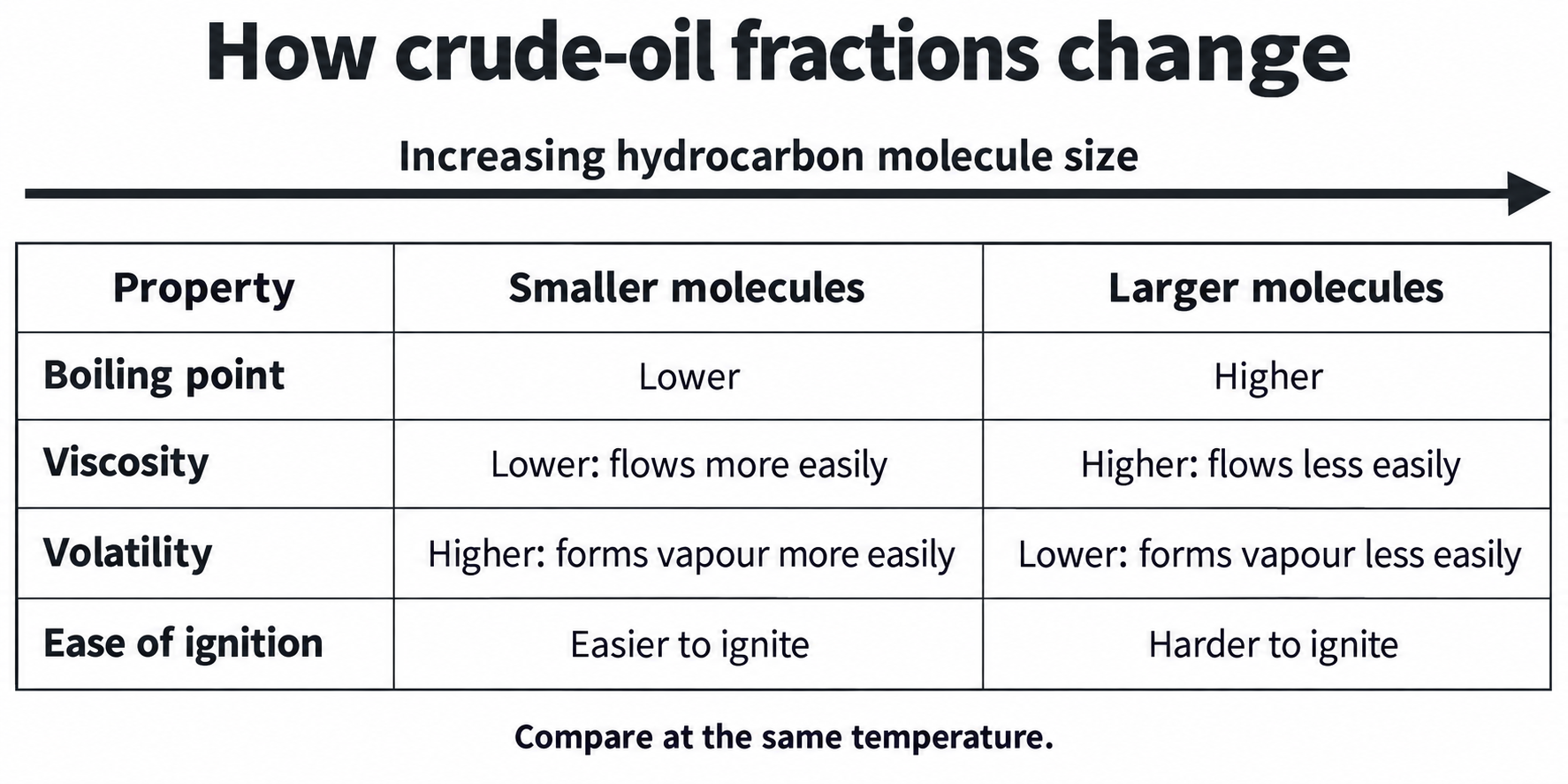
The diagram and table summarise the same trends. Use the explanations below to connect them to attractions between molecules and vapour formation.
| As molecule size increases | Trend |
|---|---|
| Boiling point | Increases |
| Viscosity | Increases: liquids flow less easily |
| Volatility | Decreases: vapour forms less easily |
| Ease of ignition | Decreases: harder to start burning |
Viscosity is resistance to flow. Volatility describes how readily a substance forms vapour. Compare fractions at the same temperature.
Why boiling point and viscosity increase
Larger hydrocarbon molecules have stronger intermolecular forces: attractions between molecules. More energy is needed to separate the molecules, so the boiling point is higher.
Continue this lesson.
You’re previewing NovaLearn without an account. Create a free account to read the rest.
Create free account