7.2 - Choosing methods to measure reaction rates
A rate experiment measures how quickly a reaction changes with time. For this specification point, the skill is to suggest a practical method that matches the reaction: choose a measurable change, record it against time, control the important variables, then use the data to determine a rate. Edexcel often uses gas production and colour or precipitate change in rates contexts, but the same reasoning can be applied to any reaction with a reliable measurable change.
Choosing a measurable change
The rate of reaction is how fast reactants are used up or products are formed. A practical method must therefore measure something that changes because the reaction is happening.
Rate of reaction
Rate of reaction is the change in amount of reactant or product per unit time.
The measured "amount" does not always have to be moles. At GCSE it is often a practical quantity such as volume of gas, mass, concentration, colour intensity, or the time taken for a fixed visible change.
| Reaction feature | Suitable measured change | Typical rate unit or comparison |
|---|---|---|
| A gas is produced | volume of gas collected over time | cm3/s |
| A gas leaves an open flask | decrease in mass over time | g/s |
| A coloured reactant or product changes | colour intensity or time to a fixed colour change | absorbance/s or 1/time |
| A precipitate forms | time for a cross to disappear or mixture to become cloudy | 1/s for relative rate |
| A concentration can be measured from samples | concentration of reactant or product over time | mol dm-3 s-1 or g dm-3 s-1 |
The first question to ask is not "what apparatus do I remember?" It is "what change can this reaction produce that I can measure reliably?"
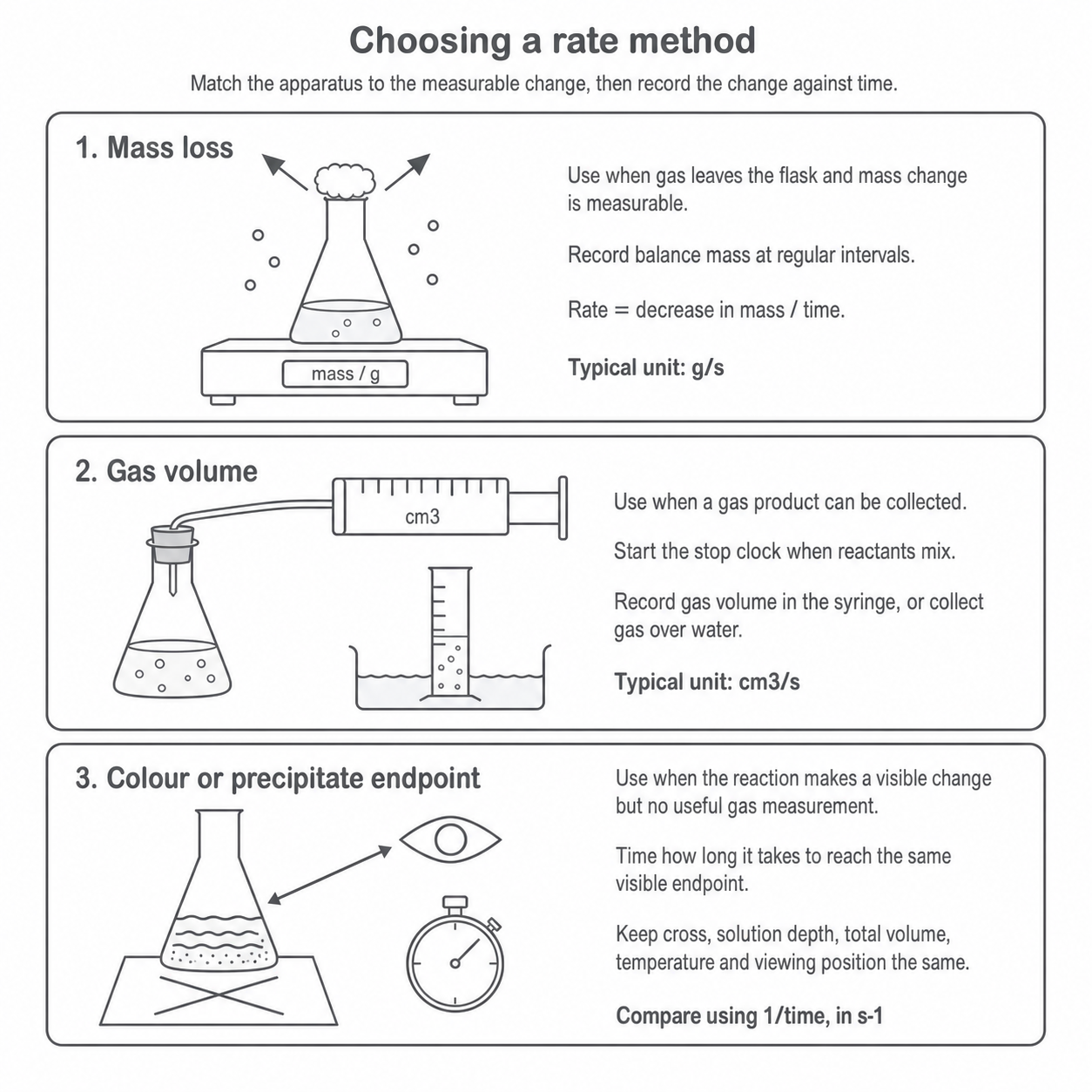
[DIAGRAM: asset_name: rate_method_selection_apparatus: Choosing a practical method for measuring reaction rate - diagram 1; asset_slug: 164_7_2_practical_methods_for_determining_the_rate_of_a_diagram1; file: 164_7_2_practical_methods_for_determining_the_rate_of_a_diagram1_imagegen_v1.png; recommended_method: deterministic_drawn; description: Exact monochrome apparatus comparison showing three suitable rate-method routes: mass-loss on a balance for gas escaping, gas volume collection with a gas syringe and the alternative of an upturned measuring cylinder over water, and a precipitate/colour endpoint using a conical flask on a cross with a stop clock. Labels identify the measured quantity, time reading, and when each method is suitable. Assessed practical visual; deterministic drawing is used because apparatus names and method-choice labels must be exact.]
Gas and mass methods
If a reaction produces a gas, two common methods are gas collection and mass loss. The apparatus sketches summarise the choices. For collection over water, the delivery tube must lead under the submerged opening of a water-filled, inverted measuring cylinder.
For gas collection, place the reactants in a conical flask and fit a bung with a delivery tube. The gas can be collected in a gas syringe, or over water in an upturned measuring cylinder. Start the stop clock as soon as the reactants are mixed, then record the gas volume at regular time intervals.
A gas syringe gives direct volume readings in cm3 and is usually more precise than collecting gas over water. However, the bung must be fitted quickly and tightly, because gas escaping before the apparatus is sealed will make the measured volume too low.
For mass loss, place the reaction vessel on a balance and let the gas escape. A cotton wool plug can reduce spray without sealing the flask. Start the stop clock when the reactants are mixed, then record the balance reading at regular time intervals. The mass decreases because gas leaves the flask.
Mass loss is only suitable if a gas leaves the apparatus. It is not suitable for a reaction in a sealed flask, and it is a poor choice if the gas is produced very slowly or the mass change is too small for the balance to measure reliably.
Colour and precipitate methods
Some reactions do not produce a gas that is easy to collect. Instead, the reaction may cause a colour change or form a precipitate. A precipitate is a solid formed in a solution, and it can make the mixture cloudy.
In the Edexcel rates context, sodium thiosulfate solution reacts with dilute hydrochloric acid. Solid sulfur forms, so the mixture becomes cloudy and a cross under the flask gradually disappears from view. The method measures the time taken to reach the same visible endpoint each time.
A suitable method is:
- Place a white paper cross under a conical flask.
- Measure a fixed volume of sodium thiosulfate solution into the flask.
- Measure a fixed volume of dilute hydrochloric acid separately.
- Mix the acid into the flask and start the stop clock immediately.
- Look down through the solution from the same position.
- Stop the clock when the cross can no longer be seen.
- Repeat under controlled conditions.
This gives a time for a fixed amount of cloudiness to form. If the endpoint is the same each time, a shorter time means a faster reaction. A relative rate can be calculated using:
Colour-change methods can also use a fixed endpoint, for example the time taken for a colour to disappear. If a colorimeter is supplied in a question, it can make the colour measurement more objective by measuring intensity rather than relying only on eyesight. Do not assume a colorimeter is required for the Edexcel core practical unless the question gives it.
Sodium thiosulfate and hydrochloric acid can produce sulfur dioxide. The room should be well ventilated, small volumes should be used, and eye protection should be worn.
Controls and timing
A rate method is valid only if the measured change is caused by the variable being investigated, not by an uncontrolled difference in the setup.
The variable you deliberately change is the independent variable. The variable you measure is the dependent variable. Control variables are kept the same so the comparison is fair.
Keep the variables below constant unless one is the independent variable being investigated:
| Control variable | Why it matters |
|---|---|
| volume and concentration of solutions | concentration changes particles per unit volume; volume changes total amount and may change solution depth |
| mass of solid | changes the total amount available to react |
| surface area or chip size of a solid | changes how much solid surface is exposed |
| temperature | changes how fast the reaction proceeds |
| total volume and solution depth | affects concentration and visibility in colour/precipitate methods |
| same apparatus and timing intervals | improves fair comparison and repeatability |
| same endpoint for colour or precipitate change | makes the time measurements comparable |
Continue this lesson.
You’re previewing NovaLearn without an account. Create a free account to read the rest.
Create free account