5.13C - Understanding atom economy
Atom economy describes how much of the reactant mass enters a specified desired product. You will connect this idea to a balanced equation and distinguish it from the amount of product actually collected.
What atom economy means
In many chemical reactions, not every product is useful for the purpose of the process. The product you want is the desired product. Any extra products are other products, often called by-products or waste products unless they have a useful purpose.
Atom economy
Atom economy is the percentage of the total reactant mass that enters the specified desired product, according to the balanced equation. It tracks atoms by their masses; it is not the percentage found by simply counting atoms.
Atom economy is based on the balanced chemical equation. It is not measured by weighing what you collect in a practical, so it is different from percentage yield. A reaction can have a high percentage yield but a low atom economy if the equation also makes a lot of unwanted product.
[DIAGRAM: asset_name: atom_economy_accounting_model - diagram 1; asset_slug: 132_5_13c_atom_economy_of_a_reaction_forming_a_desired_product_diagram1; file: diagram_assets/132_5_13c_atom_economy_of_a_reaction_forming_a_desired_product_diagram1.png; recommended_method: deterministic_drawn; description: Monochrome mass-accounting model showing reactants in a balanced equation forming products, then separating desired products from other products. The visual teaches that desired products count in the numerator, all products count in the denominator, and a balanced equation gives the same total relative formula mass for reactants and products. Exact conceptual visual, not decorative.]
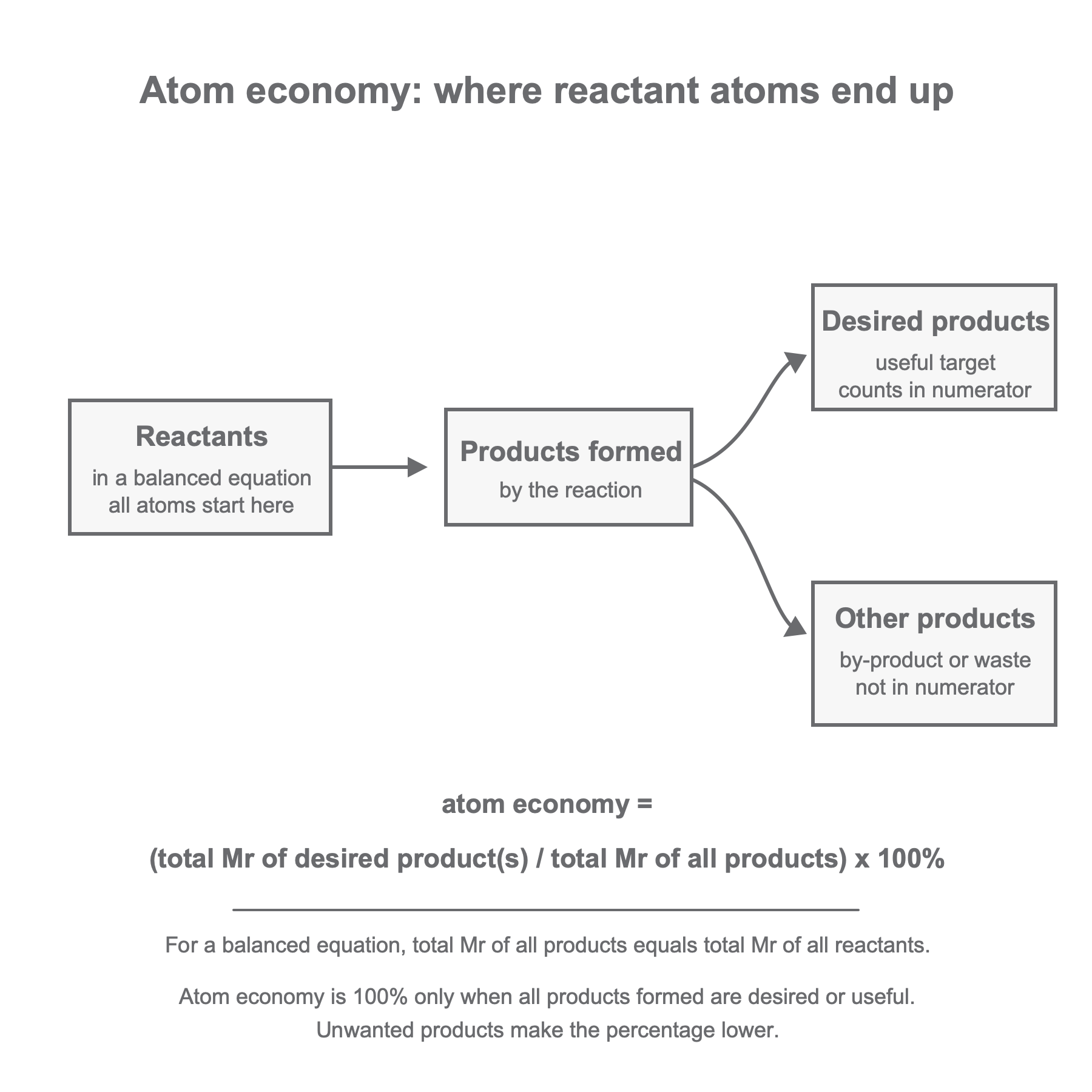
Atom economy is about how efficiently the atoms in the balanced equation are used to make the desired product.
The relationship to recall
For Edexcel atom economy questions, the key recall is the relationship between the desired product and everything made by the balanced equation. The desired product goes on the top of the fraction. The total of all the products goes on the bottom.
Atom economy
The word total matters. If a balanced equation has a coefficient, include it when working out the relative formula mass contribution. For example, contributes , not just one Mr(H2O).
Because balanced equations obey conservation of mass, the total Mr of all products is the same as the total Mr of all reactants. Some mark schemes or textbooks use the reactants total in the denominator instead. That is fine only when the equation is balanced and the total includes all substances and coefficients.
Continue this lesson.
You’re previewing NovaLearn without an account. Create a free account to read the rest.
Create free account