2.8 - Choosing a separation method
You will choose and describe separation methods from the properties of a mixture. The target product matters: collecting a dissolved solid needs a different method from collecting its solvent.
Choose from properties and the target product
Choosing a method requires two decisions: what properties differ between the components, and which component you want to collect. Miscible liquids mix completely with each other.
In a mixture of sand, salt and water, filtration first removes the insoluble sand. The salt remains dissolved in the filtrate. You can then recover salt by crystallisation or collect water by simple distillation.
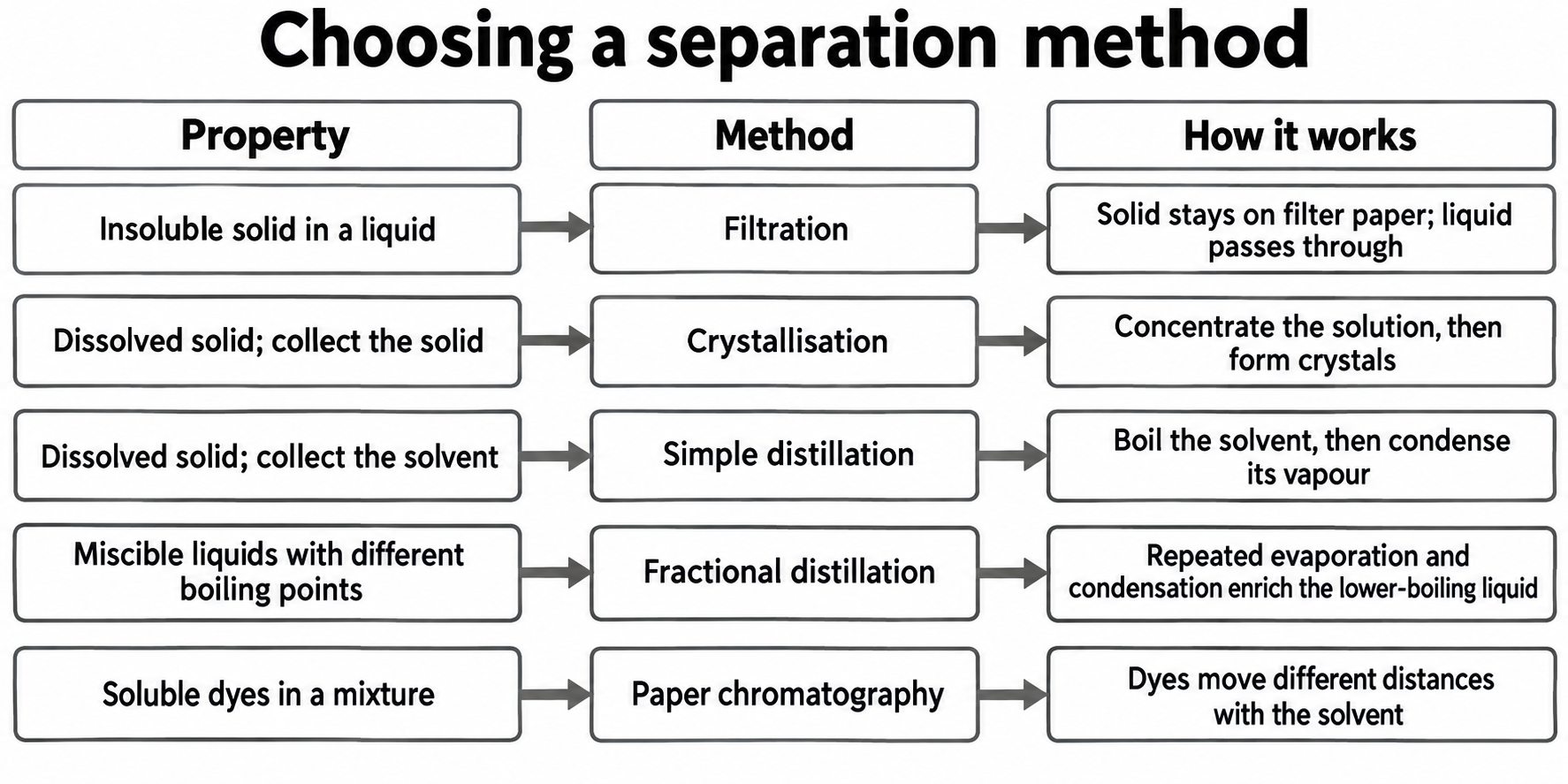
[DIAGRAM: asset_name: separation technique decision flow - diagram 1; asset_slug: 067_2_8_choosing_separation_techniques_from_component_properties_diagram1; file: separation_methods_repaired.png; recommended_method: imagegen; description: Five-row property-to-method map: insoluble solid filtration; dissolved solid crystallisation; solvent simple distillation; miscible liquids fractional distillation by repeated evaporation and condensation; soluble dyes chromatography by different travel distances. The adjacent text supplies the same decisions.]
| Property evidence in the question | Suitable technique | Why that technique fits |
|---|---|---|
| An insoluble solid is mixed with a liquid | Filtration | The solid particles cannot pass through the filter paper, but the liquid can. |
| A soluble solid is dissolved in a liquid and the solid is wanted | Crystallisation | The solvent is partly removed, then the dissolved solid forms crystals on cooling a saturated solution or during further slow evaporation. |
| A soluble solid is dissolved in a liquid and the liquid is wanted | Simple distillation | The liquid solvent boils, the vapour is cooled in a condenser, and the pure liquid is collected. |
| Two or more liquids are miscible and have different boiling points | Fractional distillation | The liquid with the lower boiling point evaporates more readily; the fractionating column helps separate liquids by repeated evaporation and condensation. |
| Several soluble substances are present, such as dyes in ink | Paper chromatography | The soluble components move at different rates with the solvent over the paper. |
Collecting liquids
Worked example: collecting one liquid
Continue this lesson.
You’re previewing NovaLearn without an account. Create a free account to read the rest.
Create free account