5.6C - Why iron is alloyed to make alloy steels
Different steel compositions suit different jobs. You will use the layer model to explain increased strength and distinguish this from corrosion resistance when choosing an alloy steel.
From pure iron to alloy steel
Steel is an alloy based mainly on iron with a small amount of carbon. Alloy steels also contain added elements, including metals such as chromium, nickel or manganese, to change their properties. The chosen elements and amounts are the alloy's composition.
Pure iron has regular layers of same-sized particles that slide relatively easily. Added atoms of different sizes disturb this arrangement in an alloy steel. Sliding becomes harder, so suitable alloy steels resist deformation better than pure iron.
[DIAGRAM: asset_name: Pure iron and alloy steel particle model - diagram 1; asset_slug: 125_5_6c_iron_is_alloyed_with_other_metals_to_produce_alloy_steels_diagram1; file: diagram_assets/125_5_6c_iron_is_alloyed_with_other_metals_to_produce_alloy_steels_diagram1.png; recommended_method: deterministic_drawn; description: Monochrome particle model comparing pure iron with alloy steel. Shows pure iron as same-sized Fe atoms in regular layers with an arrow showing layers sliding, and alloy steel as Fe atoms mixed with labelled Cr, Ni and Mn atoms of different sizes that distort the layers and block sliding. Exact assessed idea: different-sized atoms disrupt the regular layers so the layers cannot slide easily, making the alloy steel harder and stronger. Nearby prose explains that the labels are examples rather than required alloy recipes.]
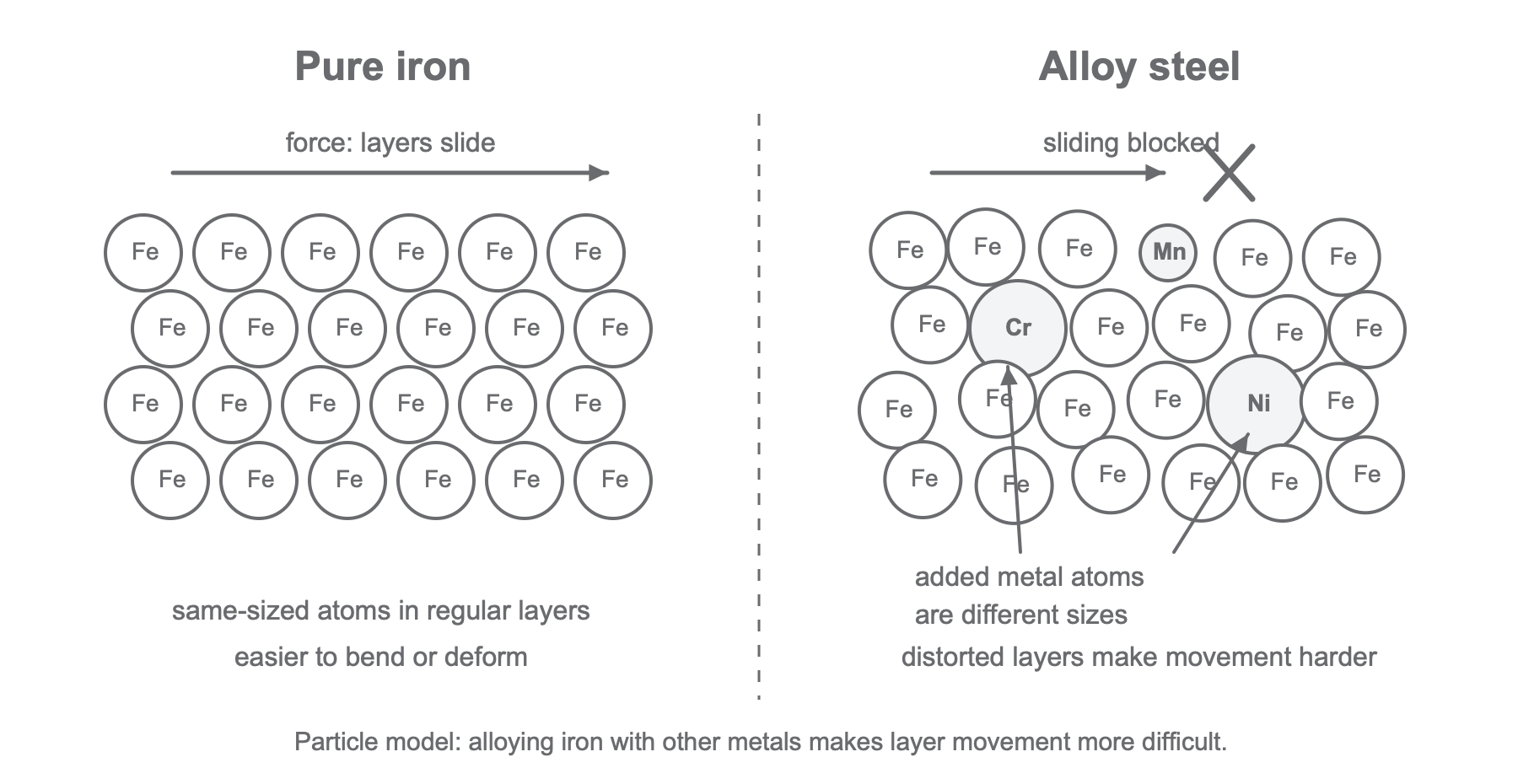
The circles show a simplified model, not atomic sizes to scale or a required recipe. "Sliding blocked" means hindered, not impossible. Carbon and delocalised electrons are omitted from this drawing to focus on the added metals; they are not absent from real steel.
Continue this lesson.
You’re previewing NovaLearn without an account. Create a free account to read the rest.
Create free account