3.28 - Oxidation and reduction as electron transfer
Higher tier. Use electron transfer to identify oxidation and reduction, including changes from atoms to ions and from ions to atoms.
Follow the electrons
Oxidation and reduction
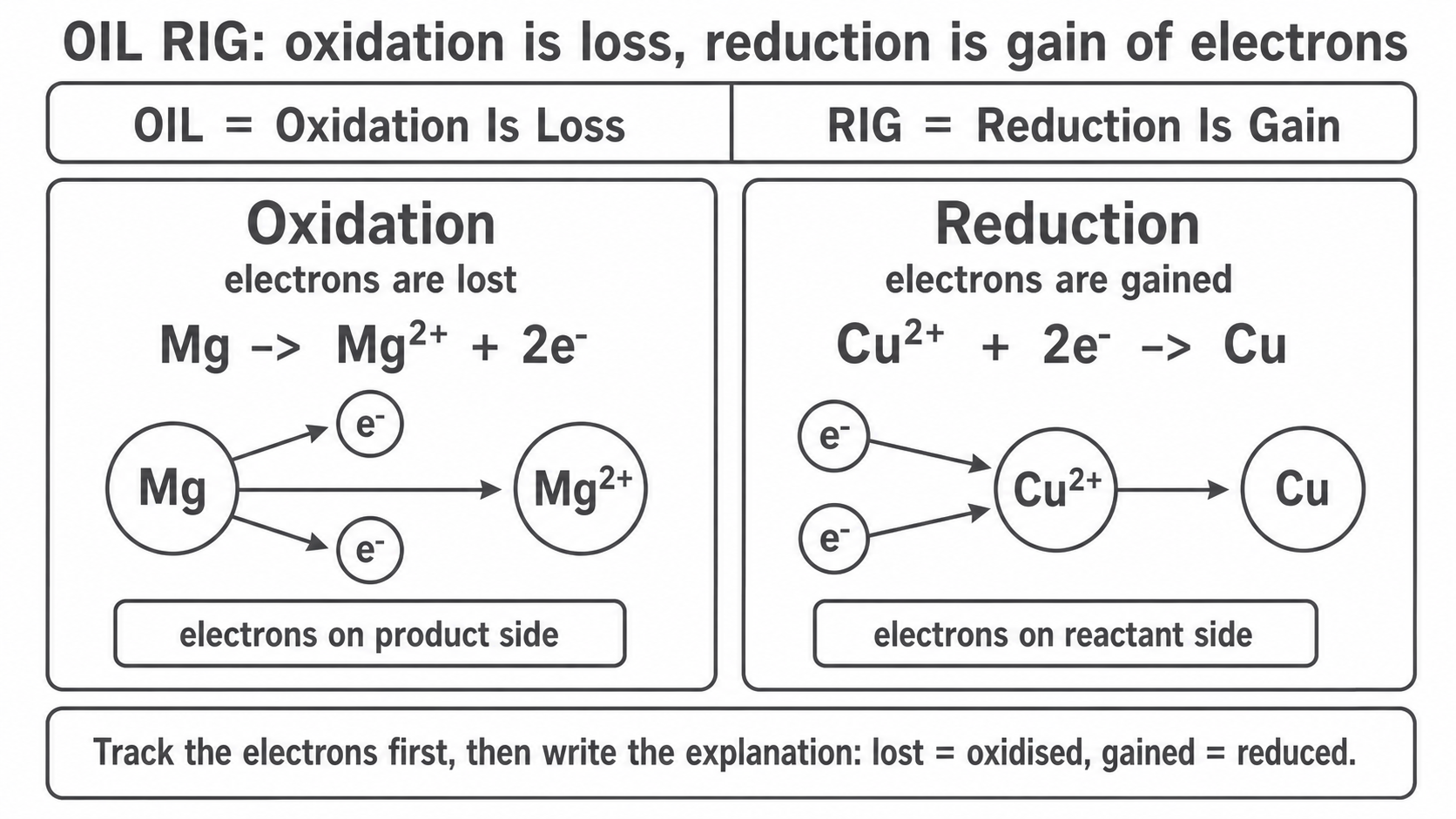
Oxidation is loss of electrons. Reduction is gain of electrons.
OIL RIG is a useful reminder: Oxidation Is Loss, Reduction Is Gain. These definitions apply even when oxygen is absent.
In Mg → Mg²⁺ + 2e⁻, each magnesium atom loses two electrons, so magnesium is oxidised. Electrons appear on the product side because they leave the atom.
In Cu²⁺ + 2e⁻ → Cu, each copper(II) ion gains two electrons, so it is reduced. Electrons appear on the reactant side because the ion takes them in.
[DIAGRAM: asset_name: oil_rig_half_equation_signpost: OIL RIG electron-transfer signpost - diagram 1; asset_slug: 099_3_28_oxidation_and_reduction_in_terms_of_loss_or_gain_of_electrons_diagram1; file: 099_3_28_oxidation_and_reduction_in_terms_of_loss_or_gain_of_electrons_diagram1_imagegen_v1.png; recommended_method: deterministic_drawn; description: Exact monochrome teaching visual for Edexcel 3.28. Shows two labelled panels. Left panel: Oxidation is loss, with Mg -> Mg2+ + 2e-, two e- particles moving away from Mg, and the label electrons on product side. Right panel: Reduction is gain, with Cu2+ + 2e- -> Cu, two e- particles moving toward Cu2+, and the label electrons on reactant side. Includes OIL RIG memory strip. White background with #6A6B6E linework and text only. Assessed formula/label visual, so deterministic drawing is required.]
Continue this lesson.
You’re previewing NovaLearn without an account. Create a free account to read the rest.
Create free account