5.9C - Accurate acid-alkali titration
In this Edexcel core practical, you carry out an accurate acid-alkali titration using a burette, pipette and a suitable indicator. The aim is to find the volume of one solution needed to exactly neutralise a measured volume of the other solution. Good titration work is careful practical chemistry: accurate apparatus, a sharp end point, repeated concordant titres, and a mean titre that can be used in a concentration calculation.
Purpose and apparatus
A titration is used when an acid and an alkali react in solution and the end point is not obvious from a solid forming or disappearing. A suitable indicator changes colour close to the point at which the acid and alkali have reacted in the balanced-equation ratio.
For a simple acid-alkali example:
hydrochloric acid + sodium hydroxide -> sodium chloride + water
HCl(aq) + NaOH(aq) -> NaCl(aq) + H2O(l)
At the particle level, the neutralisation step is:
H+(aq) + OH-(aq) -> H2O(l)
The Edexcel core practical apparatus must be named precisely:
- burette: measures and delivers variable volumes of acid or alkali accurately
- pipette: measures a fixed accurate volume, commonly 25.0 cm3, into the conical flask
- pipette filler: fills the pipette safely; never mouth-pipette
- conical flask: holds the measured solution and indicator while it is swirled
- white tile: makes the indicator colour change easier to see
- suitable indicator: changes colour sharply at the end point
[DIAGRAM: asset_name: Accurate acid-alkali titration setup - diagram 1; asset_slug: 128_5_9c_core_practical_accurate_acid_alkali_titration_diagram1; file: 128_5_9c_core_practical_accurate_acid_alkali_titration_diagram1_imagegen_v1.png; recommended_method: deterministic_drawn; description: Exact assessed apparatus layout for the Edexcel core practical. Shows a burette clamped vertically above a conical flask on a white tile, hydrochloric acid added from the burette to sodium hydroxide plus suitable indicator in the flask, the tap for dropwise addition near the end point, and swirling. Monochrome deterministic drawing supports apparatus identification and method recall; nearby prose states indicator colours and safety.]
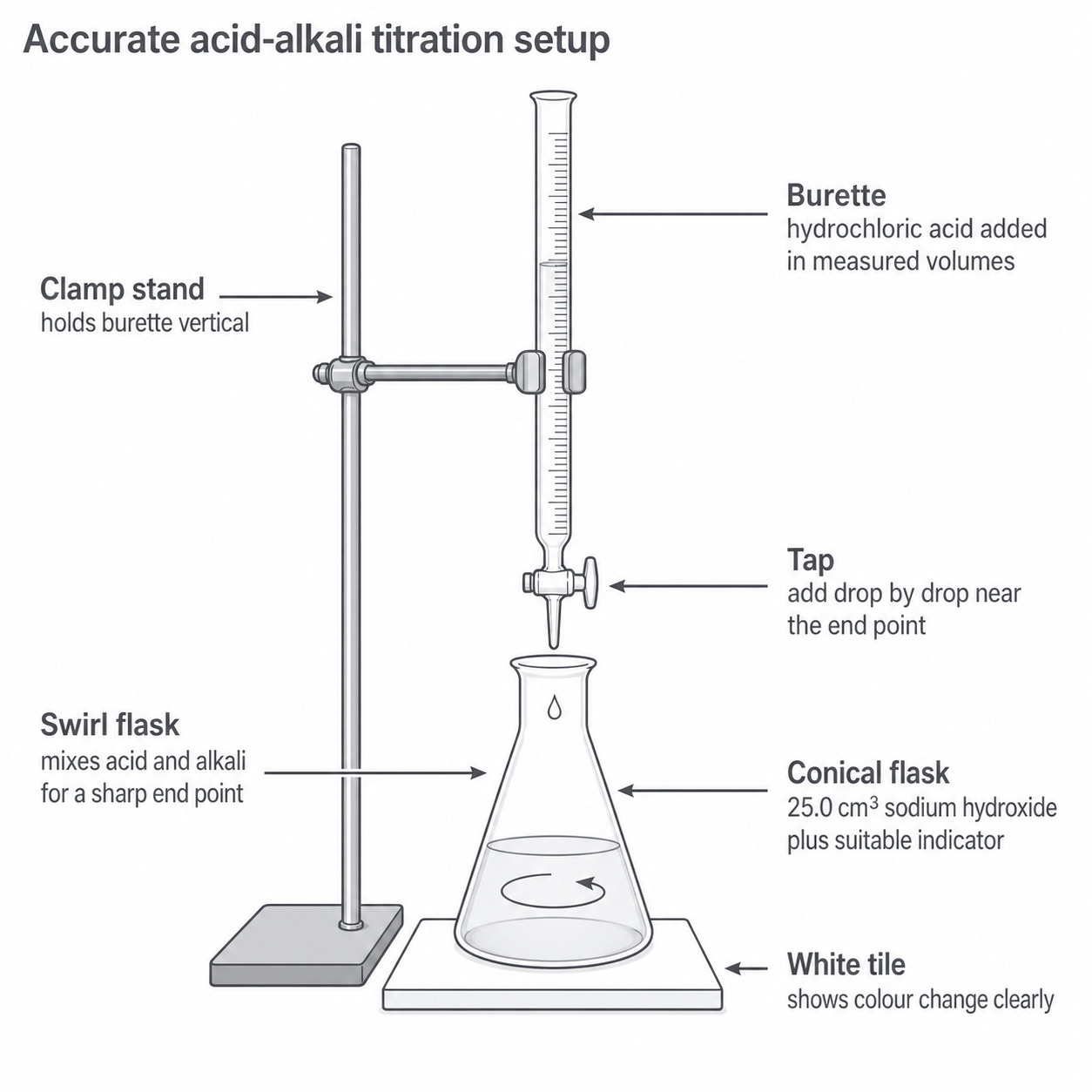
Titre
The titre is the volume delivered from the burette during one titration.
Eye protection is needed because dilute acids and alkalis can irritate eyes and skin. Use a pipette filler rather than your mouth, fill the burette below eye level if possible, remove the funnel before titrating, and wash small spills away with plenty of water as instructed by the teacher.
Setting up the titration
One common setup is to put sodium hydroxide solution in the conical flask and hydrochloric acid in the burette. The same technique applies if the acid and alkali are swapped, as long as the roles are stated clearly.
A careful setup follows this sequence:
- Rinse the conical flask with distilled water. Rinse the pipette with the solution it will measure, then use a pipette filler to transfer 25.0 cm3 of the solution into a conical flask. Allow a volumetric pipette to drain naturally; do not blow out the small amount left in its tip.
- Add a few drops of a suitable indicator to the conical flask. Methyl orange is suitable for hydrochloric acid and sodium hydroxide; it is yellow in alkali and orange at the end point.
- Place the conical flask on a white tile.
- Rinse the burette with the solution it will contain, clamp it vertically, then fill it using a funnel.
- Remove the funnel so extra drops cannot run into the burette during the titration.
- Run a little solution through the tap so the jet is full and there are no air bubbles.
- Record the initial burette reading at eye level from the bottom of the meniscus.
The rinsing step matters because water left in the burette or pipette would dilute the solution and change the amount of substance delivered. The white tile matters because the final colour change can be very pale near the end point.
End Point
The end point is the point in a titration where the indicator just changes colour and the reaction is judged to be complete.
Rough and accurate titres
The first titration is usually a rough titration. It gives an approximate titre, so the next titrations can be done more carefully near the end point.
For the rough titration, add the solution from the burette to the conical flask while swirling. When the indicator changes colour, record the final burette reading and calculate the approximate titre:
titre = final burette reading - initial burette reading
Continue this lesson.
You’re previewing NovaLearn without an account. Create a free account to read the rest.
Create free account