9.20C - Monomers and addition polymers
Practise deducing an addition polymer from its monomer and working backwards, while keeping atoms, side groups and continuation bonds consistent.
From monomer to repeating unit
A monomer is a small molecule that can join with others to form a polymer. A repeating unit is a section of the polymer chain that repeats. For these addition polymers, show the unit derived from one alkene monomer.
To deduce a polymer structure, find the two carbon atoms in , change the double bond to a single bond and add a continuation bond from each of those carbons. Keep every attached atom or group in place, then add square brackets and n.
[DIAGRAM: asset_name: monomer_repeat_unit_conversion: Deducing an addition-polymer repeat unit from a monomer - diagram 1; asset_slug: 224_9_20c_monomers_and_addition_polymers_diagram1; file: diagram_assets/224_9_20c_monomers_and_addition_polymers_diagram1_imagegen_v1.png; recommended_method: deterministic_drawn; description: Exact monochrome deterministic structure-support diagram for Pearson Edexcel GCSE Chemistry 1CH0 9.20C. It shows propene as the monomer CH2=CH-CH3, an arrow labelled C=C becomes C-C, and the repeat unit for poly(propene) as [-CH2-CH(CH3)-]
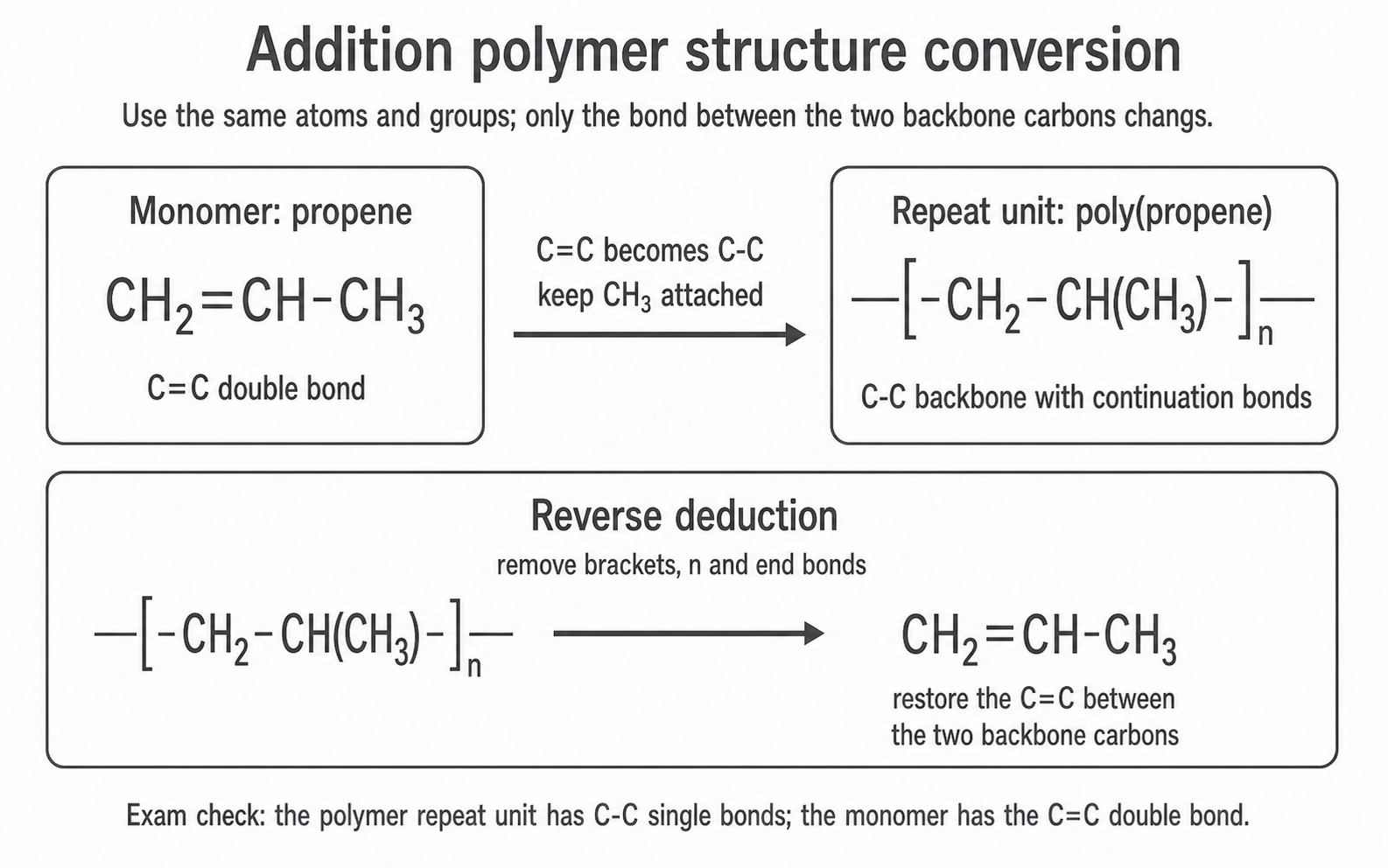
In the worked propene example, becomes [-CH2-CH(CH3)-]n. The is a side group, not a third backbone carbon. In condensed notation, the end dashes represent continuation bonds; in a displayed diagram, draw those bonds through the brackets.
Check the result by counting bonds. Each backbone carbon forms two bonds along the chain and two bonds to attached atoms or groups: four in total. Addition polymerisation removes no atoms.
Continue this lesson.
You’re previewing NovaLearn without an account. Create a free account to read the rest.
Create free account