7.14 - Energy change from bond energies
Higher tier. Learn to calculate energy changes from a balanced equation and supplied bond energies. Count the bonds, total the energy taken in and released, then subtract and interpret the sign.
What the calculation means
A chemical reaction rearranges atoms. Bonds in the reactants are broken, and new bonds in the products are formed. Bond energies put numbers on those changes.
Bond energy
Bond energy is the energy needed to break one mole of a particular covalent bond in gaseous molecules. Forming the same bonds from gaseous atoms releases the same amount of energy.
Bond energies are supplied in kJ mol-1 (kilojoules per mole). When the totals are calculated using the equation coefficients, the result is per mole of reaction as written: for , this means two moles of hydrogen reacting. You do not need to memorise the values. Your job is to use the balanced equation and the bond-energy table carefully.
Bond breaking takes in energy, so it is counted as the energy input. Bond making releases energy, so it is counted as the energy output.
Energy change from bond energies
The sign of the answer matters.
| Result of calculation | Meaning |
|---|---|
| negative energy change | more energy is released than taken in, so the reaction is exothermic |
| positive energy change | more energy is taken in than released, so the reaction is endothermic |
Tables usually give mean bond energies averaged across different molecules, so calculated reaction energies are estimates. These calculations describe gaseous molecules; condensation or vaporisation adds further energy changes.
Counting bonds
Before doing any arithmetic, count the bonds that are broken and formed. The balanced equation tells you how many molecules are involved. The displayed or structural formula tells you how many bonds are in each molecule.
For example:
H2 + I2 -> 2HI
The reactants contain one H-H bond and one I-I bond. The products contain two H-I bonds because the equation makes two molecules of HI.
[DIAGRAM: asset_name: bond_energy_calculation_map: Bond counting for an energy-change calculation - diagram 1; asset_slug: 176_7_14_energy_change_in_a_reaction_diagram1; file: diagram_assets/176_7_14_energy_change_in_a_reaction_diagram1.png; recommended_method: deterministic_drawn; description: Monochrome deterministic calculation map for Pearson Edexcel GCSE Chemistry 1CH0 7.14. Show the reaction H2 + I2 -> 2HI with a reactants panel labelled bonds broken: one H-H bond and one I-I bond, and a products panel labelled bonds formed: two H-I bonds. Include the supplied bond energies H-H 436 kJ mol-1, I-I 151 kJ mol-1, H-I 299 kJ mol-1. Show totals: energy in = 436 + 151 = 587 kJ mol-1; energy out = 2 x 299 = 598 kJ mol-1; energy change = 587 - 598 = -11 kJ mol-1, exothermic. Exact assessed calculation support; white background with all linework and labels in #6A6B6E.]
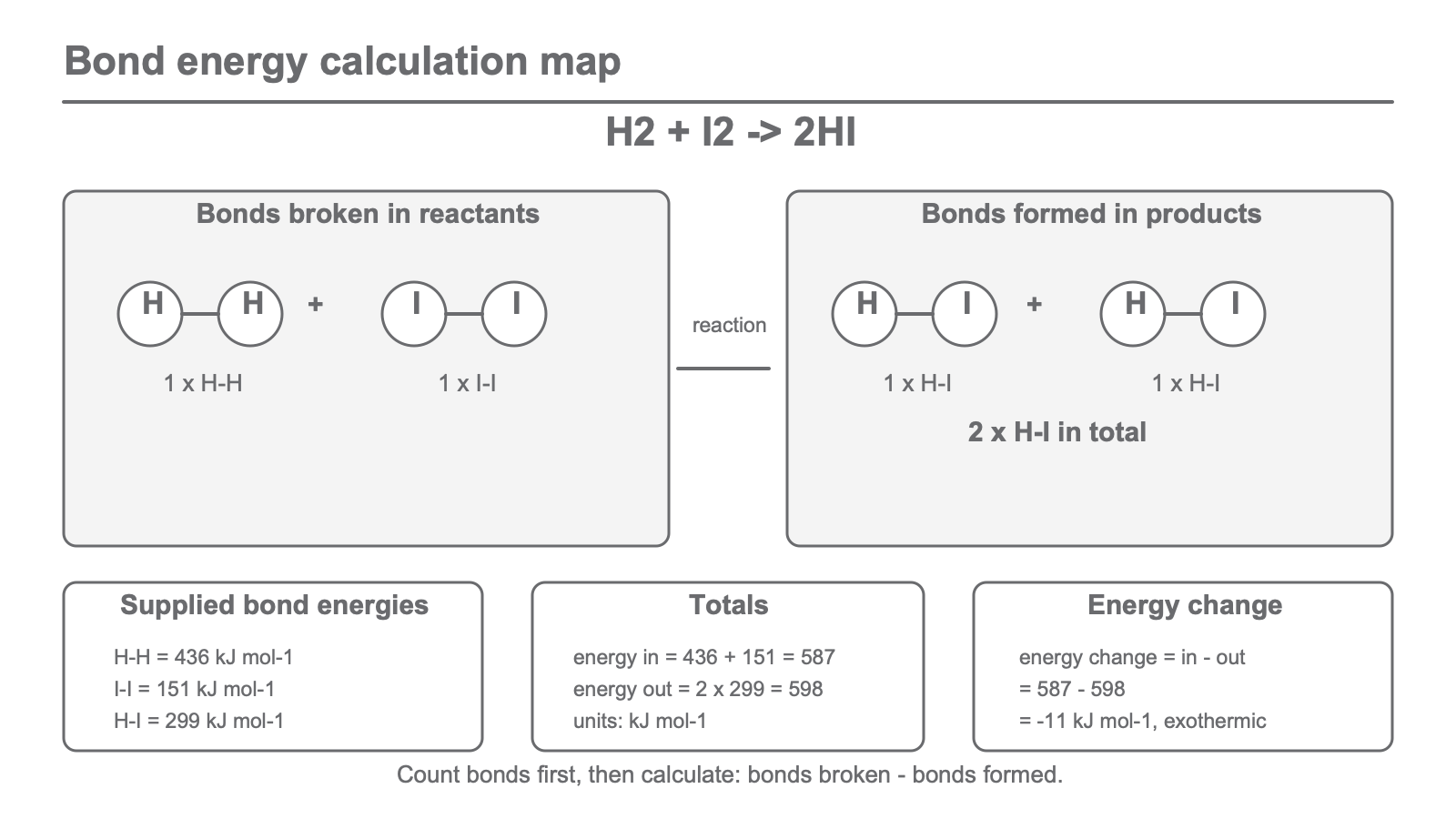
The coefficient in front of a formula multiplies every bond inside that molecule. In , there is one H-I bond per HI molecule, but two HI molecules are made, so two H-I bonds form.
Common counting mistakes include:
| Mistake | Fix |
|---|---|
ignoring the 2 in front of a formula | multiply the bonds in one molecule by the coefficient |
| treating a double bond as two single bonds | use the bond type given in the table, such as O=O rather than two O-O bonds |
| counting bonds in products as broken | reactant bonds are broken; product bonds are formed |
Continue this lesson.
You’re previewing NovaLearn without an account. Create a free account to read the rest.
Create free account