6.3 - How alkali metals react with water
Lithium, sodium and potassium react with cold water to form hydrogen and a metal hydroxide. Learn to describe the observations, write balanced equations and connect demonstration precautions to their hazards.
The shared reaction
Lithium, sodium and potassium all react with cold water. In each reaction, the metal disappears as it reacts, a gas is produced, and an alkaline solution is left behind.
The gas is hydrogen. The alkaline solution forms because the metal reacts with water to make a soluble metal hydroxide: lithium hydroxide, sodium hydroxide or potassium hydroxide.
Alkaline solution
An alkaline solution has a pH above 7 and contains hydroxide ions, OH⁻. In these reactions the alkaline solution is a metal hydroxide dissolved in water.
If universal indicator is present, the water changes towards blue or purple as the alkaline hydroxide solution forms. If phenolphthalein is present, it turns pink. The indicator provides evidence that the solution has become alkaline.
All three reactions fit the same product pattern: Group 1 metal + water -> metal hydroxide + hydrogen.
Observations for the three metals
A good Describe answer should name the metal and give observations that a person could see, hear or record. For these three reactions, useful observations are fizzing, movement on the water surface, whether the metal melts into a ball, whether a flame is seen, and that the metal disappears as it reacts.
[DIAGRAM: asset_name: Lithium, sodium and potassium with water comparison - diagram 1; asset_slug: 149_6_3_reactions_of_lithium_sodium_and_potassium_with_water_diagram1; file: 149_6_3_reactions_of_lithium_sodium_and_potassium_with_water_diagram1.png; recommended_method: deterministic_drawn; description: Monochrome table comparing the observations, products and balanced symbol equations for lithium, sodium and potassium reacting with water. The visual is exact and assessed: labels must show Lithium/Li, Sodium/Na and Potassium/K; observations must include floating, fizzing and movement for all three, sodium possibly melting to a ball, and potassium possibly igniting hydrogen with a lilac flame or pop; equations must show the three metal hydroxides and hydrogen gas. Nearby prose states colour words instead of using colour in the diagram.]
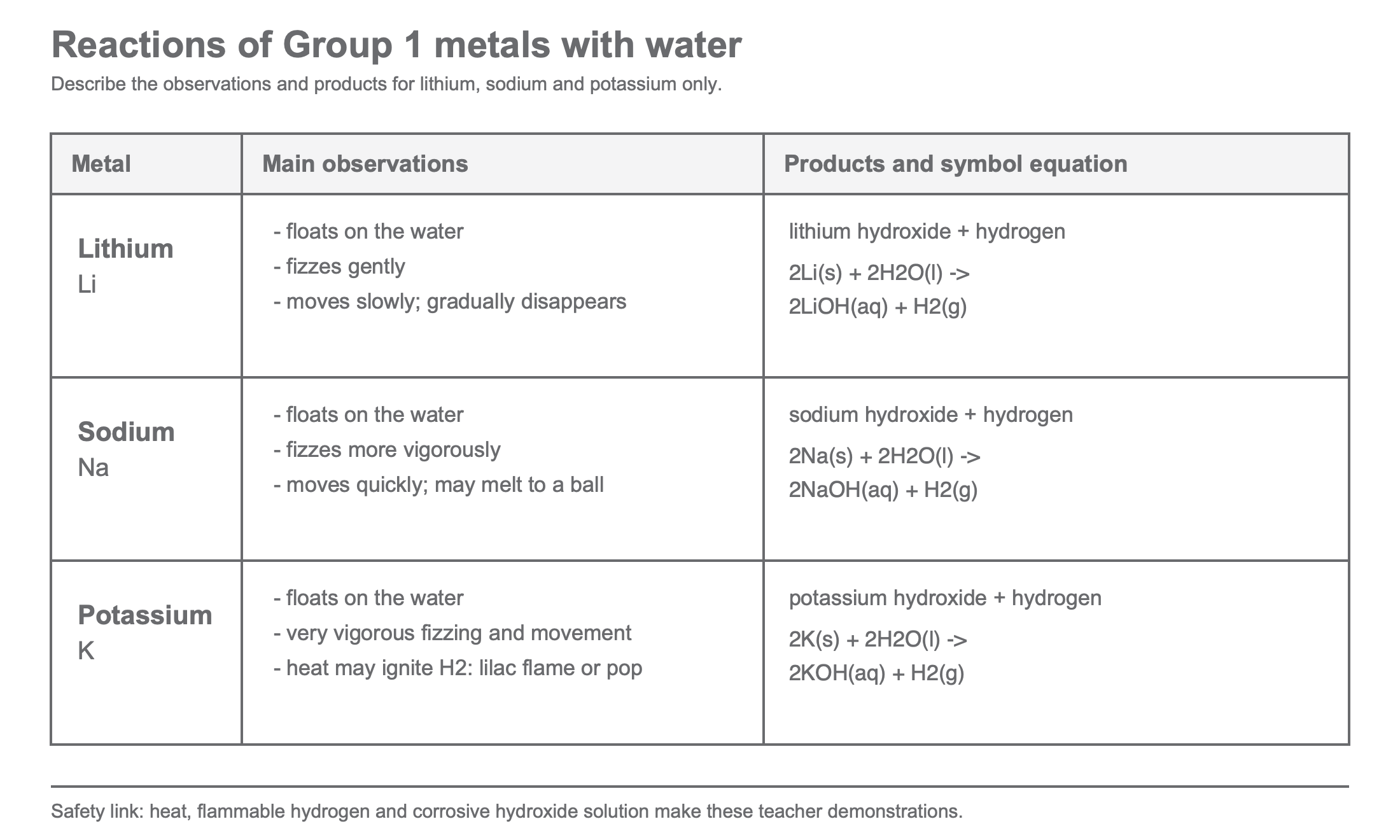
Lithium reacts gently compared with the other two named metals. A small piece floats, fizzes gently as hydrogen bubbles form, moves slowly on the water surface, and gradually disappears.
Sodium reacts more vigorously than lithium. A small piece floats, fizzes, moves quickly across the surface, and may melt into a silvery ball because the reaction releases heat.
Potassium reacts very vigorously. It floats, fizzes strongly, moves rapidly, and the heat produced may ignite the hydrogen, with a lilac flame or a pop sometimes seen or heard. The lilac colour comes from potassium species in the flame; it is not the characteristic colour of pure hydrogen burning. These visible changes are observations. Naming the hydrogen or hydroxide explains what is being formed, but is not itself something seen directly.
Continue this lesson.
You’re previewing NovaLearn without an account. Create a free account to read the rest.
Create free account