5.8C - Calculating molar concentration
Learn to calculate concentrations from moles, mass and solution volume, and convert between mol dm⁻³ and g dm⁻³. This separate Chemistry point is Higher tier only.
Meaning of mol dm-3
A solution is made when a solute dissolves in a solvent. For concentration calculations, the volume used is the final volume of the solution, not just the volume of water added.
Concentration
Concentration is the amount of solute dissolved in a given volume of solution.
Concentration in mol dm-3 means the amount of solute, in moles, in each of solution.
For example, a sodium chloride solution with concentration 0.200 mol dm-3 contains 0.200 mol of sodium chloride in every of solution.
This is different from concentration in g dm-3:
| Unit | Meaning |
|---|---|
g dm-3 | mass of solute in grams per of solution |
mol dm-3 | amount of solute in moles per of solution |
The same solution can be described in either unit if you know the relative formula mass, Mr, of the solute. A mole-based concentration is especially useful when the dissolved substance reacts, because balanced equations use moles.
Calculate concentration
The concentration equation in moles is:
Concentration in mol dm-3
where:
cis concentration inmol dm-3nis amount of solute inmolVis volume of solution in
The volume must be in before you use this equation.
1000 cm3 = 1 dm3
volume in dm3 = volume in cm3 / 1000
Worked example:
A solution contains 0.0125 mol of sodium hydroxide in of solution. Calculate its concentration in mol dm-3.
V = 250 / 1000 = 0.250 dm3
c = n / V
c = 0.0125 / 0.250
c = 0.0500 mol dm-3
The most common error is to divide by 250 instead of 0.250. That gives an answer that is 1000 times too small.
For mol dm-3, convert to before calculating.
Now try the same route.
Rearranging concentration
The same relationship can be rearranged if a question asks for the amount of solute or the volume of solution.
c = n / V
n = c x V
V = n / c
Use these only with V in .
Worked example:
Calculate the amount, in moles, of sodium hydroxide in of 0.200 mol dm-3 sodium hydroxide solution.
V = 40.0 / 1000 = 0.0400 dm3
n = c x V
n = 0.200 x 0.0400
n = 0.00800 mol
Notice that gives mol. The units cancel, leaving amount in moles.
Convert between concentration units
To convert between g dm-3 and mol dm-3, use the relative formula mass of the solute. The molar mass in g mol⁻¹ has the same numerical value as Mr; Mr itself has no unit.
[DIAGRAM: asset_name: concentration_conversion_route: Concentration calculation route map - diagram 1; asset_slug: 127_5_8c_concentration_of_solutions_in_mol_dm3_and_convert_concentration_in_g_dm3_i_diagram1; file: diagram_assets/127_5_8c_concentration_of_solutions_in_mol_dm3_and_convert_concentration_in_g_dm3_i_diagram1.png; recommended_method: deterministic_drawn; description: Exact monochrome route map for Edexcel 5.8C. It shows c = n / V with V in dm3, the cm3 to dm3 conversion by dividing by 1000, and the two concentration-unit conversions: mol dm-3 times Mr gives g dm-3, while g dm-3 divided by Mr gives mol dm-3. Deterministic drawing is required because units, formula direction and operations are assessed calculation content.]
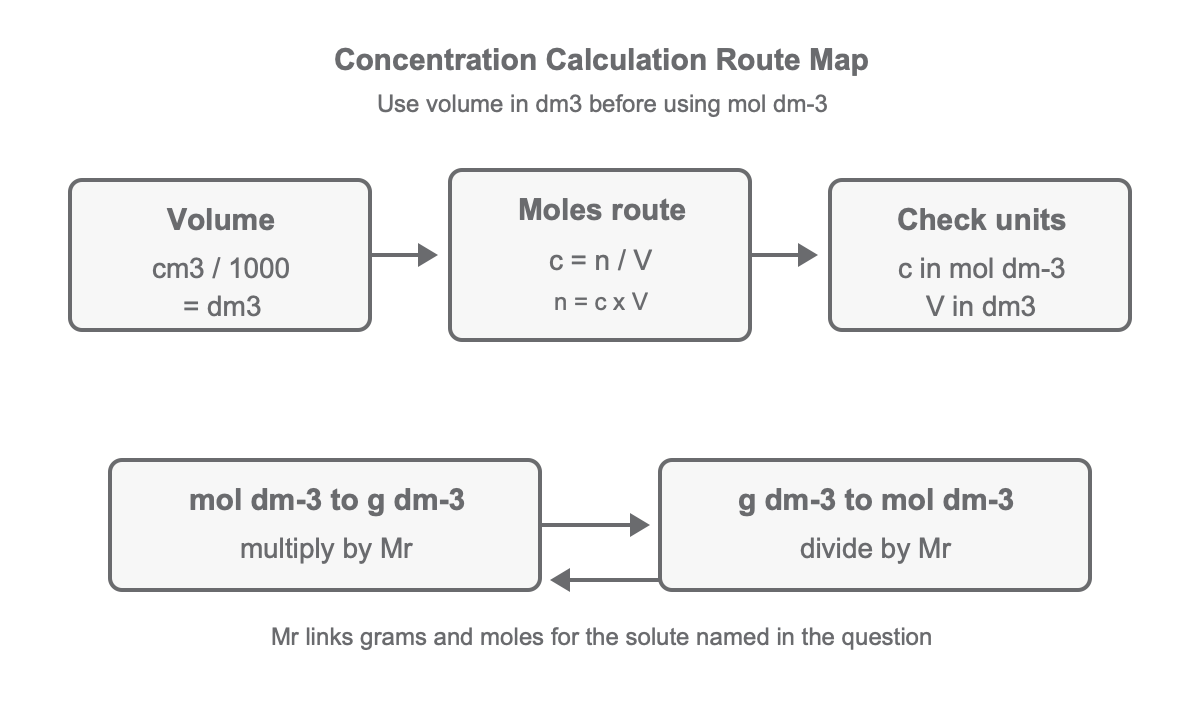
If you know concentration in mol dm-3:
Moles to grams per dm3
Continue this lesson.
You’re previewing NovaLearn without an account. Create a free account to read the rest.
Create free account