9.2C - Flame tests for metal ions
Learn how to carry out a flame test on a solid salt, match five characteristic colours to metal ions, and avoid contamination that could lead to a wrong identification.
Characteristic flame colours
Some metal ions give characteristic flame colours when their compounds are heated.
Learn the ion, its charge and the exact flame colour together.
| Metal ion in the solid | Symbol | Positive flame-test colour |
|---|---|---|
| lithium ion | Li+ | red |
| sodium ion | Na+ | yellow |
| potassium ion | K+ | lilac |
| calcium ion | Ca2+ | orange-red |
| copper ion | Cu2+ | blue-green |
Name the metal ion clearly. An ion name or correct formula can identify it; both are useful when learning the table.
Use precise colour descriptions: blue-green for copper(II) and orange-red for calcium distinguish the expected observations.
Flame test method
A GCSE flame test uses a tiny amount of the solid and a clean flame-test wire loop. The loop is usually nichrome or platinum because these metals can be heated strongly and do not usually add their own strong flame colour.
[DIAGRAM: asset_name: flame_test_wire_loop_method: Flame test wire-loop method - diagram 1; asset_slug: 206_9_2c_flame_tests_for_metal_ions_diagram1; file: diagram_assets/206_9_2c_flame_tests_for_metal_ions_diagram1.png; recommended_method: deterministic_drawn; description: Exact monochrome Edexcel GCSE Chemistry 9.2C method diagram. Show a heatproof mat with a Bunsen burner labelled "blue flame while testing (shown monochrome)", a nichrome or platinum wire loop held at the edge of the flame, a small beaker labelled "hydrochloric acid for cleaning loop", a watch glass labelled "solid salt sample", and an observation box labelled "record colour word: red / yellow / lilac / orange-red / blue-green". Include a safety note label: "hot wire loop and open flame". The diagram must be entirely monochrome with white background and #6A6B6E linework/text; true flame colours must appear only as written words, not coloured flame fills. Deterministic drawing is required because the apparatus and sequence are assessed practical content.]
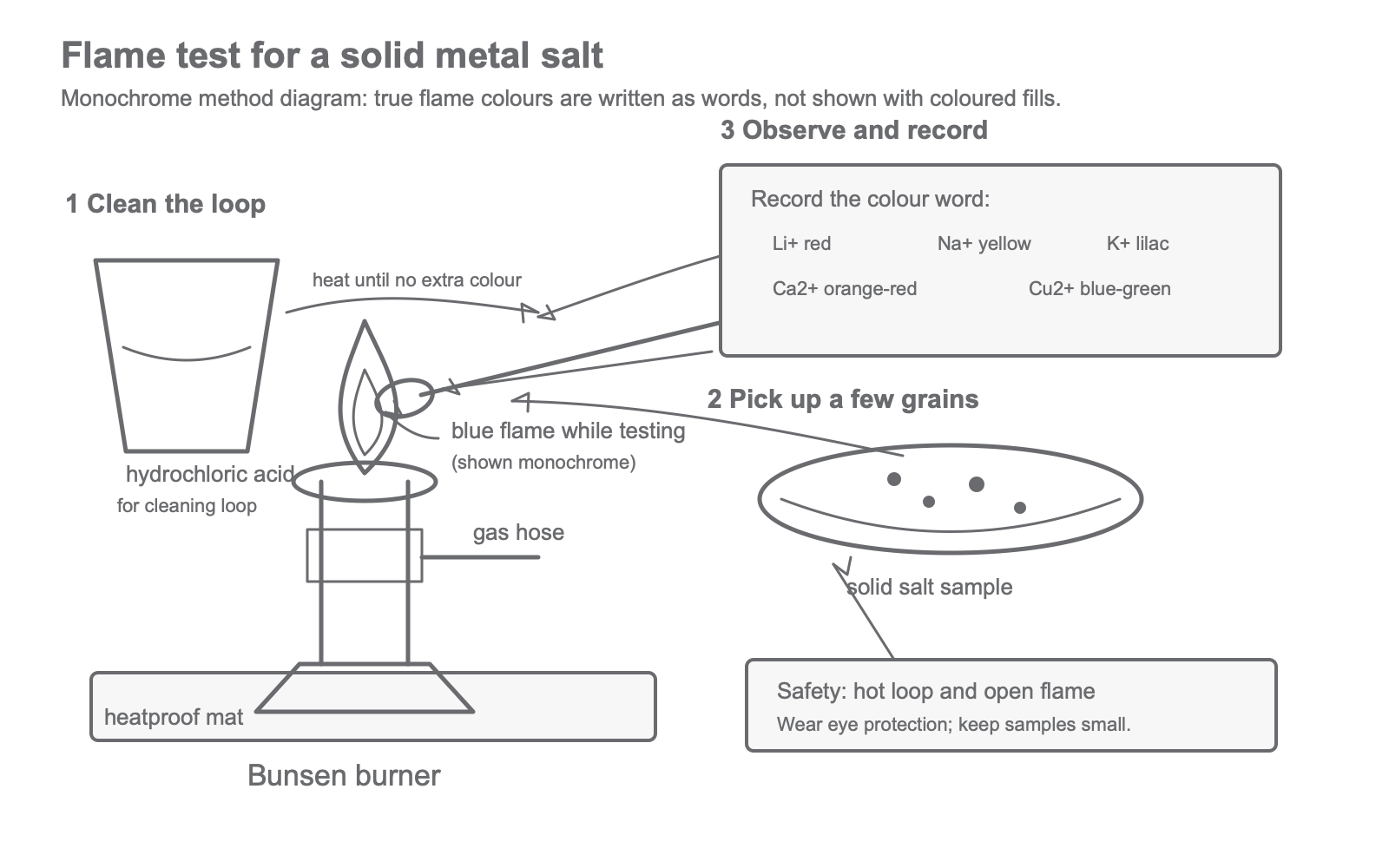
A suitable method is:
- Put on eye protection and place the Bunsen burner on a heatproof mat.
- Clean the wire loop by dipping it into hydrochloric acid supplied for the practical, then heating it in a blue Bunsen flame.
- Repeat the cleaning until the loop gives no extra flame colour.
- Dip the clean loop into the acid again, then use it to pick up a few grains of the solid sample.
- Hold the loop at the edge of the blue flame.
- Observe the flame colour immediately and record the colour word.
- Clean the loop again before testing another solid.
Continue this lesson.
You’re previewing NovaLearn without an account. Create a free account to read the rest.
Create free account