4.16 - Conditions for the Haber process
The Haber process uses a hot, pressurised reactor and a catalyst to make ammonia. Learn the temperature, pressure and catalyst, with the correct units for each condition.
Temperature, pressure and catalyst
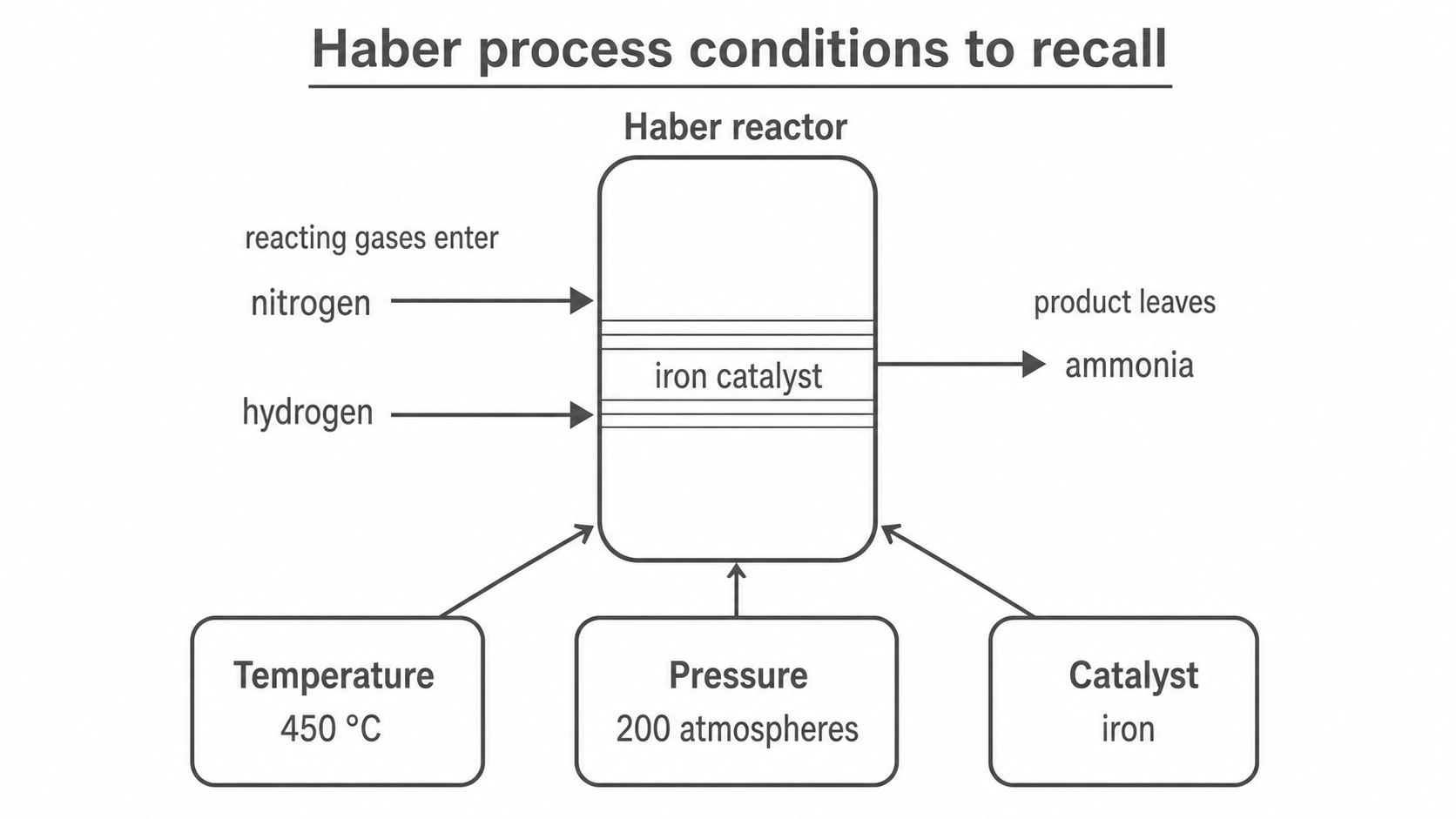
Nitrogen and hydrogen react reversibly to make ammonia. The conditions specified for the Haber process are:
| Condition | Value or substance |
|---|---|
| Temperature | 450 °C |
| Pressure | 200 atmospheres |
| Catalyst | Iron |
The unit °C identifies temperature; atmospheres is a pressure unit. Keep each value paired with its unit.
[DIAGRAM: asset_name: haber_conditions_memory_map - diagram 1; asset_slug: 118_4_16_conditions_for_the_haber_process_as_a_temperature_450_degrees_c_b_pressure_diagram1; file: 118_4_16_conditions_for_the_haber_process_as_a_temperature_450_degrees_c_b_pressure_diagram1_imagegen_v1.png; recommended_method: deterministic_drawn; description: Deterministic monochrome memory-map diagram showing nitrogen and hydrogen entering a labelled Haber reactor and ammonia leaving. Three exact assessed callouts around the reactor state: temperature 450 °C, pressure 200 atmospheres, and iron catalyst. The visual teaches the recall set only; it must not show yield percentages, equilibrium shift predictions, compromise reasoning, recycling loops, or industrial plant detail beyond a simple reactor context. Nearby prose supplies all assessed facts for accessibility.]
Continue this lesson.
You’re previewing NovaLearn without an account. Create a free account to read the rest.
Create free account