4.15 - Making ammonia in a reversible reaction
Ammonia is made by reacting nitrogen with hydrogen. Learn their industrial sources, balance the formation equation, and apply dynamic equilibrium to this particular reaction.
Sources of nitrogen and hydrogen
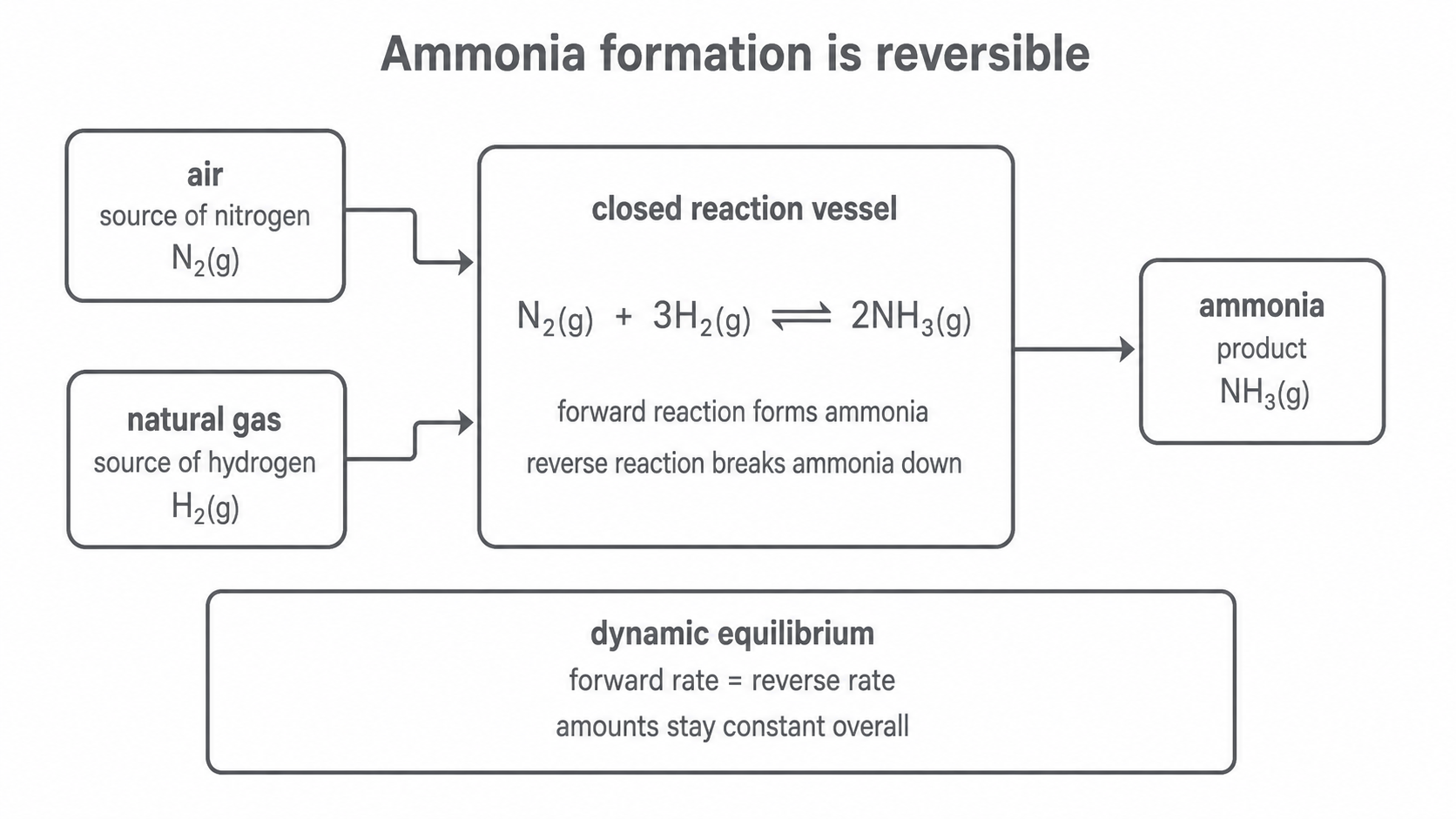
Ammonia has the formula : each molecule contains one nitrogen atom and three hydrogen atoms. The conventional Haber process uses these sources:
| Reactant | Formula | Source |
|---|---|---|
| Nitrogen | N2 | Extracted from air |
| Hydrogen | H2 | Obtained from natural gas |
Air contains a large proportion of nitrogen. Natural gas, mainly methane, is processed to obtain hydrogen; it is not simply a supply of hydrogen gas.
Balancing ammonia formation
Nitrogen and hydrogen form ammonia in the forward reaction. In the reverse reaction, ammonia decomposes into nitrogen and hydrogen.
Check the atoms: each side has two nitrogen atoms and six hydrogen atoms. The coefficients therefore give a reacting ratio of 1 nitrogen molecule : 3 hydrogen molecules : 2 ammonia molecules. The (g) symbols show that all three substances are gases in the reaction mixture.
[DIAGRAM: asset_name: ammonia_reversible_reaction_overview: Formation of ammonia and dynamic equilibrium - diagram 1; asset_slug: 117_4_15_formation_of_ammonia_as_a_reversible_reaction_between_nitrogen_extracted_f_diagram1; file: 117_4_15_formation_of_ammonia_as_a_reversible_reaction_between_nitrogen_extracted_f_diagram1_imagegen_v1.png; recommended_method: deterministic_drawn; description: Exact monochrome teaching visual for Edexcel 4.15. It shows air as the source of N2(g), natural gas as the source of H2(g), both entering a closed reaction vessel, the balanced reversible equation N2(g) + 3H2(g) <=> 2NH3(g), forward and reverse arrows, and a dynamic equilibrium note: forward rate = reverse rate; amounts stay constant. It must not include Haber process condition values, catalyst, yield-shift predictions, ammonia removal, recycling, or fertiliser production. Deterministic drawing is required because formulae, arrows and labels must be exact.]
Continue this lesson.
You’re previewing NovaLearn without an account. Create a free account to read the rest.
Create free account