8.16 - Cracking long-chain hydrocarbons
Cracking changes large hydrocarbon molecules into smaller molecules, including alkenes. Learn how the bonds and products differ, then use atom conservation to complete cracking equations.
From a large alkane to smaller products
Cracking
Breaking down larger hydrocarbon molecules into smaller, more useful hydrocarbons.
The starting molecules here are alkanes: saturated hydrocarbons containing only carbon and hydrogen, with no carbon–carbon double or triple bonds. Heat supplies energy for bonds to break; atoms rearrange and new bonds form in smaller molecules. This is a chemical change. Fractional distillation instead separates existing molecules by their boiling points.
A typical simplified pattern is a larger alkane forming a smaller alkane and an alkene. Alkenes contain a carbon–carbon double bond and are unsaturated: they have fewer hydrogen atoms than the corresponding alkane with the same number of carbon atoms.
[DIAGRAM: asset_name: cracking_reaction_scheme: Cracking a larger alkane into smaller alkane and alkene - diagram 1; asset_slug: 194_8_16_cracking_involves_the_breaking_down_of_larger_saturated_hydrocarbon_molecu_diagram1; file: 194_8_16_cracking_involves_the_breaking_down_of_larger_saturated_hydrocarbon_molecu_diagram1_imagegen_v1.png; recommended_method: imagegen; description: Reaction schematic: dodecane C12H26 forms octane C8H18 and butene C4H8. Carbon chains contain 12, 8 and 4 atoms respectively; the alkene has a visible double bond. Hydrogen atoms are omitted.]
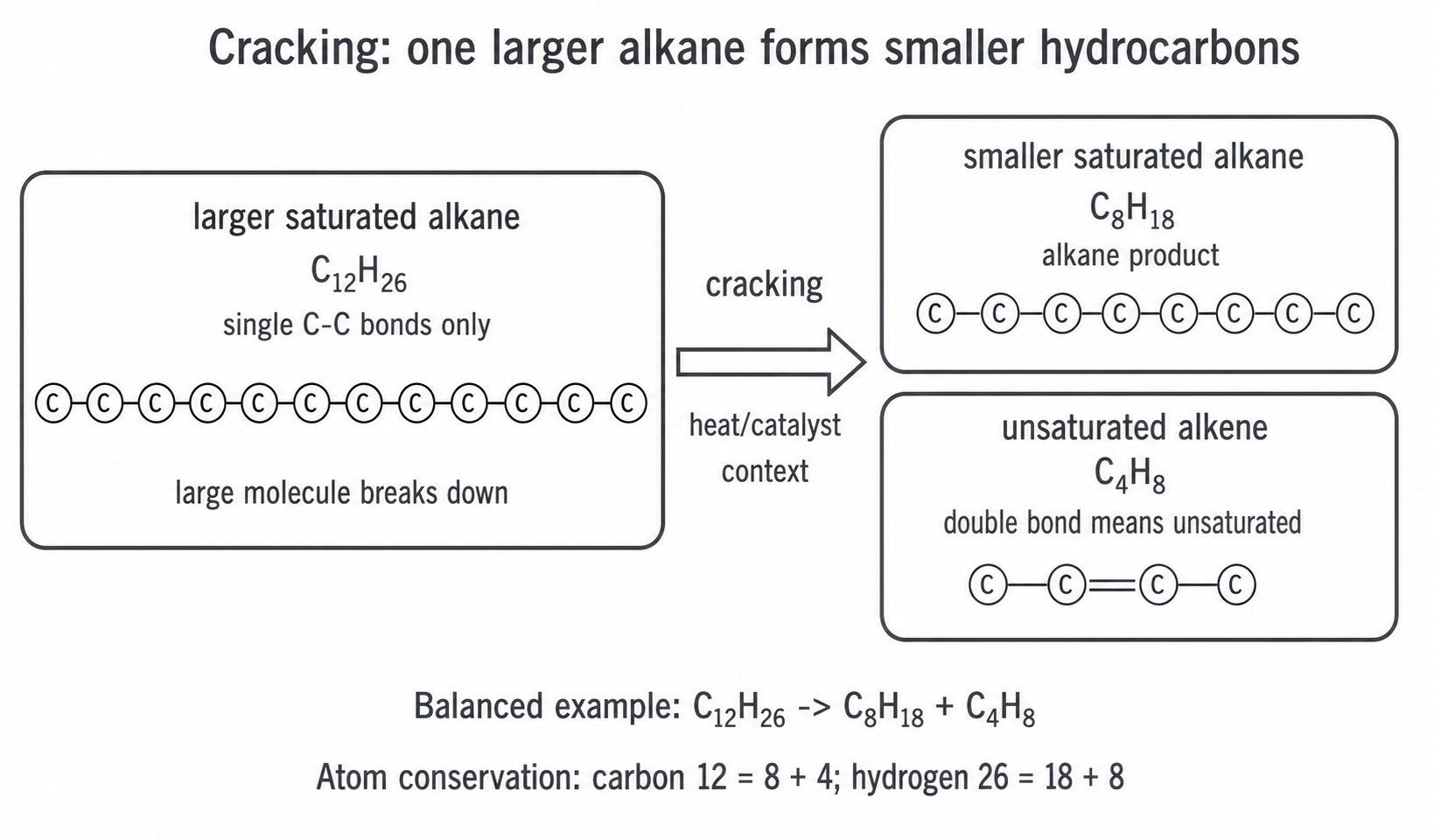
The picture shows only carbon atoms and carbon–carbon bonds. Hydrogen atoms are omitted: each carbon must have four bonds in total. In the four-carbon product, the middle double bond counts as two bonds at each carbon, giving CH₃–CH=CH–CH₃ and C₄H₈. The octane product has only single bonds and is saturated. Real cracking produces a mixture, not necessarily just these two products.
Smaller hydrocarbons can be useful fuels; alkenes can be starting materials for other chemicals.
Conserving atoms in cracking equations
Cracking equations do not require oxygen. Oxygen reacting to produce carbon dioxide and water would describe combustion.
Continue this lesson.
You’re previewing NovaLearn without an account. Create a free account to read the rest.
Create free account