3.30 - Copper purification by electrolysis
Electrolysis transfers copper from an impure anode onto a pure copper cathode. You will link the electrode reactions to the changes in mass and explain why the copper collected is purer than the starting material.
Setting up the purification cell
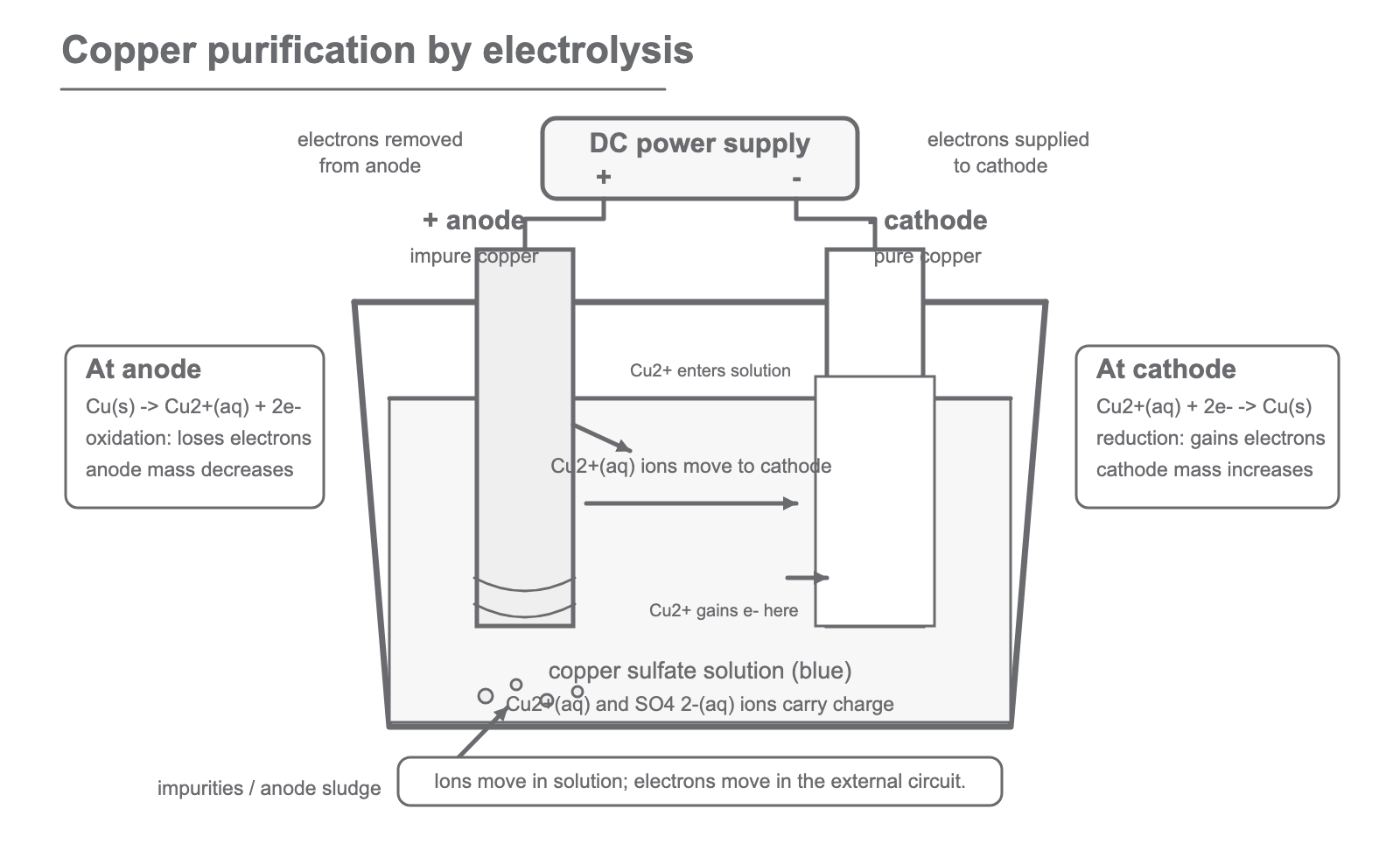
Use impure copper as the positive anode and a thin sheet of pure copper as the negative cathode. Both dip into copper sulfate solution and connect to a direct current supply.
Electrolyte
An electrolyte is an ionic compound in the molten state or dissolved in water, with mobile ions that carry charge.
Copper sulfate solution contains and ions. Positive copper ions move towards the negative cathode; negative sulfate ions move towards the positive anode. Electrons travel through the metal wires and electrodes; ions carry charge through the solution.
Unlike graphite, the copper anode takes part in the reaction: it supplies copper ions. This electrode material is why the anode dissolves instead of giving oxygen as the main product.
Linking the two electrode reactions
At the anode, copper atoms leave the solid electrode and enter the solution as copper ions. The anode therefore loses mass. Each copper atom loses two electrons: oxidation is loss of electrons.
At the cathode, copper ions gain electrons and become copper atoms. Copper metal builds up on the cathode, increasing its mass. Reduction is gain of electrons.
The half-equations show the electron transfers. Writing these equations is a Higher-tier extension; the mass changes can also be explained in words.
Higher-tier electrode half-equations
Anode:
Cathode:
[DIAGRAM: asset_name: copper_purification_cell: Copper purification by electrolysis cell - diagram 1; asset_slug: 101_3_30_copper_purification_by_electrolysis_diagram1; file: diagram_assets/101_3_30_copper_purification_by_electrolysis_diagram1.png; recommended_method: existing_asset; description: Exact monochrome electrolysis cell diagram for Edexcel GCSE Chemistry 1CH0 3.30. Show a beaker containing copper sulfate solution labelled "copper sulfate solution (blue)"; left electrode labelled "+ anode: impure copper, Cu(s) -> Cu2+(aq) + 2e-"; right electrode labelled "- cathode: pure copper, Cu2+(aq) + 2e- -> Cu(s)"; DC power supply connected by wires; arrows showing Cu2+(aq) supplied from the anode region and moving towards the cathode; electron-removal/supply labels on the external circuit, not through the solution; bottom residue labelled "impurities / anode sludge". Use only white background, #6A6B6E linework/text/arrows, and very light neutral grey fills. The inspected illustration is retained; half-equations are a Higher-tier extension.]
Continue this lesson.
You’re previewing NovaLearn without an account. Create a free account to read the rest.
Create free account