3.26 - Electrolysis of molten binary compounds
Learn to predict the products from the ions in a molten binary compound. With inert electrodes and no water present, each product comes from an element in the compound.
From a molten compound to its elements
A binary ionic compound contains exactly two different elements. Most GCSE examples are a metal combined with a non-metal, such as sodium chloride, magnesium bromide or aluminium oxide.
Binary Ionic Compound
A binary ionic compound is an ionic compound containing two different elements.
The word molten means the compound has been heated until it is liquid. This matters because the ions can move in a liquid. In a solid ionic compound, the ions are held in fixed positions in the lattice, so the solid cannot act as the electrolyte for electrolysis.
Molten
Molten means melted into the liquid state by heating.
Aqueous solutions contain water, which adds extra ions and can change the products. In a molten compound there is no water, so there are no hydrogen ions or hydroxide ions competing at the electrodes.
During electrolysis, ions move towards the electrode with the opposite charge. Positive ions are cations, so they move to the negative electrode, the cathode. Negative ions are anions, so they move to the positive electrode, the anode.
[DIAGRAM: asset_name: molten_binary_electrolysis_cell: Predicting products from ion movement in a molten binary ionic compound - diagram 1; asset_slug: 097_3_26_products_of_electrolysis_of_other_binary_ionic_compounds_in_the_molten_sta_diagram1; file: 097_3_26_products_of_electrolysis_of_other_binary_ionic_compounds_in_the_molten_sta_diagram1_imagegen_v1.png; recommended_method: deterministic_drawn; description: Exact monochrome teaching diagram for Edexcel 3.26. Shows a direct current supply connected to two inert electrodes dipping into a molten binary ionic compound. Labels must show the cathode as negative and where metal forms, the anode as positive and where non-metal forms, cations moving to the cathode, and anions moving to the anode. The visual is assessed/exact because electrode signs and ion directions determine product prediction, so deterministic drawing is required.]
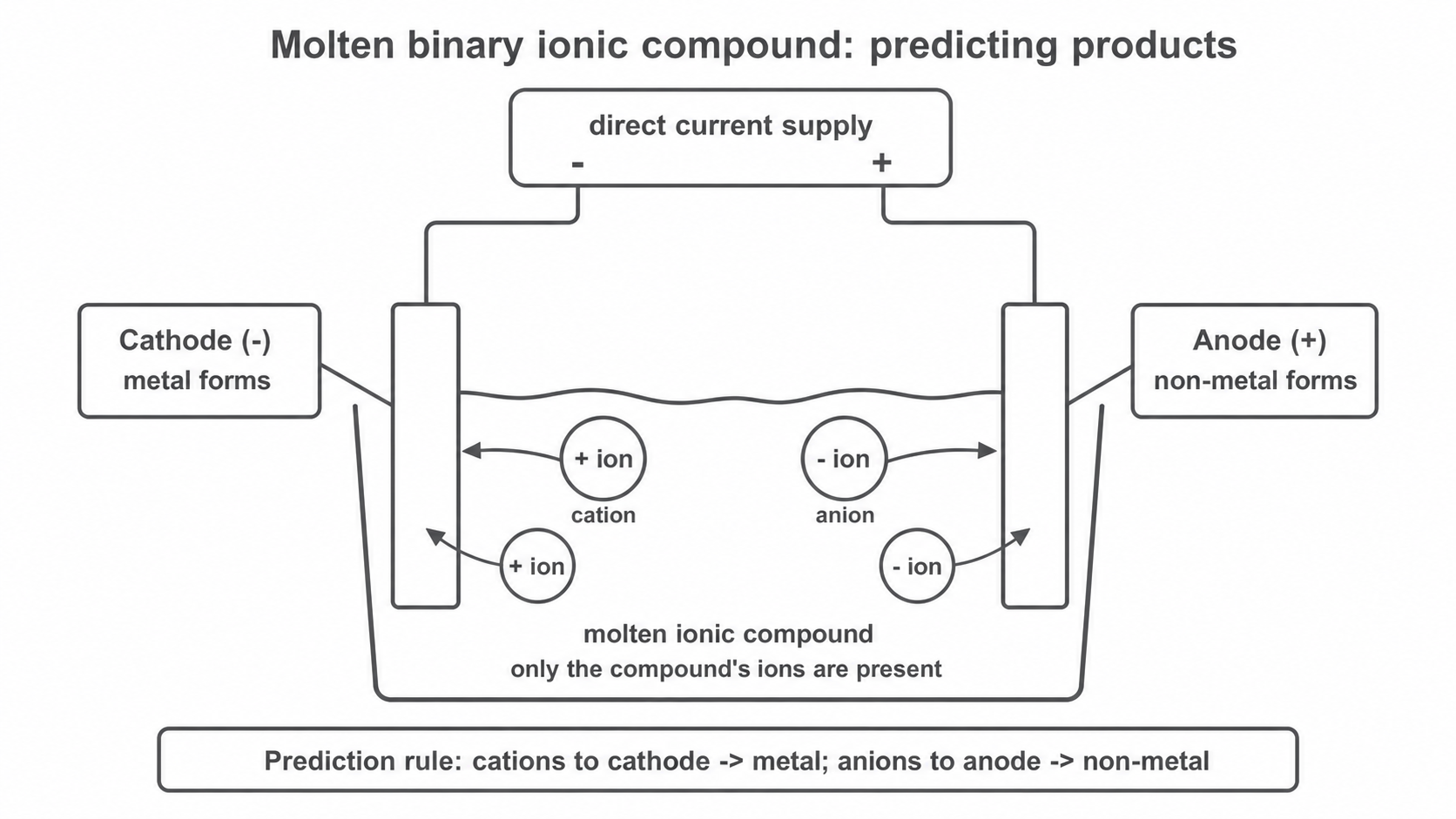
With inert electrodes, the product rule for a molten binary ionic compound is:
| Electrode | Ion attracted | Product formed |
|---|---|---|
| cathode, negative electrode | positive cation | the element from the cation, usually a metal |
| anode, positive electrode | negative anion | the element from the anion, a non-metal |
Use the element name in the product, not the ion name. For example, chloride ions form chlorine, bromide ions form bromine, and oxide ions form oxygen. The word endings change because ions such as chloride and oxide are charged particles, while products such as chlorine and oxygen are neutral elements.
In molten binary ionic compounds, the metal forms at the cathode and the non-metal forms at the anode.
Predicting products from the ions
Use a short routine each time.
- Identify the positive ion and the negative ion.
- Send the positive ion to the cathode and name its element as the cathode product.
- Send the negative ion to the anode and name its element as the anode product.
- Check that the product name is the element name, not the ion name.
Continue this lesson.
You’re previewing NovaLearn without an account. Create a free account to read the rest.
Create free account