4.14 - Dynamic equilibrium
Learn why an equilibrium mixture can remain unchanged even while its particles keep reacting. You will connect a closed system, equal reaction rates and constant amounts, then interpret rate data.
Keeping the reacting substances together
A reversible reaction can reach dynamic equilibrium when it takes place in a closed system: matter cannot enter or leave. For a gas reaction, a sealed container prevents the reacting gases from escaping. Energy can still pass between a closed system and its surroundings.
If a gaseous product continually escapes from an open container, it is no longer available for the reverse reaction. The equilibrium model here therefore considers a closed mixture under unchanged conditions.
How equal rates develop
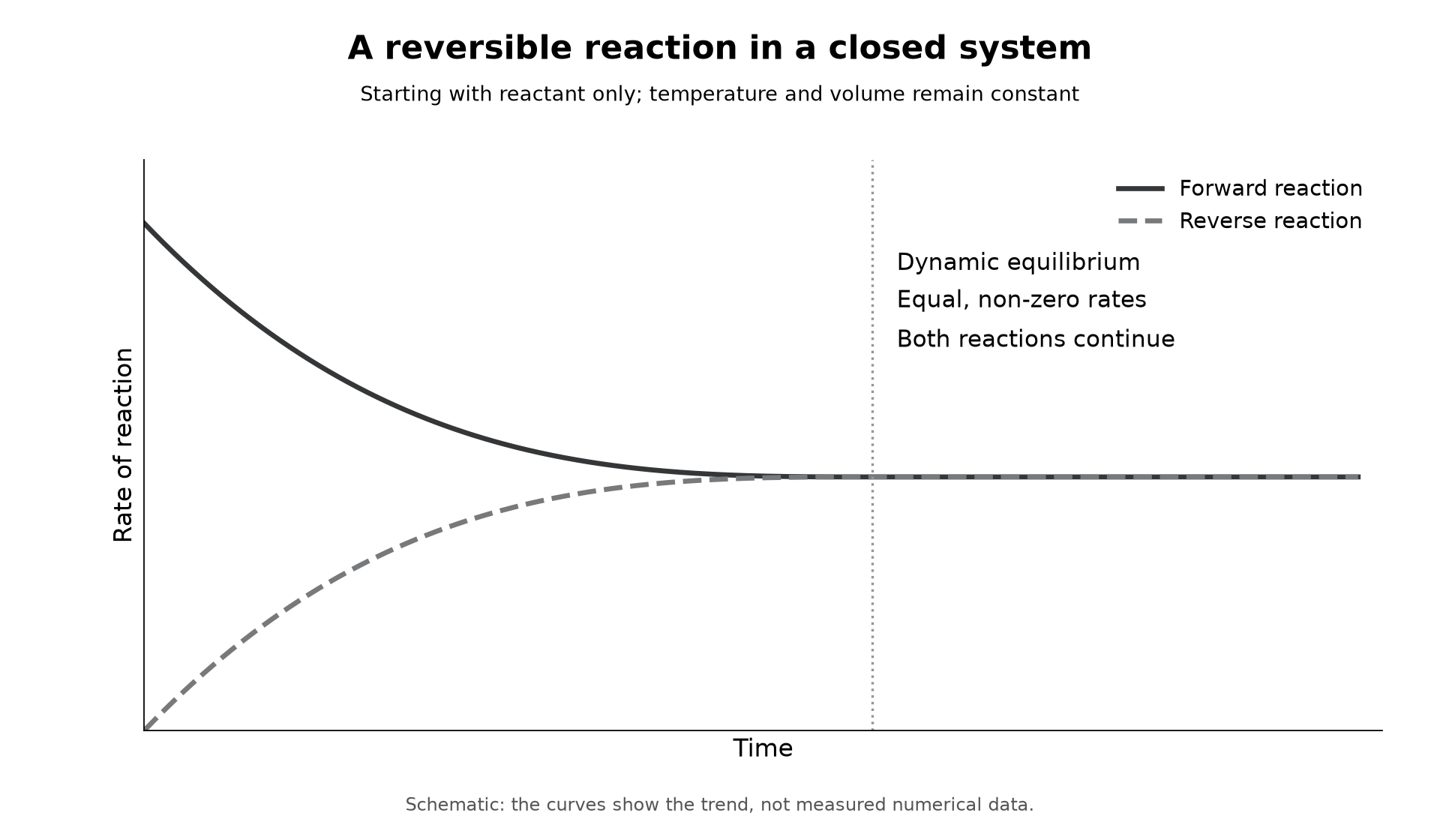
Imagine starting with only reactant in a closed container at constant temperature. At first, the forward reaction occurs but there is no product for the reverse reaction. As reactant is used, the forward rate falls. As product builds up, the reverse rate rises.
Dynamic equilibrium
Dynamic equilibrium is reached when the forward and reverse reactions continue at equal rates in a closed system. The amounts of reactants and products then remain constant under unchanged conditions.
[DIAGRAM: asset_name: dynamic_equilibrium_rates - diagram 1; asset_slug: 116_4_14_dynamic_equilibrium_diagram1; file: 116_4_14_dynamic_equilibrium_diagram1_corrected_v2.png; recommended_method: deterministic_drawn; description: Deterministic monochrome rate-time graph for a reversible reaction in a closed system. The y-axis is labelled rate of reaction and the x-axis is labelled time. A solid forward-reaction curve starts high and decreases; a dashed reverse-reaction curve starts low and increases; both curves meet and then continue at the same constant rate after a labelled vertical line, dynamic equilibrium reached. Text labels state forward and reverse reactions continue, rates are equal, and amounts stay constant. This exact teaching visual supports the assessed meaning of dynamic equilibrium without teaching changes in conditions, Haber conditions, or equilibrium-position prediction. Nearby prose supplies all assessed facts for accessibility.]
Continue this lesson.
You’re previewing NovaLearn without an account. Create a free account to read the rest.
Create free account