5.25C - How a chemical cell produces a voltage
A chemical cell transfers energy from a chemical store to an electrical circuit. You will learn why its voltage depends on a chemical reaction and why the cell stops working when an essential reactant is used up.
From chemical reaction to voltage
A chemical cell uses chemical reactions to produce a voltage (potential difference) between two electrodes. Voltage is measured in volts, V, with a voltmeter connected across the terminals. When a complete external circuit is connected, the voltage can drive a current through a lamp or motor.
A simple cell can be made from two different metal electrodes in an electrolyte, a substance containing mobile ions. Electrons carry charge through the external metal wires, from the negative terminal towards the positive terminal. Ions carry charge through the electrolyte; electrons do not travel through the solution from one electrode to the other.
The cell contains reacting chemicals, not a stock of voltage or current. As the cell supplies energy to the circuit, reactants are converted into products.
Why a cell goes flat
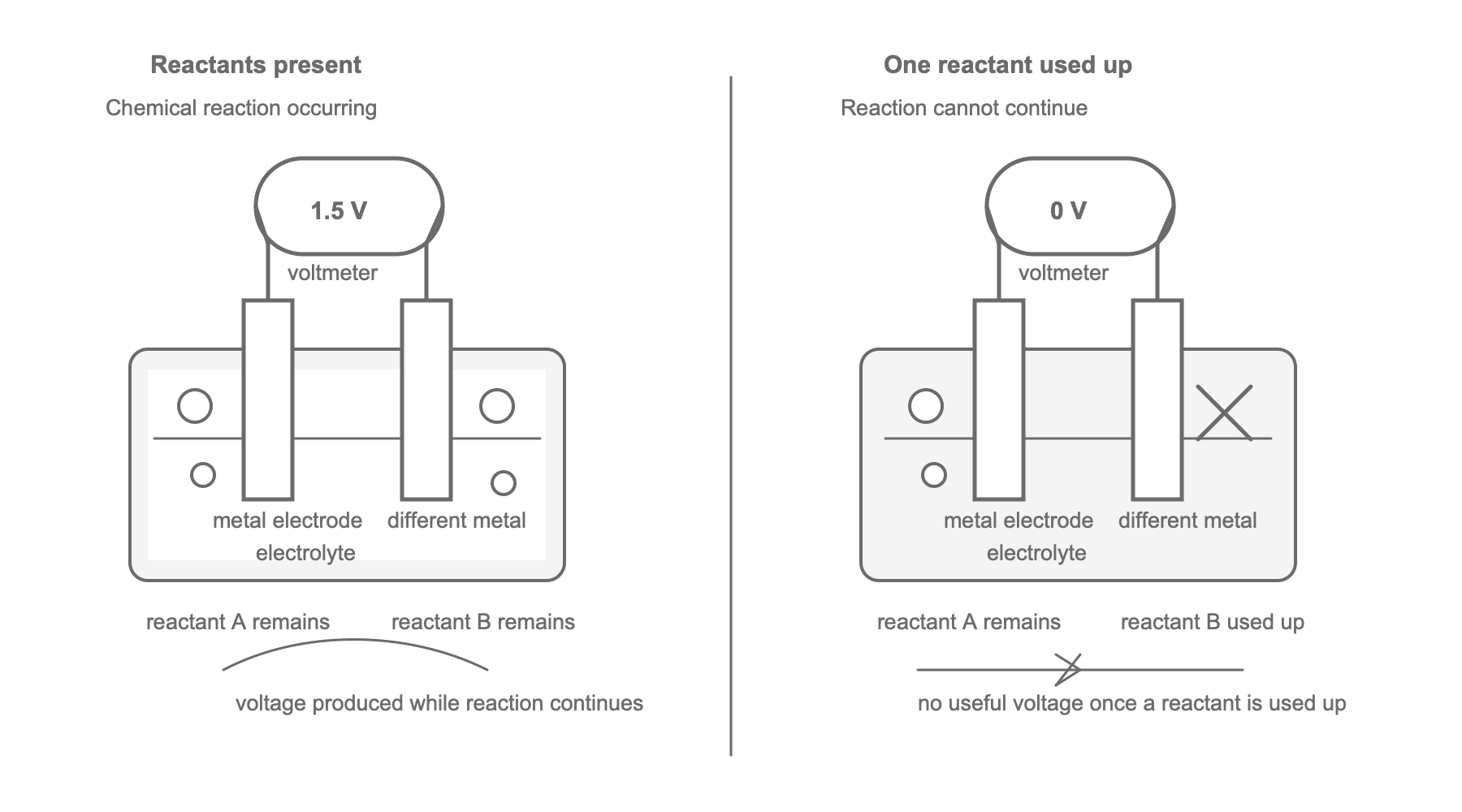
The reaction needs all its essential reactants. Once one is used up, that reaction cannot continue to maintain a useful voltage, even if some of another reactant remains. We say the cell has gone flat.
[DIAGRAM: asset_name: chemical_cell_voltage_until_reactant_used_up: chemical cell before and after a reactant is used up - diagram 1; asset_slug: 144_5_25c_a_chemical_cell_produces_a_voltage_until_one_of_the_reactants_is_used_up_diagram1; file: diagram_assets/144_5_25c_a_chemical_cell_produces_a_voltage_until_one_of_the_reactants_is_used_up_diagram1.png; recommended_method: deterministic_drawn; description: Exact monochrome GCSE chemical-cell visual for Edexcel 1CH0 5.25C. Two panels show the same simple chemical cell with two different metal electrodes in an electrolyte connected to a voltmeter. The left panel is labelled reactants present, chemical reaction occurring and voltmeter shows a non-zero voltage. The right panel is labelled one reactant used up, reaction cannot continue and voltmeter shows 0 V / no useful voltage. Deterministic drawing is required because circuit layout, electrode labels, voltmeter readings and the used-up-reactant state are assessed meaning. Nearby prose states the same information for accessibility.]
Continue this lesson.
You’re previewing NovaLearn without an account. Create a free account to read the rest.
Create free account