3.29 - Oxidation and reduction at the electrodes
Higher tier. Connect each electrode to electron transfer: reduction occurs at the cathode and oxidation at the anode. Use that connection to identify an electrode from its reaction.
Why the electrode reactions differ
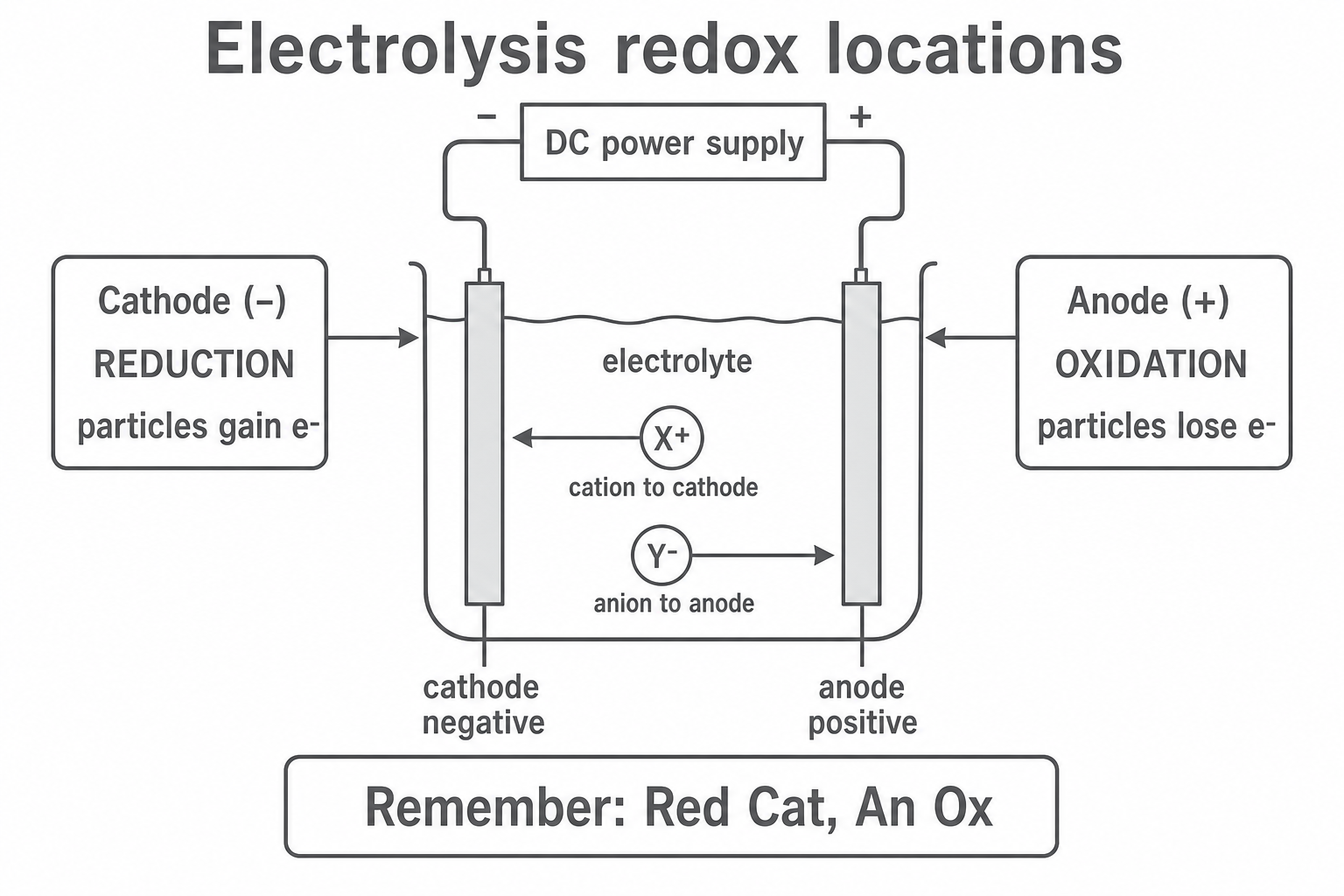
During electrolysis, the DC supply provides electrons to the negative cathode. Reacting particles gain these electrons, so reduction occurs at the cathode. At the positive anode, reacting particles lose electrons, which are removed through the external circuit. Oxidation occurs at the anode.
| Electrode | Electron transfer by reacting particles | Process |
|---|---|---|
| Cathode (negative in electrolysis) | Gain | Reduction |
| Anode (positive in electrolysis) | Loss | Oxidation |
[DIAGRAM: asset_name: electrolysis_redox_locations: Electrolysis redox locations - diagram 1; asset_slug: 100_3_29_reduction_occurs_at_the_cathode_and_that_oxidation_occurs_at_the_anode_in_diagram1; file: 100_3_29_reduction_occurs_at_the_cathode_and_that_oxidation_occurs_at_the_anode_in_diagram1_imagegen_v1.png; recommended_method: deterministic_drawn; description: Exact monochrome electrolysis cell showing a DC power supply connected to a negative cathode and positive anode in an electrolyte. The cathode callout says "Cathode (-): reduction; particles gain e-" and the anode callout says "Anode (+): oxidation; particles lose e-". Generic cations X+ move to the cathode and generic anions Y- move to the anode. Deterministic drawing is required because electrode polarity, ion direction, redox labels and electron-transfer labels are assessed recall content.]
Continue this lesson.
You’re previewing NovaLearn without an account. Create a free account to read the rest.
Create free account