9.28C - Investigating energy released by alcohols
This core practical compares the temperature rise produced when four alcohols burn: ethanol, propanol, butanol and pentanol. The alcohol is burned in a spirit burner, and the heat released is used to warm a known mass of water. You will plan a fair comparison, process measurements per gram of fuel and explain why heat loss limits the results.
Aim and apparatus
The aim is to investigate the temperature rise produced in a known mass of water by the combustion of ethanol, propanol, butanol and pentanol.
Temperature Rise
The temperature rise is the final temperature of the water minus the initial temperature of the water.
The independent variable is the alcohol burned. The dependent variable is the temperature rise of the water, or a processed value such as temperature rise per gram of alcohol burned. The water must have a known mass because the same temperature rise means a different energy transfer if a different amount of water is heated.
In a school laboratory, the water mass is usually found from its volume. For water, has a mass of about 1 g, so of water has a mass of about 100 g.
[DIAGRAM: asset_name: alcohol_combustion_apparatus: Spirit-burner setup for alcohol combustion - diagram 1; asset_slug: 232_9_28c_core_practical_temperature_rise_from_alcohol_combustion_diagram1; file: 232_9_28c_core_practical_temperature_rise_from_alcohol_combustion_diagram1_imagegen_v1.png; recommended_method: deterministic_drawn; description: Exact monochrome Edexcel 9.28C apparatus layout. Show a spirit burner/alcohol burner with cap nearby, a lit wick heating a beaker or copper can containing 100 cm3 water, thermometer in the water, clamp/stand or tripod support, heatproof mat, draught shield around the flame with gaps for air, measuring cylinder for the water volume, balance for weighing burner plus cap before and after, and a stop clock. Labels must include spirit burner, alcohol, wick, cap, known volume of water, thermometer, draught shield, balance, heatproof mat and same height from flame to container. Deterministic drawing is required because the apparatus and labels are assessed practical content.]
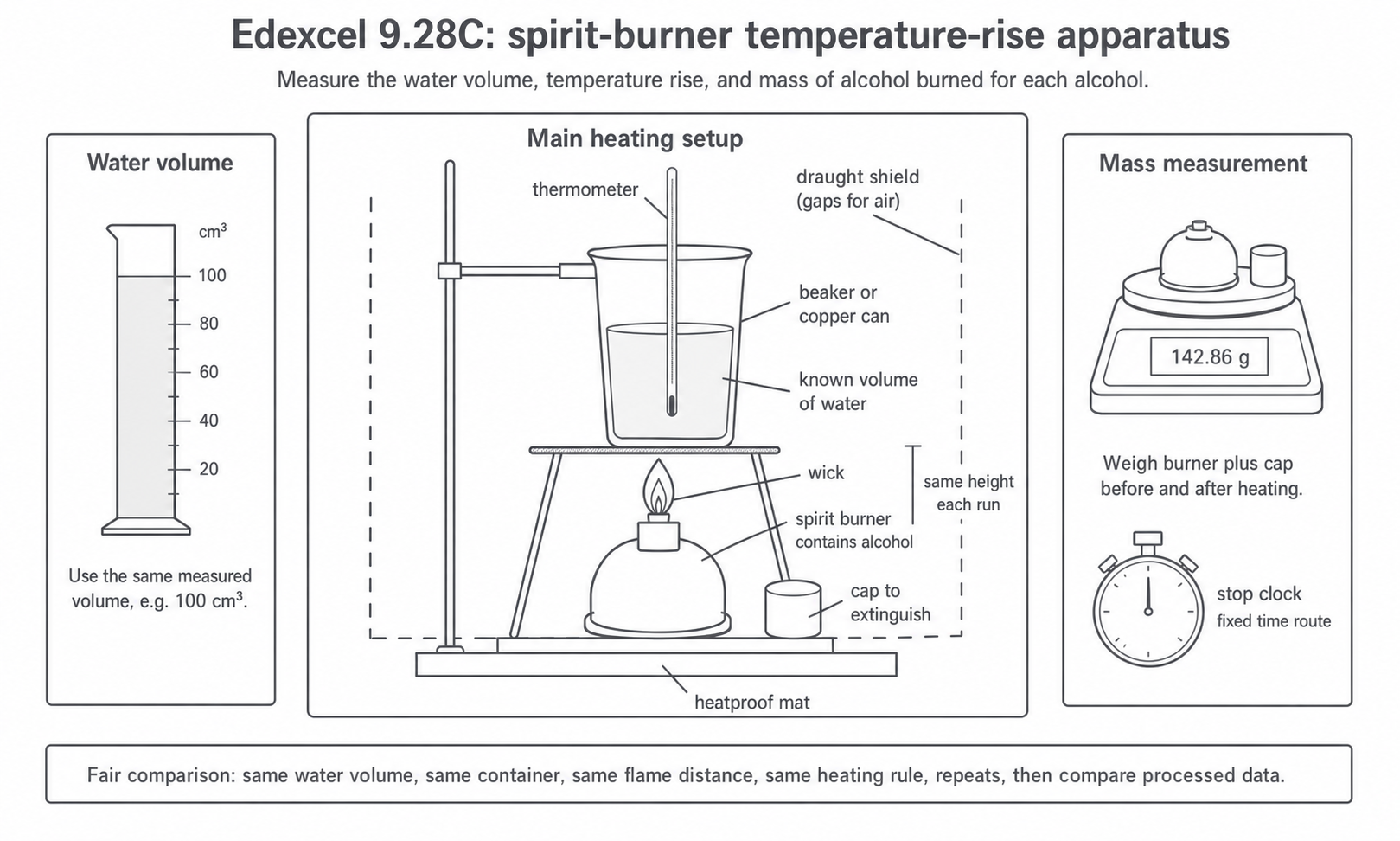
Core apparatus and materials:
- ethanol, propanol, butanol and pentanol in labelled spirit burners
- spirit burner or alcohol burner with a cap
- measuring cylinder for the water volume
- beaker or copper can, used consistently throughout
- thermometer or temperature probe
- balance to measure the mass of burner, cap and alcohol
- stop clock if using a fixed heating time
- heatproof mat, stand or tripod, and draught shield
- eye protection and a splint or lighter used as instructed
The draught shield reduces air movement, so more of the heat from the flame reaches the water. It must not completely enclose the flame, because the alcohol still needs oxygen to burn.
Method and controls
One fair method is to heat the same volume of water for the same time with each alcohol, then calculate the temperature rise per gram of alcohol burned. This works well because different spirit burners may burn different masses of alcohol during the same time.
- Measure of water into the beaker or copper can.
- Put the thermometer into the water and record the initial temperature.
- Weigh the spirit burner, cap and alcohol. Record the alcohol name and initial mass.
- Place the burner under the water container. Keep the distance from the wick to the bottom of the container the same each time.
- Put the draught shield in place, leaving enough air for the flame.
- Light the wick and start the stop clock.
- Heat for a fixed time, such as
3 min, stirring the water gently or moving the thermometer carefully so the water temperature is even. - Extinguish the flame using the burner cap. Do not blow the flame out.
- Record the highest temperature reached by the water.
- Reweigh the spirit burner, cap and remaining alcohol as soon as it is safe to handle.
- Repeat for each alcohol, using fresh water of the same volume and a similar starting temperature.
- Repeat the whole procedure to obtain repeat results and calculate means.
Another accepted fair route is to heat the water until the same temperature rise is reached each time, then compare the mass of each alcohol burned. In that version, less alcohol burned for the same temperature rise suggests that alcohol transferred more heat to the water per gram. Whichever route is used, the control variables must match the comparison being made.
| Variable type | In this practical | Why it matters |
|---|---|---|
| Independent variable | alcohol: ethanol, propanol, butanol or pentanol | this is the factor being changed |
| Dependent variable | temperature rise of the water, or temperature rise per gram of alcohol burned | this is the measured effect of burning the alcohol |
| Control variable | volume or mass of water | more water needs more energy for the same temperature rise |
| Control variable | same beaker or copper can | different containers absorb different amounts of heat |
| Control variable | same distance from wick/flame to container | distance affects how much heat reaches the water |
| Control variable | same heating time, or same target temperature rise | the comparison must use one fair rule |
| Control variable | same draught shield and lid arrangement | shielding changes heat loss to the surroundings |
| Control variable | similar wick length and flame height, as far as possible | flame size affects the rate of burning and heat transfer |
Specific safety
The safety points must fit the actual hazards. Alcohols are flammable, so keep the stock bottles away from flames and use only the small amount in the labelled spirit burner. Replace the cap when the burner is not being used. Never refill a burner while it is lit or hot, because alcohol vapour can ignite.
The flame, burner, tripod, beaker or copper can become hot. Use a heatproof mat and allow hot apparatus to cool before handling or weighing. Extinguish the spirit burner with its cap rather than blowing across the flame. Tie back long hair and keep loose clothing, paper and bags away from the flame.
The draught shield is a control and a safety issue. It should reduce draughts without trapping the apparatus in a sealed space. If the flame is starved of oxygen, incomplete combustion can occur and soot may form on the container. Soot is evidence that less heat may be reaching the water and the result may be less valid.
Continue this lesson.
You’re previewing NovaLearn without an account. Create a free account to read the rest.
Create free account