8.3 - Fractional distillation of crude oil
Follow how heating, cooling and different boiling ranges separate crude oil into useful fractions.
What separation produces
A fraction is a mixture of hydrocarbons with similar boiling points, collected from crude oil. Different fractions have different boiling ranges.
Fractional distillation is a physical separation. Evaporation and condensation change the state of the hydrocarbons without making new substances. The hydrocarbons collected in petrol, for example, were already present in crude oil.
Heating, cooling and collecting
- Heat crude oil so that many of its hydrocarbons evaporate.
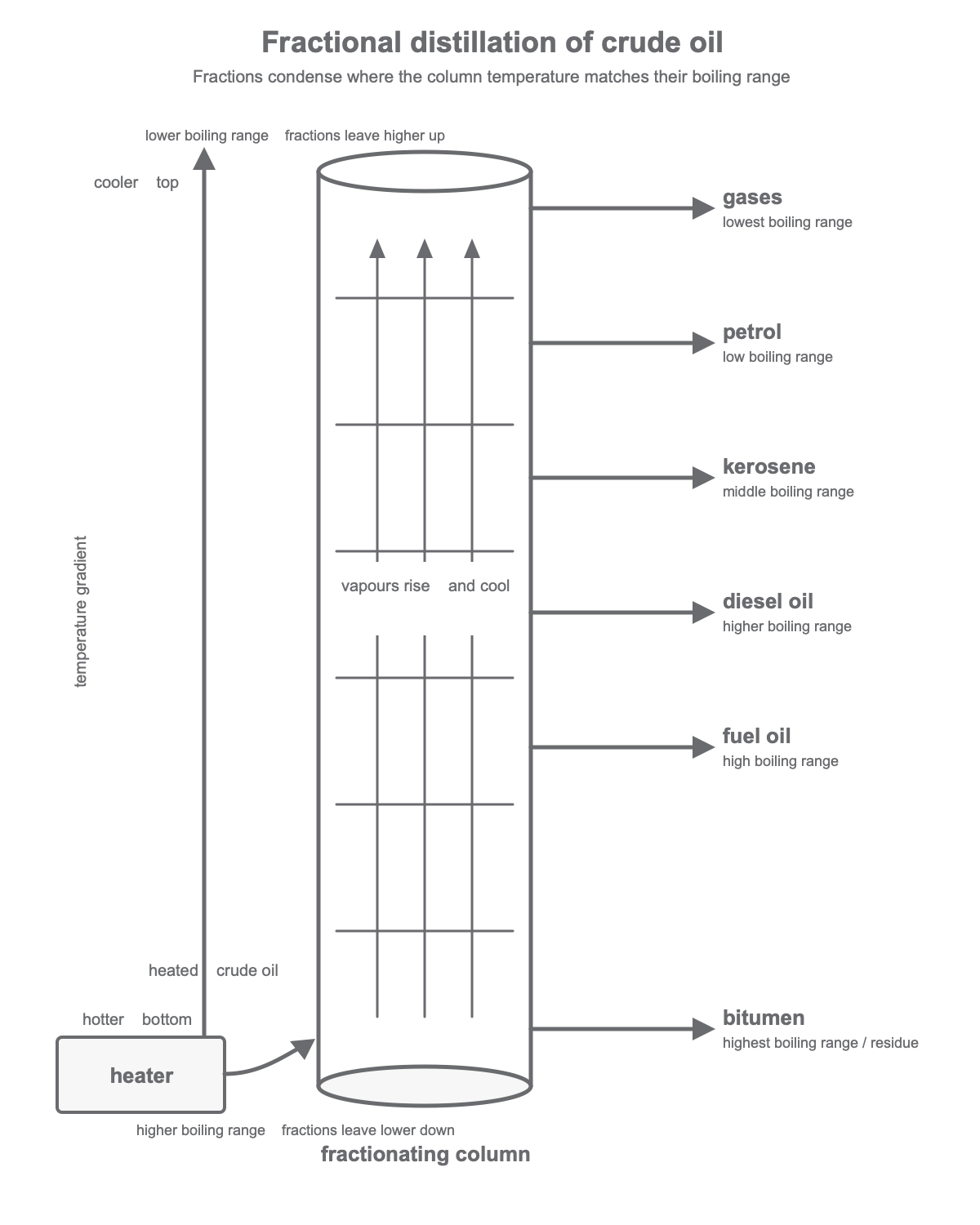
- Feed the hot mixture into a fractionating column. The column is hot at the bottom and cooler at the top.
- Vapours rise and cool. Different hydrocarbons condense at different heights because their boiling points differ.
- Collect the liquid fractions through outlets at those heights.
[DIAGRAM: asset_name: crude_oil_fractionating_column: Crude oil fractionating column - diagram 1; asset_slug: 181_8_3_separation_of_crude_oil_into_simpler_more_useful_mixtures_by_the_process_o_diagram1; file: 181_8_3_separation_of_crude_oil_into_simpler_more_useful_mixtures_by_the_process_o_diagram1.png; recommended_method: deterministic_drawn; description: Exact monochrome teaching diagram for Edexcel 8.3. It shows heated crude oil entering near the bottom of a vertical fractionating column, vapour rising through a hot-bottom-to-cool-top temperature gradient, and outlet pipes for gases, petrol, kerosene, diesel oil, fuel oil and bitumen from top to bottom. Labels must make clear that lower boiling range fractions leave higher up and higher boiling range fractions leave lower down. Deterministic drawing is required because the outlet order, arrows and labels are assessed teaching content.]
Continue this lesson.
You’re previewing NovaLearn without an account. Create a free account to read the rest.
Create free account