2.2 - Changes of state
Learn the names and directions of changes of state, distinguish evaporation from boiling, and decide whether an observed change makes a new substance.
Naming changes of state
An interconversion is a change from one physical state to another. The material can look different while remaining the same substance.
[DIAGRAM: asset_name: state_change_interconversion_map: State-change interconversion map - diagram 1; asset_slug: 061_2_2_changes_of_state_as_physical_changes_diagram1; file: 061_2_2_changes_of_state_as_physical_changes_diagram1.png; recommended_method: deterministic_drawn; description: Exact monochrome teaching diagram showing three labelled boxes, Solid, Liquid and Gas, with arrows labelled melting, freezing, evaporation/boiling, condensation, sublimation, and deposition (reverse sublimation). It teaches the six names Edexcel expects for interconversions and includes a small note: "state changes are physical: no new substance". Deterministic drawing is required because the direction labels are assessed recall and must be exact.]
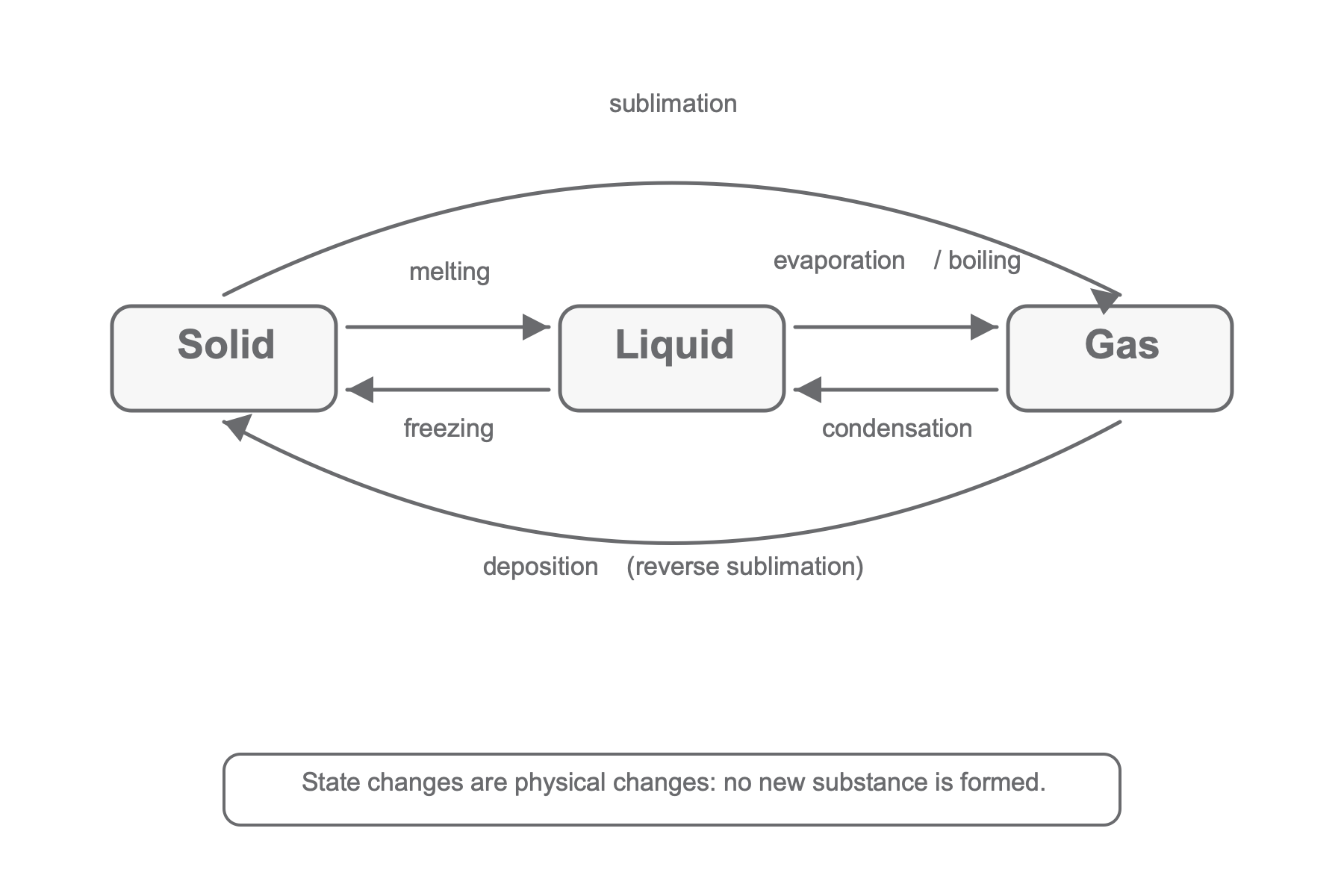
| Change | Name |
|---|---|
| solid → liquid | melting |
| liquid → solid | freezing or solidification |
| liquid → gas | evaporation or boiling |
| gas → liquid | condensation |
| solid → gas directly | sublimation |
| gas → solid directly | deposition or reverse sublimation |
The word directly matters: sublimation and deposition do not pass through a liquid state. Water vapour becoming frost directly on a cold surface is deposition; liquid water becoming ice is freezing.
Evaporation and boiling
Both processes change liquid into gas, but they happen differently. Evaporation occurs at the surface and can happen below the boiling point. Some surface particles have enough energy to escape the attractions of their neighbours. A puddle can therefore dry without boiling.
Continue this lesson.
You’re previewing NovaLearn without an account. Create a free account to read the rest.
Create free account