3.19 - Solubility rules for common salts
Use the common solubility rules to decide whether a salt stays dissolved or remains as a solid in water. You will learn the rule groups and exceptions that let you predict precipitation reactions.
What solubility means
A salt is an ionic compound. In this lesson, soluble means the salt dissolves in water to form an aqueous solution. Insoluble means the salt does not dissolve enough in water and remains as a solid.
Soluble
A substance is soluble in water if it dissolves in water to form a solution.
Insoluble
An insoluble substance dissolves only negligibly in water under the conditions considered.
These are the Edexcel rules for common salts. Solubility is a matter of degree: calcium hydroxide is sparingly soluble, although this school rule places it with insoluble hydroxides. The small amount that dissolves forms alkaline limewater. Use the stated rule when classifying these common salts.
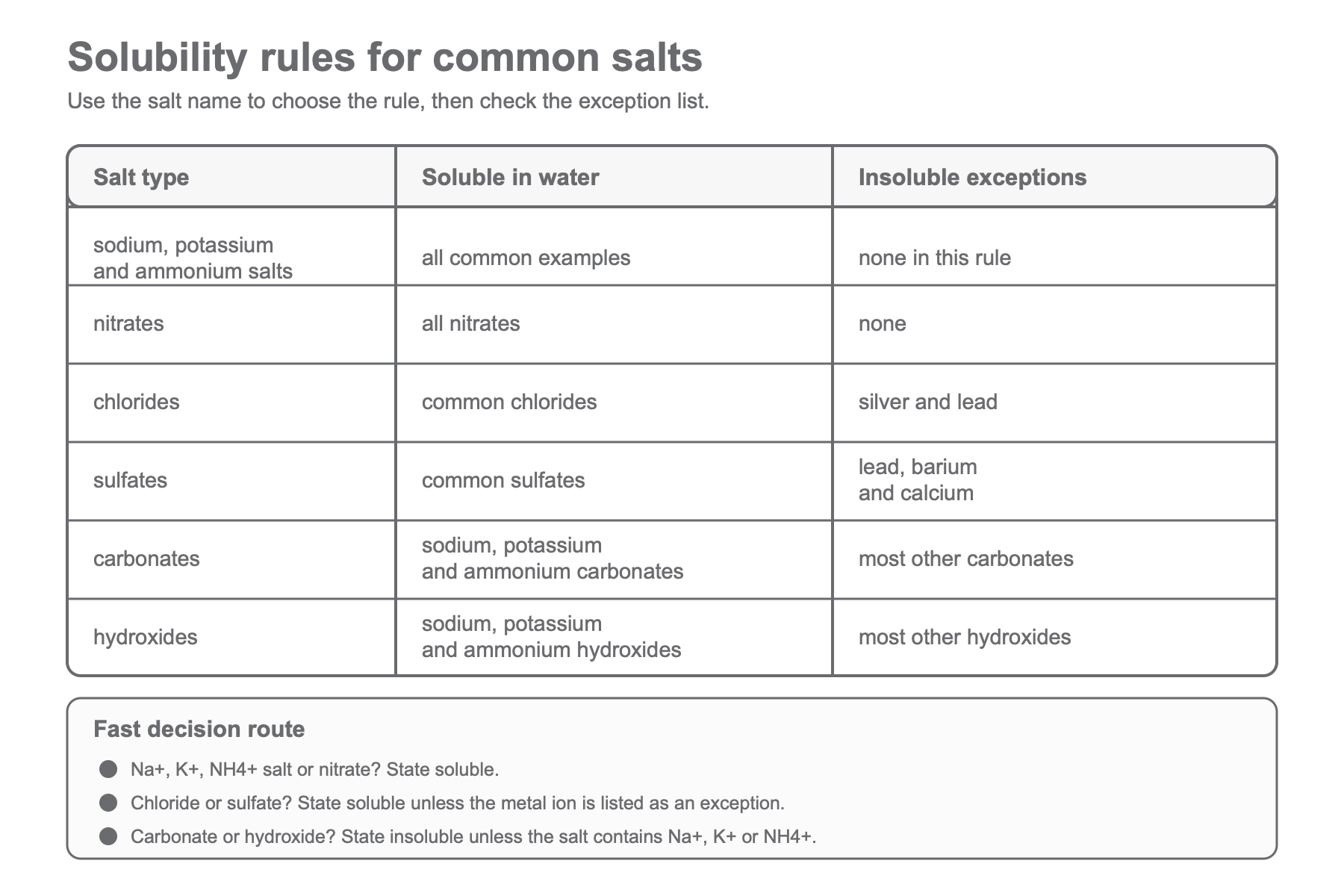
Rules and exceptions
Pearson Edexcel 3.19 requires these rules:
| Common salt type | Solubility rule in water |
|---|---|
| sodium, potassium and ammonium salts | all common sodium, potassium and ammonium salts are soluble |
| nitrates | all nitrates are soluble |
| chlorides | common chlorides are soluble except those of silver and lead |
| sulfates | common sulfates are soluble except those of lead, barium and calcium |
| carbonates | common carbonates are insoluble except those of sodium, potassium and ammonium |
| hydroxides | common hydroxides are insoluble except those of sodium, potassium and ammonium |
Two rule patterns are especially important.
First, nitrates are simple: all nitrates are soluble. If a salt name ends in nitrate, the answer is soluble.
Second, carbonates and hydroxides are the reverse of chlorides and sulfates. Common chlorides and sulfates are usually soluble, with named exceptions. Common carbonates and hydroxides are usually insoluble, with sodium, potassium and ammonium as the soluble exceptions.
Continue this lesson.
You’re previewing NovaLearn without an account. Create a free account to read the rest.
Create free account